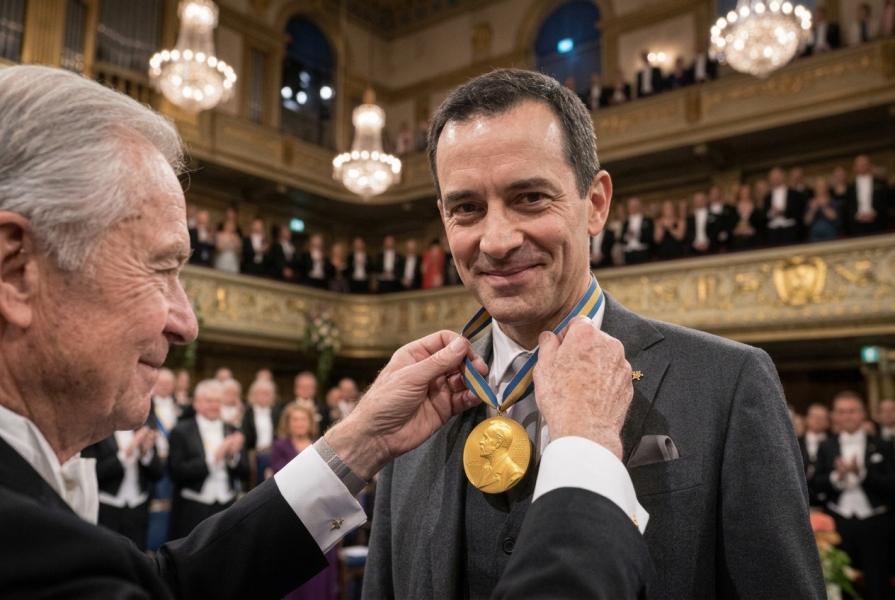
From October 5 to 12, the world gradually learned the names of the new Nobel laureates. The traditional award ceremony will take place on December 10. The cash prize currently stands at 12 million Swedish kronor (approximately 1.2 million dollars).
So which researchers and cultural figures were recognized as especially outstanding this year?

Physiology and Medicine
- Karl Deisseroth (Howard Hughes Medical Institute and Stanford),
- Peter Hegemann (Humboldt University of Berlin),
- Georg Nagel (University of Würzburg).
This year the prize was awarded for discoveries in the field of light-sensitive ion channels and optogenetics. Optogenetics is now one of the main tools for studying the brain: it is the pinpoint action on specific neurons, their activation, which makes it possible to adjust behavior and reactions, memory, and perception of the surrounding world.
The idea of working with light in this field appeared back in the 1970s, after the discovery of the structure of DNA. After that, the process unfolded like in a good football team, through a system of passes and assists:
- Francis Crick, one of the discoverers of the structure of DNA, put forward the hypothesis itself,
- Peter Hegemann discovered channelrhodopsin proteins and identified the genes responsible for their production,
- Georg Nagel conducted extensive experiments confirming the hypotheses,
- Karl Deisseroth (a psychiatrist and neuroscientist) managed to introduce the channelrhodopsin-2 gene into the brain of a living mouse and thus experiment with light exposure, giving rise to larger-scale optogenetic research. For example, today, with the help of optogenetics, it has already been possible to partially restore sight to a person who had not seen for 40 years!
Physics

- Francis Halzen (University of Wisconsin-Madison, USA)
- For a key contribution to the creation of the IceCube neutrino observatory and the detection of high-energy neutrinos of astrophysical origin.
This project brought together 450 scientists from 14 countries who came together to study cosmic neutrinos. In Antarctica, boreholes were drilled to depths of up to 2,500 meters, and building the observatory as a whole took almost 5 years (2005-2010). The optical sensors are greatly helped by the transparency of Antarctic ice.
Chemistry
- Henri Kagan (University of Paris-Sud) and Kenso Soai (Tokyo University of Science),
- For research into nonlinear effects and autocatalysis in asymmetric organic synthesis.
There are remarkable molecules that are mirror images of one another — such forms of existence are called enantiomers. These forms are very important in the synthesis of substances, particularly in medicine and pharmaceutics.
Literature

- Anne Carson (Canada)
- For bold and innovative work in which a dialogue with classical tradition helps to create new forms of contemporary literature.
The Canadian writer, essayist, and poet became famous for her English translations of ancient authors. She published her first book in 1986 (essentially growing it out of her own dissertation). Afterward, Carson's style remained eclectic, a "stereoscopic" blending of different eras, cultures, and styles.
Peace Prize
- Navi Pillay (lawyer, South Africa)
- For efforts to strengthen peace and international law.
Pillay was born in South Africa in 1941. She managed to obtain a higher education, and in 1967 opened her own legal practice, focusing on helping victims of apartheid. In the 1980s she earned a doctoral degree (at Harvard University), and since 1992 has been defending women's rights through her international project Equality Now. In 1995 she became a judge of the South African High Court and a judge of the International Criminal Tribunal for Rwanda, in 2003 she was already working at the ICC, and she now serves as a judge of the International Court of Justice of the UN.
Economics

- Robert Hall (Stanford) and Michael Woodford (Columbia University),
- For developing the microeconomic foundations of macroeconomic stabilization.
They are considered the founders of the New Keynesian paradigm: in it, economic models are built from the bottom up, that is, from the micro level and individual households, which have the greatest influence on consumer spending. Since 2003, the researchers have examined questions of output volumes, inflation, unemployment, and bank interest rates. Today these models are used by ministries of finance and central banks in a wide range of countries to assess the consequences of economic decisions and to adjust stabilization policy measures.