
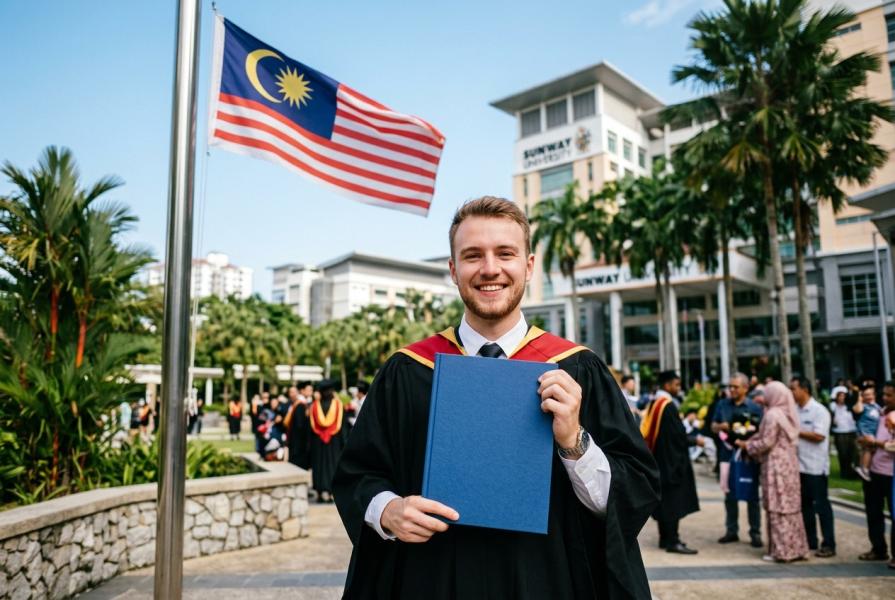
Studying in Europe is becoming more expensive every year, the United Kingdom has long been one of the most expensive destinations for education, while Canada and Australia are tightening rules for international students. Against this backdrop, alternative destinations are gaining popularity, one of which is Malaysia.
The main advantage here is the combination of English-language education, international campuses, affordable prices, the opportunity to work part-time, and the ease of obtaining visas.
There is another important distinction: English here, unlike in the Middle East, did not arrive yesterday — the country was long within the British imperial orbit. The Federation of Malaya gained independence in 1957, modern Malaysia emerged in 1963, but the British imprint on law, business culture, education, and language remains very deep to this day and has become a market advantage: Malaysia sells not only tropics and campuses, but a familiar English-speaking environment.


How «British education» works in Malaysia
The phrase «British education in Malaysia» actually encompasses not one format, but several different scenarios.
Branch campuses of British universities

The most obvious option is full-fledged campuses of British universities. The country hosts University of Nottingham Malaysia, Heriot-Watt University Malaysia, University of Southampton Malaysia, University of Reading Malaysia, Newcastle University Medicine Malaysia. This is the most direct path for those who want to study on a British program, in English, and in a system as close to the British one as possible.
But the price matches accordingly. For example, at University of Nottingham Malaysia in 2026, humanities programs for international students cost around RM52,000 per year, while at Heriot-Watt University Malaysia a bachelor’s degree in a number of fields also exceeds RM50,000 per year. This is already quite a different price level, closer to classic overseas study in Europe.
It is more appropriate to compare such campuses not with local universities, but with British ones — both in terms of tuition costs and living and accommodation rates. For instance, while an international student in the UK needs to budget roughly £1,300–1,400 per month for living in London and £900–1,300 outside it, Malaysian campuses offer a more compromise option: with comparable tuition costs, living expenses rarely exceed $500–700 per month.
Partner universities
The second format is partnership programs. Simply put, a student begins studying in Malaysia and then either transfers to a British university or receives a degree associated with it. This can be a «2+1» or «3+0» scheme, where part or all of the program takes place in Malaysia but to British standards. Such programs can differ greatly from one another, so it is important to carefully study the terms and delve into the many nuances: first of all, which university awards the degree, whether relocation to the UK is required, and what the transfer requirements are.
Malaysian university

The third option is studying at a Malaysian university in English. This is the most affordable path: the degree is awarded by a local university, instruction is in English — the student studies in an international environment but without the high costs typical of British universities.
For example, at Universiti Teknologi Malaysia, the total cost of a bachelor’s degree for international students in management, accounting, and a number of natural science fields is around $14,800 for the entire course, in IT — $16,700, in engineering — $17,700. If we break this down over several years of study, the average comes out to roughly $2,500 to $4,000 per year depending on the program — a very affordable level by international standards! But it is important to understand that this is not a British degree, but affordable English-language education.
Preparatory courses / Transfer programmes
There is also a fourth layer — preparatory programs: they help improve English, develop academic writing skills, fill gaps in preparation, and get ready for immersion in Malaysian higher education.
Malaysia is not limited to the British model — other international systems are represented here as well, primarily the Australian one. Monash University Malaysia has already established itself in the country as one of the key overseas campuses, and in 2025 it announced plans to open a new campus in Kuala Lumpur for nearly 23,000 students by 2040.
How Malaysia became the new education hub

Why has Malaysia come to the forefront right now? It is quite simple: the global education market has changed dramatically. According to OECD data, the highest tuition costs for international students remain characteristic of Australia, Canada, and the UK. At the same time, Canada has limited the number of study permits — in 2026, no more than 408,000 are planned to be issued, which is noticeably fewer than in previous years. Australia has increased the cost of a student visa to AUD$2,000. The UK maintains its status as a prestigious destination, but high inflation and rising living costs have made studying there too expensive.
Against this backdrop, Malaysia stands out with its straightforward arithmetic. The country’s Ministry of Higher Education reports that around 131,000 international students are currently studying here, with plans to increase this number to 250,000 by 2030. This is the result of a deliberate state policy — the country is consistently building its status as Asia’s education hub by developing universities, simplifying visa procedures, expanding campuses, and strengthening international ties.
The main practical advantage is an affordable cost of living. According to Education Malaysia, an international student spends on average around $582 per month, on-campus accommodation costs approximately $50—150, off-campus rental — $100—300, and inexpensive local food costs around $1—3 per meal. In Kuala Lumpur, expenses are higher than in smaller cities, but even the capital remains significantly cheaper than London for a student.
The visa process is also simpler and more accessible: an international student first receives an offer of admission, then processes a student pass through the university and Education Malaysia Global Services, receives an electronic entry permit, arrives in the country, and all formalities can be completed on arrival.
International students can combine study with work, though with certain restrictions:
- They are only permitted to work in certain sectors — for example, in restaurants, hotels, mini-markets, petrol stations, or on campus,
- Work is generally only permitted during official holidays or study breaks lasting more than seven days,
- A mandatory requirement is a valid student pass and a separate permit from immigration authorities.
Without meeting these requirements, any employment will be considered a violation of the conditions of stay (and will in all likelihood result in such a student being expelled from the country with a black mark in their passport).
Who is Malaysia suitable for?

First and foremost, those who are looking for English-language education, an international environment, and a reasonable budget, while also wanting to receive not just a degree, but a profession with real career prospects. Malaysia «performs» best in applied fields: IT, engineering, business, finance, architecture, design, and medicine. A particularly strong niche is Islamic finance: the country has long been among the world’s leading centres in this field.
IT and engineering are rooted in the region’s real economy. Malaysia is consistently developing itself as a technology and industrial hub of Southeast Asia, so IT and engineering here are part of the real economy, in high demand and well-regarded. The campuses of universities such as University of Nottingham Malaysia, Heriot-Watt University Malaysia, and Monash University Malaysia offer programs aligned with British and Australian standards, but adapted for the Asian market — a graduate will leave with skills in demand both at international companies and in rapidly growing regional economies.
Business, finance, and accounting are another strong field. Malaysia plays a notable role as an important regional financial and trade centre: universities collaborate with banks and major companies, and programs often include practical assignments and internships.
Traditionally expensive architecture, design, and medicine with pharmaceuticals also look attractive: programs in all these fields in Malaysia are noticeably more affordable than in developed countries, and are quite good.