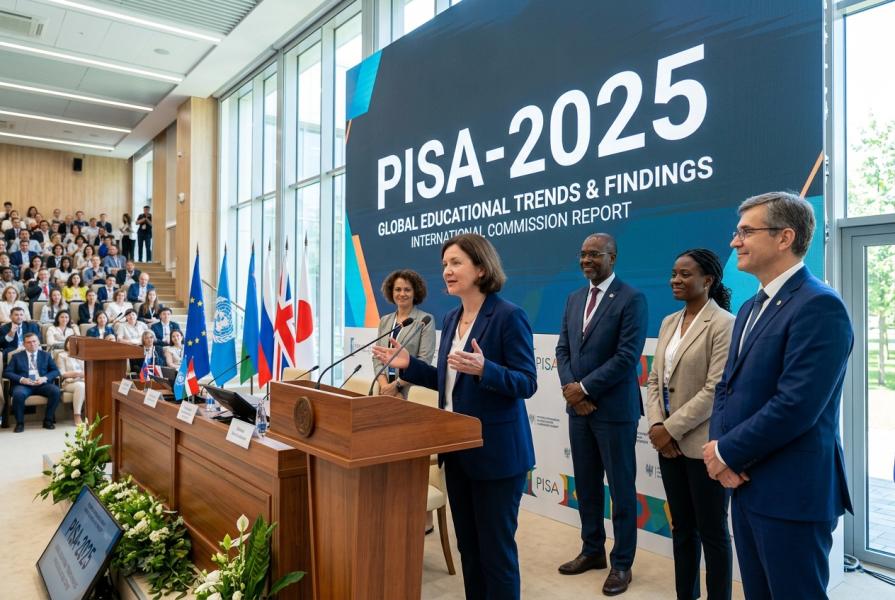
In 2025, PISA (the international program for assessing students' educational achievement) conducted another large-scale study: 91 countries, more than 760 000 schoolchildren. The results, frankly speaking, are far from encouraging, and in some places plainly alarming.


PISA-2025 results: a summary
The performance of 15-year-old students declined most notably in the following areas:
- Reading literacy,
- Mathematics,
- Reading,
- Science.
In OECD countries, average scores in mathematics and reading reached their lowest levels in the history of the study; over the period from 2015 to 2025, the average mathematics score in OECD countries fell by 22 points. Reading scores dropped by 28 points — the most significant decline. Science scores decreased by seven points over the decade, from 489 to 482.
Positive trends were recorded in science — among students in the United Kingdom, Slovakia, Turkey, and Costa Rica.
Leaders and laggards

Singapore and four Chinese regions — Beijing, Shanghai, Jiangsu, and Zhejiang — took the top positions in the main subject areas. Among the leaders were also Macao (China), Taiwan, Japan, South Korea, the United Kingdom, and Estonia.
Solid "middle-of-the-pack" performers (scores above average) included Estonia, Finland, Ireland, Austria, Poland, and the Czech Republic. Below-average scores were recorded in Spain, Croatia, Luxembourg, Malta, Greece, Romania, Cyprus, and Bulgaria.
Let us look at the data for specific subject areas.
Reading and the digital environment
Particular attention in the study was paid to reading literacy: PISA assesses not only text comprehension, but also the ability to verify the reliability of information, cross-reference data from different sources, and think critically about what has been read — in other words, thoughtful, analytical reading.
However, the picture since 2018 has been nearly the opposite: the share of "fast" or "hasty" readers — students who skim through a text quickly but understand its content less well — has almost doubled, reaching 9% in 2025. Among the reasons cited are growing digitalisation, increased screen time, and a decline in reading for pleasure as a hobby.
The results show a clear link between digital device use and academic performance: in countries where older students reported using devices for schoolwork for no more than 2–3 hours a day, scores were still at an acceptable level, whereas longer usage was associated with lower scores. It is also worth noting that more than a quarter of students in high-income countries reported that classmates are distracted by digital devices in most lessons; in schools with stricter rules on mobile phone use, the level of distraction was lower.
PISA-2025 for the first time included a separate scale for computational thinking skills, assessing students' ability to use modelling and programming, conduct experiments, and create digital products. The highest scores were achieved by students from Macao, Singapore, Japan, and the Chinese regions.
The researchers also looked separately at AI use. Students who used AI for specific academic tasks — summarising texts, writing abstracts, preparing drafts, or conducting research — scored on average 20 points lower in science than students who did not use AI in this way. The study links this to a reduction in independent intellectual effort. At the same time, teenagers who use AI outside school on a weekly basis and simultaneously have opportunities at school to develop AI literacy scored slightly higher. The results make it clear that the effect of technology depends on exactly how it is used, and that AI should not replace attention, independent work, and understanding of the material.
Social disparities and the role of the family

The share of students in OECD countries who simultaneously fail to reach the basic second level in reading, mathematics, and science grew from 16% in 2022 to 20% in 2025. Moreover, the socioeconomic gap is narrowing primarily not because of improved results among less affluent students, but due to a decline in the scores of students from more advantaged families: in science, scores for students from disadvantaged families in OECD countries remained stable on average, while those of students from more affluent backgrounds fell.
The education systems of Turkey, the UAE, Qatar, Montenegro, and Slovakia managed to reduce the share of low-performing students and increase the number of high performers.
The study also revealed a link between family involvement and outcomes: students who reported that a family member asks them at least once a week about what they did at school scored roughly 35 points higher in science than students whose families showed less interest in their schooling.
Academic engagement
On average, 76% of teenagers in OECD countries consider themselves part of the school community: the highest rates were recorded in Spain and Japan, while in Denmark, Poland, Italy, and Lithuania, only 64% of students or fewer reported this sense of belonging. Girls are less likely than boys to report a strong sense of belonging to the school community; children from disadvantaged families feel less connected to school than their more affluent peers. 57% of teenagers say they are interested in learning new things, but overall levels of academic engagement declined in as many as 60 countries. Girls more often demonstrate curiosity, persistence, a willingness to seek help, and a desire to grow, while boys more frequently show cognitive flexibility and adaptability.
Classroom discipline in science lessons improved in 37 countries. Unfortunately, bullying and cyberbullying remain factors associated with academic outcomes and students' emotional wellbeing.
Environmental literacy

Here the results are far more encouraging. On average, 74% of teenagers in OECD countries reached at least the basic level of environmental literacy, and 62% of students stated that they would like to pursue a career related to environmental protection and sustainable development. In Vietnam and Indonesia, this figure exceeded 90%.
PISA recommendations based on the latest study
Paradoxically, PISA found no direct link between spending per student and high outcomes once a certain level of funding has been reached. Luxembourg, for example, spends more on educating one student than any other country — around $288,521 — yet its students in science scored lower than those in Ireland, France, and Italy, where spending is roughly half as high.
The OECD recommends:
- Focusing on foundational knowledge and in-depth study of a limited number of key topics,
- Aligning curricula, teaching methods, and assessment,
- Reducing the distracting influence of digital devices,
- Developing the professional skills of teachers,
- Using AI as a tool that complements, rather than replaces, independent thinking.
Individual countries have already announced measures in response to the PISA results:
- In Spain, programs aimed at improving reading comprehension and mathematical knowledge have been promoted since 2024,
- In France, the Minister of Education stated the need for changes to teaching approaches, identifying secondary schools as one of the key priorities for the next five years,
- In the Netherlands, where nearly four in ten children are at risk of leaving school with low literacy levels according to the study's findings, the Deputy Minister of Education announced the preparation of a balanced program to address the issue (with no concrete details yet available).