 Spain
Spain
 For partners
 Dukes Cambridge Summer School, Summer School and Language Camp in Cambridge


Programs and prices, tuition fees in Dukes Cambridge Summer School, Summer School and Language Camp in Cambridge


Academic Courses
- Age of students: 14-17 years.
- Duration: 2 weeks.
In the Academic Courses of Dukes Cambridge Summer School, participants choose one of five areas: Business, Medicine, Psychology, Art & Design or Sciences & Technology (STEM). Despite the different themes, all programs are united by a single structure: classes are held in small groups, with an emphasis on seminars, practical assignments, discussions and project work. At the end of each session, students publicly defend their projects in English as part of the Time to Shine presentation.
The format is close to university-level: instead of classic lessons — working with case studies, group analytics, individual mini-research.
- In the medicine course, participants study the basics of anatomy, ethics and diagnostics, practice on simulations and master basic first aid skills,
- In the business program they build product models, study marketing, finance and practice presenting ideas,
- Art & Design — is studio practice, criticism of works, visual research and design,
- In psychology — acquaintance with cognitive, social and age psychology, exercises in observation, analysis and interpretation of behavior,
- In the STEM course, physics, chemistry, biology and engineering are combined: students complete laboratory and engineering assignments, learn to work with data and hypotheses.
The courses are suitable for those who want to try a future specialty in an academic but informal environment — without exams and grades, but with a study load, clear structure and motivation. This is an opportunity to "try on" a profession, understand your own interests and gain first experience of specialized education in an international team.
English Pathways
- Age of students: 14-17 years old.
- Duration: 2 weeks.
English Pathways — a program for teenagers with any level of English. The course is designed for 20 academic hours per week and focuses on speaking practice, listening, writing and reading, with particular emphasis on academic vocabulary, public speaking skills and participation in discussions.
Special attention is paid to academic vocabulary and preparation for public speaking. During the shift, students work on their own mini-project, which they present at the final Time to Shine presentation. This approach helps develop not only language skills but also confidence, critical thinking and argumentation structure.
The program is suitable for both those who are just starting to learn English and those who want to go beyond the school curriculum and learn to use the language in real life — at the level of presentations, discussions and independent work. It's a great start for further transition to studying abroad.
Description of Dukes Cambridge Summer School, Summer School and Language Camp in Cambridge
- Year of opening: 2008
- Location: Cambridge, United Kingdom
- Number of students: ~700
- Type of education: (mixed, separate)
- Type of institution: international children's summer camp
- Language of instruction: English.
This is an academic summer program for teenagers aged 14–17. The format is two-week sessions with accommodation, subject courses and a rich cultural program. Participants choose one area — from medicine and business to design or engineering — and take an intensive course in a small group; the culmination is a final public project presentation.
The learning model is close to university: seminars, project assignments, fieldwork, discussions and defense of results. The schedule balances classes, city trips, excursions and evening events. The program takes place at partner educational venues in central Cambridge, with accommodation arranged in the separate Tripos Court residence.
Educational process
The central element of the course — an individual or group project that is prepared throughout the shift and presented at the final defense called Time to Shine. This is a full-fledged presentation with visual materials, open to the entire group and teaching team.
Faculties and colleges
Inside the camp, the structure is organized according to the faculty principle, each of which is responsible for a separate academic field — there are six in total:
- Faculty of Business — includes courses in entrepreneurship, marketing, finance and management,
- Faculty of Medicine — introduces the basics of anatomy, diagnostics, medical ethics and clinical practice,
- Faculty of Psychology — covers cognitive, social and developmental psychology, with an emphasis on applied tasks and mini-research,
- Faculty of Art & Design — combines studio work, theory of visual culture and the practice of installation, criticism and presentations,
- Faculty of Sciences & Technology (STEM) — unites elements of physics, biology, chemistry and engineering, involves laboratory and project tasks,
- English Pathways — a language track for students of any level of English proficiency: emphasis on academic vocabulary, presentations and communication.
Each participant chooses one faculty for the entire shift. The program is implemented at several partner sites in Cambridge, including Sancton Wood School and Cardiff Sixth Form College.
Things to know about
- The program takes place in Cambridge — the learning format and environment are as close as possible to the classic British "college experience".
- As part of the Art & Design and Business courses, students not only complete a final project but also jointly create a magazine or prepare an exhibition, improving their curatorial, design and promotion skills.
- In addition to the main program, individual academic consultations are offered, including assistance with admission to universities in the UK and choosing a learning path.
Accommodation, meals, prices
Students live in the Tripos Court residence — this is a separate campus with modern rooms (including doubles), a common lounge area, laundry facilities and Wi-Fi. All household processes are well organized: breakfast and dinner are served on site, lunch — at the study center, and packed lunches are provided on excursion days. The summer school team monitors order and safety; there is a curfew on the premises, and shops, pharmacies and a bus stop are nearby.
Activities Dukes Cambridge Summer School, Summer School and Language Camp in Cambridge
On weekdays in the evenings, different events are held: themed quizzes, a film club, sports games, board game tournaments, master classes and creative assignments. This is not "time off from studying" but part of the overall environment — a place for communication, relaxation and involvement in campus life.
During the shift, at least two large excursions are planned. One of them is a trip to London with visits to key attractions, a walk around the center and free time. The second is an excursion around Cambridge colleges, providing an understanding of the university's structure, its architecture and student life. In addition, some classes may be held in the form of field sessions: museums, urban studies, public spaces.
The culmination is the final evening — Graduation Reception and certificate presentation ceremony: this is a solemn event where participants present their projects, summarize the results and celebrate their two-week experience — both academically and personally.
Advantages
- Academic format. The program is built around subject courses with a clear logic: classes, project, final presentation — this provides learning experience close to university education.
- Early career guidance without exam pressure. Teenagers try their hand at medicine, business, psychology, design, STEM or academic English — through practical assignments and cases, not dry textbook language.
- Study in Cambridge. The program uses the city's school campuses and is integrated into the academic infrastructure of Cambridge, rather than being reduced to a «tour of the university for the sake of it».
- Final project and public defense. Each course ends with a presentation of results (Time to Shine): this forms the skill of academic speaking and argumentation in English.
Facilities and equipment at Dukes Cambridge Summer School, Summer School and Language Camp in Cambridge
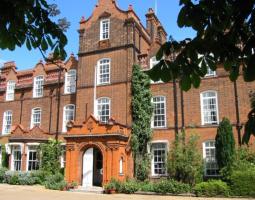
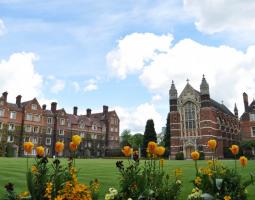
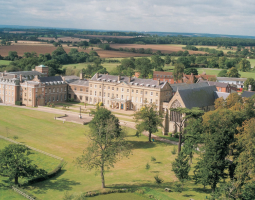
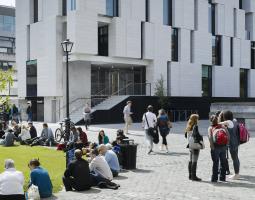
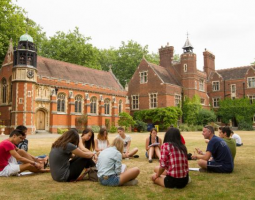
Classes are held at several locations in central Cambridge — including Sancton Wood School, Cardiff Sixth Form College and other venues adapted for summer programs. Students have access to classrooms, lecture halls, studios for practical classes, and group work rooms. The learning process is built on a university model: small classes, presentations, project sessions, and field trips in the urban environment.
The Tripos Court residence is located within a few minutes' drive of the center: it is a modern building with rooms, laundry facilities, Wi-Fi, a common relaxation area and 24/7 team support. Transfer to the study location is organized daily, and logistics are well-established.
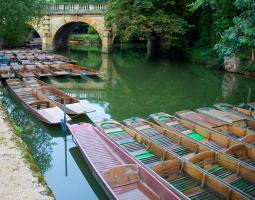
Cambridge itself is ideal for this format: compact, safe, culturally and visually rich. Within walking distance — university colleges, museums, libraries, parks and walking routes along the River Cam.
Admission dates and extra charges
The educational program is held in the summer and divided into three two-week sessions. Classes are held on weekdays, weekends are reserved for excursions and recreation.
In addition to the basic cost of the educational course, there may be additional fees for airport transfer, participation in individual optional activities (for example, a boat trip or rowing on the Cam River), individual academic consultations and university application services. You should also provide pocket money for personal expenses — for food during trips, souvenirs, purchases in the city and incidental expenses.
Enrolment process
The application process is organized with a minimum of formalities:
- Online application.
- Course selection, dates, accommodation format, discussion of language level and visa issues.
- Booking confirmation: invoice, contract, deposit payment.
- Preparation for participation: questionnaires, flight information, medical data, visa processes (if necessary).
- Online testing for group assignment.
- Receiving the final package: schedule, rules, contacts, list of things.
- Check-in and start of shift — airport pickup, transfer, accommodation and meeting the team.
Entry requirements, how to apply, what is required to enrol
- Age of students: 14–17 years old (for the STEM course — from 15 years old);
- English language: for subject courses — level not lower than B1; for English Pathways — any level, including beginner.
- Testing: online test before starting education to be assigned to groups.
Institution on the map
Residence permits, citizenship and other services
- Guardianship services during the studies
- Student supervision
Review about Dukes Cambridge Summer School, Summer School and Language Camp in Cambridge
Recommendations on when to apply
| Language courses, schools and children's language camps | Primary and secondary education - private schools | Preparation programmes for entering universities - higher education | Higher education (after completing accredited programs A-level, IB, High School) - Bachelor, Master, MBA |
| - we recommend to apply 6-9 months before the start of the course (some camps and schools offer discounts for early booking or for lengthy study programs) - there are some very popular and high demand children's camps, where the applications need to be submitted 1 year in advance (in particular Switzerland , Great Britain , USA , Canada , Austria) | - we recommend to apply one year before the start of the training program, - some schools have a specific time frame (September-November - please specify an individual school) - some schools require tests in several stages (UKISET, internal tests of the school: English, mathematics, logics, subjects, interview, some require a personal visit) | - we recommend to apply one year before the start of the program, - for Foundation and Pathway programs, IELTS and TOEFL certificates are usually required, respectively | - recommended submission one year before the start of the program, - the deadline normally closes in January, for TOP HEIs and, as a rule, in March in other universities - for a bachelor, a Foundation or Pathway preparatory program a completed A-level, IB, High School + IELTS / TOEFL are required - for Masters you need a graduated higher education, in some cases you need a pre-Masters program - MBA requires completed higher education, work experience preferably at least 2-3 years, etc. |