Oxford Royale Academy – Cambridge Summer School


Programs and prices, tuition fees in Oxford Royale Academy – Cambridge Summer School


Architecture & Design
- Students age: 16-18 years,
- Duration: 2 weeks,
- There are up to 15 people in a class.
The thematic program is suitable for those high school students who are fond of art and architecture, want to connect their lives and careers with these industries, engage in urban planning, urbanism and construction. The summer course will provide an understanding of a variety of engineering and construction concepts, teach how to combine aesthetics and functionality in a project. Students will dive into the intricacies of cartography, design, planning, technical drawing, and model building ("paper" and digital). All works can be added to your personal portfolio by the end of the course.
Cambridge itself and the University of Cambridge will be able to inspire students every day. This is one of the architectural gems of the world, an ancient city, incredibly rich in historical monuments and values.
The course already includes:
- Accommodation and meals (university residences),
- Training course (20 lessons per week),
- Any help from teachers and experts,
- Cultural extracurricular program, excursions,
- Graduation party, certificate of completion and full report card.
Law & Politics
- Students age: 16-18 years,
- Duration: 2 weeks,
- There are up to 15 people in a class.
"Discuss the present and protect the future" is the motto of the summer course in law and politics at Cambridge. For high school students who are interested in a career in jurisprudence, the program will be a good preparation for admission to specialized universities.
Students will examine not only the various branches of law (criminal, civil, commercial, contractual, ethics, and human rights), but also their relationship to politics. The classes will consider a variety of legal studies (including their ethical aspects): from human rights, women's rights to the availability of resources, the rules of world trade, globalization issues, and the fight against international terrorism. In the classroom, teachers will talk about the roles played by different organizations in the modern world: governments, large transnational corporations, non-governmental organizations, management agencies.
The program will hone many skills that are incredibly valuable for the legal profession:
- Critical thinking,
- Analytical thinking,
- Logic
- Finding an effective solution to the problem,
- Public speaking, oratory, debate skills, argumentation skills,
- Ability to cooperate,
- A full analysis of the situation,
- Ethics and tolerance,
- Effective leadership, leadership skills, different management styles,
- Ability to work ethically in a team.
The multinational environment of the campus additionally stimulates the search for a common language with representatives of different peoples, cultures, races and religions, encourages social research. Theoretical knowledge is tested in practice, during trial simulations, where students will be able to try themselves in different roles.
The course already includes:
- Accommodation and meals (university residences),
- Training course (20 lessons per week),
- Any help from teachers and experts,
- Cultural extracurricular program, excursions,
- Graduation party, certificate of completion and full report card.
Summer Course in Engineering and Technology
- Students age: 13-15 and 16-18 years old,
- Duration: 2 weeks,
- There are up to 15 people in a class.
The program is divided into two courses according to the age of the students: Designing Tomorrow: Engineering & Technology (16-18 years old) and Explore Engineering and Technology (13-15 years old).
Explore Engineering and Technology
The summer course of engineering and technology will allow you to study a variety of fields and branches of technology (civil, biomedical, aerospace, mechanical), a variety of modern technical solutions, up to drones and shuttles for space travel.
The main emphasis here is on practical work: knowledge of mathematics, robotics, physics and other exact sciences will be constantly reinforced in the course of experiments, experiments, design and simulations. This will strengthen critical thinking, creative principles, and help develop special engineering thinking. The competitive stage of the Mission to Mars Design Challenge is a group work during which you and your classmates will come up with technical tricks that could help create a Martian colony!
Designing Tomorrow: Engineering & Technology
Such an engineering course for high school students aged 16-18 is also an opportunity to look into the future of the latest technologies. This is an opportunity to decide how much you are interested in an engineering career - and how to build it correctly. Students will work with a wide variety of technological industries, up to advanced robotics and alternative energy. Visits to modern technology companies and laboratories, meetings with ideological leaders of the industry, famous scientists and inventors will help you get inspired. Students will take part in the Capstone group project, which will help not only test theoretical knowledge in practice, but also give impetus to the development of leadership skills, critical thinking, creative problem solving, and communication skills.
If you are planning to go to university for a degree in technology, engineering, exact sciences or IT, this course will be an excellent preparation for you.
Each course already includes:
- Accommodation and meals (university residences),
- Training course (20 lessons per week),
- Any help from teachers and experts,
- Cultural extracurricular program, excursions,
- Graduation party, certificate of completion and full report card.
Summer Business and Entrepreneurship Course
- Students age: 13-15 and 16-18 years old,
- Duration: 2 weeks,
- There are up to 15 people in a class.
The summer business course is divided into two shifts according to the age of students: Explore Business, Innovation and Entrepreneurship (13-15 years old) and Inventing the Future: Business, Innovation & Entrepreneurship (16-18 years old).
Explore Business, Innovation and Entrepreneurship
A full introduction to the world of business, entrepreneurship, innovation, finance and marketing for teenagers 13-15 years old. The main objective of this course is to develop a special entrepreneurial mindset, a "vein", without which any business or startup will not be able to shoot.
In the program, students will explore successful cases of global companies (Tesla, TikTok) and entrepreneurs (Steve Jobs, Elon Musk). Theoretical knowledge will be tested in a business incubator – Explore Business Shark Tank Challenge: you will create a group project, a business idea that you will have to defend in front of another group.
This is a great opportunity to check whether you want to do business in the future, become an entrepreneur. If you want to get a university degree in such areas, manage finances, participate in large business operations, quickly generate and implement new ideas, successfully launch projects, develop critical thinking, communication skills - this program is ideal for you.
Inventing the Future: Business, Innovation & Entrepreneurship
A similar course, but for older students, these are usually high school graduates (16-18 years old). Students will be able to promote their idea by turning it into a business project and creating a strategy for its implementation - and teachers and course speakers will tell you which tools, skills and methods are best suited for this. The course examines:
- Basic principles of business management,
- Innovation
- Entrepreneurial thinking and behavior,
- Successful leadership,
- Leadership qualities,
- Teamwork,
- The art of persuasion,
- Accounting
- Finance
- Marketing
- Creative thinking,
- Business Modeling,
- Successful presentation skills,
- Monitoring the market and business, effectively solving emerging problems,
- Innovative methodology for solving complex problems,
- Business ethics.
Participants of the shift will be able to consider successful business examples: London incubators and business accelerators Seedcamp and RocketSpace. And inside their camp, they will be able to compete with each other in the Inventing the Future Innovation Challenge, where they will need to convince others that your idea is worthy of implementation as a startup!
Each course already includes:
- Accommodation and meals (university residences),
- Training course (20 lessons per week),
- Any help from teachers and experts,
- Cultural extracurricular program, excursions,
- Graduation party, certificate of completion and full report card.
- Students age: 13-15 and 16-18 years old,
- Duration: 2 weeks,
- There are up to 15 people in a class.
The program is divided into two options - for children 13-15 years old and teenagers 16-18 years old.
Explore Medicine (13-15 years old)
This is a large-scale, deep, all-encompassing course that will simultaneously tell teenagers a lot of useful things about the human body and mind and reveal the secrets of modern medicine and healthcare, tell you how to become a professional and sought-after physician in the XXI century.
The topics of the classes will be very different: anatomy and physiology, useful practical medical manipulations (how to put a catheter, stop bleeding, apply a splint or bandage, conduct a medical examination with a preliminary diagnosis), anatomy, the modern structure of the medical world and much more. In addition, teenagers strengthen their communication and cooperation skills: they visit interesting laboratories, research centers, biomedical clinics, meet with experienced specialists in the field - practitioners and scientists.
This is an ideal preparation for those teenagers who are interested in a career in medicine, health or psychology, but are not yet confident in their abilities, cannot outline a career and academic path. At the end of this program, each participant will have a clear route to achieve their goal.
Curing the Future: Medicine & Disease (16-18 years old)
The Curing the Future: Medicine & Disease program will introduce high school students to the world of medicine and healthcare, show modern practices, the basics of current research - all this will help to make the right choice regarding their future career. Medicine is one of the most difficult areas to master, consistently one of the most highly competitive faculties, so competent training is simply necessary here.
The program will teach students how to be a professional and sought-after physician of the XXI century. This course is almost a complete immersion in the profession of a doctor, nurse or medical professional:
- Biology
- Genetics
- Neurology
- Genomics,
- Emergency medicine,
- Anatomy
- Biomedical research.
In addition, students attend lectures and speeches by invited speakers, travel to large research laboratories, centers at universities and clinics. If you are concerned about the development of modern healthcare, you plan to strengthen the medicine of the XXI century, you want to build a reliable educational route for this - this course will be an ideal assistant for you.
The course already includes:
- Accommodation and meals (university residences),
- Training course (20 lessons per week),
- Any help from teachers and experts,
- Cultural extracurricular program, excursions,
- Graduation party, certificate of completion and full report card.
Film Academy Summer Course
- Age — 12-15 years,
- Dates — July-August,
- Course duration — two weeks.
This course will give students new knowledge and skills in the film industry: directing, filming, and post-production. Over the course of two weeks, students work with professional equipment in specialized labs, attend lectures and seminars, and masterclasses from guest specialists, studying four large blocks:
- Theoretical and technical preparation for directing: key elements of filmmaking, including composition, lighting, and sound, practical sessions on camera setup and shooting various types of shots,
- Practical filming: conducting a trial shoot and reviewing the footage, work on the main project — writing a script for a full filming process,
- Post-production: editing the film using various software, including FinalCut Pro,
- Additional training: seminars and masterclasses on screenwriting, editing, and other aspects of filmmaking.
By the end of the course, each student will add their own short film to their portfolio!
Summer Artificial Intelligence Courses
- Age — 12-15, 16-18 years,
- Dates — July-August,
- Program duration — two weeks.
The seasonal artificial intelligence program offers two curricula: for students aged 12-15 and students aged 16-18.
The course for younger students offers a chance to master the basics of AI by studying several academic modules over two weeks:
- AI fundamentals,
- Machine learning, data,
- Natural language processing,
- Computer vision,
- AI in robotics,
- AI in the real world,
- Emerging AI technologies,
- Ethics, responsible use of AI.
Older students will focus on a deeper understanding of the processes and the differences between types of artificial intelligence — their curriculum includes similar modules, but with in-depth study and more complex terminology:
- Machine learning: how AI trains itself,
- Ethics in AI,
- Generative AI: studying the language models behind many AI tools, and the extensive datasets used to train GenAI models to create content,
- Natural language processing,
- Digital forensics: identifying and collecting digital evidence of cybercrimes, mastering tools such as Autopsy and FTK Imager,
- Web exploitation: an introduction to website vulnerabilities and ethical hacking tools such as Burp Suite,
- Cryptography: history and basic principles, hands-on cracking of simple codes,
- Programming skills, binary exploits, reverse engineering: improving programming and command-line skills, an introduction to binary code and cyber-memory structures,
- Network security: working with networks, including IP addresses, DNS and firewalls, studying how malware and phishing attacks work,
- Password security: why passwords matter and the lengths hackers go to in order to crack them using software, including Brute Force and Rainbow Tables,
- Cyber ethics, careers: the ethical aspects of cybersecurity, the range of career opportunities.
By the end of the program, students have solid applied skills in using AI, knowledge of cybersecurity, and experience gained from qualified University of Cambridge educators and guest specialists from the AI sector.
New Perspectives Summer Course
- Age — 12-15 years old,
- Dates — July-August,
- Course duration — two weeks.
This course allows students to study two academic tracks in parallel, complemented by one of several workshops on developing personal skills. The curriculum, built around the student's interests, evenly combines classes in two specialties and a thematic workshop, leaving time for leisure and rest.
First, students choose from the following list:
- Astronomy, space science,
- Marketing: from ideas to viral campaigns,
- Journalism, digital media,
- History, civilization,
- Politics, international relations.
The second track is chosen from the following:
- Economics,
- Architecture,
- Climate, sustainability, the future,
- Experimental psychology,
- Creative writing.
The thematic workshops are devoted to important qualities that students will need in school, at university, and when building a career:
- Public speaking and debate
- Business case studies,
- Photography, visual storytelling,
- Academic writing, argumentation.
After creating a personalized curriculum, the student studies it over two weeks and, at the end, receives valuable certificates that add to their portfolio.
Summer Course in Economics and Finance
- Age — 16-18 years,
- Dates — July-August,
- Course length — two weeks.
This summer course, designed for students aged 16-18, offers an effective immersion into the world of economics and finance: over two weeks, students study several academic modules and take part in project work and seminars with guest specialists. The curriculum includes:
- Key concepts: from supply and demand, scarcity to inflation, IPOs and stocks,
- Global economy: the impact of international trade on the global economy, identifying trends in the world market,
- Financial strategies and risk management: ways to raise funds for startups, analysis of cash flow models,
- Modern economic challenges: the emergence of economic crises at the national and international levels and their impact on the life of the global community, crisis management by governments and institutions,
- Business and corporate finance: capital investment and investment decision issues, the role of mergers, acquisitions and corporate restructuring in shaping business financial growth,
- Investments: analyzing the feasibility of investments, the differences between high-risk and low-risk investments,
- Business and financial markets: studying the role of financial institutions such as banks and insurance companies, different types of markets and the conditions for their stability,
- International trade and economic policy: globalization and economic integration, the work of the World Trade Organization, comparing competing theories of international trade.
Working on real-world cases and projects, along with engaging with specialists from the economics and finance industry, will help students gain valuable experience, knowledge and skills that will be useful in further specialized study at college or university.
Summer Course in Psychology
- Age — 16-18 years old,
- Dates — July-August,
- Course duration — two weeks.
The summer course in psychology will provide students with the basics and some of the finer points of psychology: from biological research on the brain to individual differences between people, social and applied psychology. The two-week curriculum includes nine academic modules:
- Experimental psychology: scientific methods in psychology, consideration of career opportunities, studying the structuring of experiments and research,
- Social psychology: studying group behavior, differences between critical social psychology and experimental social psychology,
- Cognitive psychology: differences between top-down and bottom-up information processing, evaluation of various experiments investigating memory and perception,
- Biological psychology, the brain: the functions of various areas of the brain and the nervous system as a whole,
- Developmental psychology: mental development throughout a person's life,
- Developmental psychology II,
- Individual differences: different theoretical approaches to the idea of personality and methods for assessing individual psychological traits,
- Applied psychology: applying psychology to genuinely improve society's life,
- Reflection, putting knowledge into practice.
The first week is set aside for studying the basics, the second — for deeper theoretical topics, analysis of real cases in psychology, and group practice.
Summer Course in International Relations
- Age — 16-18 years,
- Dates — July-August,
- Duration — two weeks.
The program is dedicated to global politics and the relationships between countries — over two weeks, students will study eight areas covering the fundamentals and more advanced topics of international relations.
- Introduction to international relations: key concepts, analysis of the influence of power, national interests and sovereignty on global agreements and trade,
- The architecture of global governance: studying how various international organizations work, such as the UN, the African Union, the Gulf Cooperation Council,
- Diplomacy: the work of diplomats and the frameworks governing their activities,
- Negotiation and mediation: preparing diplomats for negotiations, examining alternatives and zones of possible agreement,
- International law and dispute resolution: the origins of international law and its practical application, strategies for concluding treaties between countries,
- Trade and economic diplomacy: the conclusion of trade agreements and their composition, the role of the World Trade Organization in resolving disputes and carrying out reforms,
- Climate and environmental diplomacy: an in-depth study of international cooperation, examining global ecology and the influence of countries on sustainable development,
- New horizons in diplomacy: exploring opportunities for future cooperation between countries in the fields of digital technology, the deep seas and oceans, and outer space.
Under the guidance of qualified University of Cambridge instructors and guest specialists, students gain valuable knowledge and skills, and prepare effectively for specialized university education and the start of their careers.
Summer Course with MIT: AI, Innovation, Entrepreneurship
- Age — 16-18 years,
- Dates — July-August,
- Program duration — two weeks.
Created together with MIT, this course provides high-quality knowledge and deep understanding of creating, operating, and implementing AI in any field of activity, and examines new technologies and current research on the application of AI and its benefits in entrepreneurship. Over the course of two weeks, students study several academic modules, with a focus on hands-on practice in specialized laboratories and interaction with subject-matter specialists.
Broadening Horizons Summer Course
- Age — 16-18 years old,
- Dates — July-August,
- Course duration — two weeks.
The Broadening Horizons summer programme allows students to study two academic fields at the same time, supplementing them with seminars on developing one personal skill of their choice.
First, students choose one of the following academic fields:
- Journalism, media,
- History: empires, revolutions, modern power,
- Creative writing, storytelling, publishing,
- Physics: from the quantum world to space,
- Neuroscience,
- Wildlife conservation and biodiversity,
- Sports science, performance, sports business.
In addition to their first subject, students choose a second:
- Climate science, sustainability,
- Criminology and forensic science,
- Biotechnology,
- Philosophy, politics,
- Modern marketing, advertising, brand strategy,
- English literature, critical thinking,
- Archaeology, anthropology.
Classes in each discipline are evenly distributed throughout the curriculum, allowing students to gain knowledge and skills in full. In addition to their two academic specialisations, students choose seminars on developing one of the following skills:
- Academic writing, argumentation,
- Debate, public speaking,
- Business case studies,
- Leadership, teamwork,
- Art, architecture.
Students receive graduation certificates in both fields, gain valuable skills, and build up a personal portfolio that will help them get into the university or college of their choice.
Description of Oxford Royale Academy – Cambridge Summer School
- Location: Cambridge, United Kingdom
- Year of foundation: more than 20 years ago
- Language of instruction: English
- Number of students on campuses: more than 25,000
- Type of training: mixed.
Cambridge Summer School provides programs for students from 13 to 18 years old. The University of Cambridge, like Oxford, has a worldwide reputation for quality education, preservation of traditions and achievements of graduates. Among those who graduated from Cambridge were such famous personalities as comedian Hugh Laurie, TV presenter David Attenborough, decoder and mathematician Alan Turing and many others.
The Cambridge Summer School presents 10 courses that allow students to explore medicine, engineering, art, and learn English. In addition to high-quality academic knowledge, students will gain a unique student experience, the opportunity to broaden horizons, improve language knowledge and explore the culture of the UK on excursions.
Accommodation, meals, prices
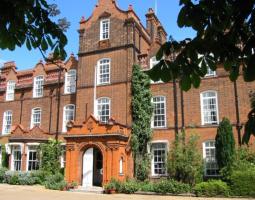
Students from 13 years old live on the territory of Clare College - the second oldest university college in the country. The buildings of the institution are known for their beautiful historical architecture, a large courtyard for recreation and communication.
Standard double rooms are equipped for accommodation, in which girls and boys are accommodated separately. Bathrooms and toilets are shared. Personal tutors and teachers live on the territory, so students are under constant supervision and safety.
Activities Oxford Royale Academy – Cambridge Summer School
Students have plenty of opportunities to explore the culture of the UK while visiting Cambridge attractions. The most popular include:
- St. Mary's University Church Tower overlooking the city
- All Saints Church in the Gothic Revival style with gardens beloved by poet John Milton
- Plaza
- Embankment of the Kem River.
During extracurricular tours, students can look at the bright lights of London's theatres, Hampton Court Palace, Waaberg Abbey, King's College Math Bridge built without nails, the college itself and much more.
On the educational territory outside the classroom there are graduation balls and parties, thematic festivals, scientific Olympiads and creative competitions.
Advantages
- International School
- Three Royal Entrepreneurship Awards
- Study in small classes with the possibility of additional 1:1 lessons with a teacher
- Regular communication with parents
- Safe and innovative campus
- Training in a historically important location of 1209 (!) year of construction.
Facilities and equipment at Oxford Royale Academy – Cambridge Summer School
Cambridge has for centuries been recognized as one of the most beautiful academic centers in the UK thanks to its many green lawns, beautiful river landscapes, quiet streets and architecture.
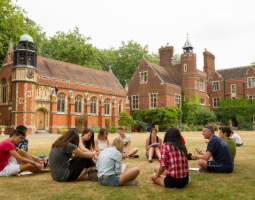
Students live, eat and study on the campus of Cambridge University College, where lecture classes, practical laboratories and computer areas for learning are equipped. In the open air, students can relax, chat with classmates or read a book.
Admission dates and extra charges
The cost of programs includes:
- More than 16 hours of lessons per week
- Accommodation, meals
- Learning Materials
- Lectures with guest speakers
- Daytime, evening activities on campus
- Bus tours around the city, trips to nature
- Welcome, graduation balls
- Branded clothing, stationery
- Certificate of completion of training.
Enrolment process
Applicants fill out the registration form and provide the required documents, after which they receive complete information about arrival in the country and on campus.
Perspectives
Upon completion of any of the courses, graduates receive a diploma confirming a high level of academic preparation and English language proficiency. During the course of study, students complete practical assignments and create projects that will complement their portfolio.
Entry requirements, how to apply, what is required to enrol
International applicants need the following to enroll in summer programs:
- Personal documents: a foreign travel passport, medical insurance, a visa or residence permit,
- English language proficiency of at least C1.
Scholarships Oxford Royale Academy – Cambridge Summer School
In addition to paying for programs in installments, applicants have access to early booking discounts for a spot on the course (please check the details with your consultant).
Institution on the map
Residence permits, citizenship and other services
- Guardianship services during the studies
- Student supervision
Review about Oxford Royale Academy – Cambridge Summer School
Recommendations on when to apply
| Language courses, schools and children's language camps | Primary and secondary education - private schools | Preparation programmes for entering universities - higher education | Higher education (after completing accredited programs A-level, IB, High School) - Bachelor, Master, MBA |
| - we recommend to apply 6-9 months before the start of the course (some camps and schools offer discounts for early booking or for lengthy study programs) - there are some very popular and high demand children's camps, where the applications need to be submitted 1 year in advance (in particular Switzerland , Great Britain , USA , Canada , Austria) | - we recommend to apply one year before the start of the training program, - some schools have a specific time frame (September-November - please specify an individual school) - some schools require tests in several stages (UKISET, internal tests of the school: English, mathematics, logics, subjects, interview, some require a personal visit) | - we recommend to apply one year before the start of the program, - for Foundation and Pathway programs, IELTS and TOEFL certificates are usually required, respectively | - recommended submission one year before the start of the program, - the deadline normally closes in January, for TOP HEIs and, as a rule, in March in other universities - for a bachelor, a Foundation or Pathway preparatory program a completed A-level, IB, High School + IELTS / TOEFL are required - for Masters you need a graduated higher education, in some cases you need a pre-Masters program - MBA requires completed higher education, work experience preferably at least 2-3 years, etc. |