For partners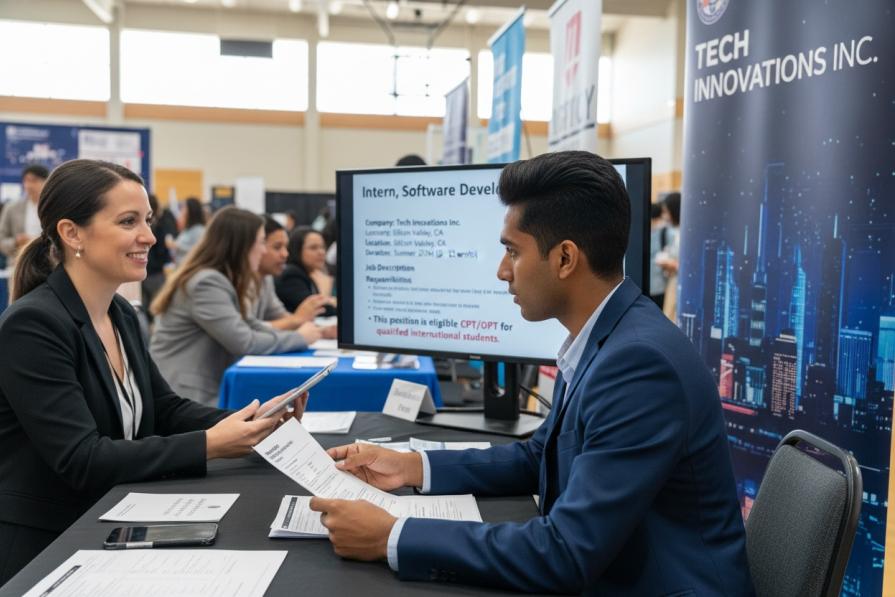
For many years, the United States has been the world's main platform for those who want to get a quality education and make an international career. In the 2024/25 academic year, there are almost 1.2 million international students studying at American universities, which is an all-time high. In terms of scale, scientific potential and variety of programs, the United States is still unrivaled. Today, however, more and more families choosing an American university are talking about more than just rankings and campuses. The key question is whether it is possible to stay working after studying in the United States and how much more difficult has it become in 2025?
The reason lies on the surface: the policy of the Donald Trump administration has greatly changed the rules of the game. In 2024-2025, the United States tightened control over student visas, strengthened checks on employers, and introduced additional barriers for those who expect to pursue a career in America. Demand for studying in the United States remains high, but the entry filters have become denser: in the last fiscal year alone, the F-1 failure rate reached about 41%, and this is one of the highest rates in recent years. Universities accept more foreign students, but it has become more difficult to get a visa and keep the status (!).
A separate tension is associated with the internship program after graduation. OPT and STEM OPT is the main route through which tens of thousands of international graduates stay to work in the U.S. each year. In 2024, there were almost 300 thousand such students. But it was this topic that became one of the stumbling blocks in 2025.
At the same time, it is important to emphasize the main thing: the United States is not closed to foreign specialists. They are becoming more demanding, yes, but the opportunities still exist — the road will be mastered by the one who walks.

F-1 Visas: The Cornerstone of Employment in America
Any conversation about looking for a job in the U.S. starts with one thing: the F-1 status that most international students receive. This is not just a "student visa", it is the legal basis on which the entire future career is built: from the first internships to the H-1B work visa or alternative immigration routes.
F-1 status gives clear opportunities and equally clear limitations.
You can:
- Work on campus for up to 20 hours per week,
- Participate in academic internships built into the program (CPT),
- After graduation, obtain the right to professional practice (OPT).
You can't:
- Work off-campus without special permission,
- Change the university or program without the notification and approval of the DSO,
- Disrupt the school schedule because any deviation is recorded in the SEVIS system and may result in loss of status.

In 2024-2025, the Trump administration increased oversight of the F-1: universities received additional reporting obligations, and students face regular inspections. Consulates have become stricter about the justification of a visit: if earlier it was enough for a student to show the educational goal, now at interviews they are much more often required to provide convincing evidence that a person really intends to study, and not use the university as a way to immigration. Particular attention is paid to those who abuse CPT or choose programs in which practice occupies a large part of the curriculum - such schemes have become the object of close attention of both USCIS and the migration police.
F-1 status is the foundation. If it is followed perfectly, the road to the OPT, then to the H-1B or other visas remains open. If not, it is almost impossible to restore it, alas.
CPT: the first step to work experience and the first risks
For most students, CPT is the earliest and easiest legal way to gain work experience in the U.S. while still studying. CPT (Curricular Practical Training) allows you to combine study and practice if it is part of an educational program: the internship is a part of the curriculum, counts as credit, or is a mandatory element of the course.
On paper, everything looks simple: the university confirms the need for an internship, the employer provides an internship, the student receives permission from his DSO and starts working.
However, the Trump administration has dramatically increased its control over programs that are "too generous" in handing out CPT to students. Some universities have already faced SEVP inspections: control bodies require confirmation that the internship is indeed educational, and does not replace full-fledged work. Programs in which a student is eligible for full-time employment under the guise of CPT almost immediately upon arrival are of particular concern.
What is important for foreign applicants and students to know:
- CPT cannot replace OPT
If a student earns many months of full-time CPT, they may lose their entitlement to one-year OPT upon graduation. This is a common but dangerous mistake.
- It all depends on the university
The American migration system is designed in such a way that it is the university that is responsible for complying with the F-1 rules: if it sees a risk of violation, a student can be denied CPT even if there is an employer.
- CPT should not look like an attempt to "circumvent" the visa regime
A job that is not related to the specialty, or going into full-time employment too early can raise suspicions.
- Each episode of CPT is recorded in SEVIS
This means that when applying for an OPT and then for an H-1B or other visa, the immigration service will see all the decisions made by the university and the student.
OPT: The Main Mechanism for the Transition from Study to Work

If CPT is a test of the pen, then OPT (Optional Practical Training) is a real opportunity to gain a foothold in the labor market after graduation. Every F-1 student is eligible for 12 months of OPT, which can be used within 14 months of graduation. But it is OPT in 2024-2025 that is in the spotlight of both universities and federal agencies.
OPT is available after completing the program (bachelor's, master's or PhD), allowing the graduate to work in their specialty at any company in the United States – provided that:
- The work corresponds to the degree obtained,
- The employer does not violate the requirements of migration legislation,
- The student observes SEVIS reporting (place of work, address, change of employer).
In 2023/24, almost 200 thousand students received OPT, which was an all-time high. Despite the rhetoric about "tightening", the program remains alive, in demand and massive.
STEM OPT: An additional chance for technical specialties
If a student was pursuing a STEM degree, they can extend their OPT for another 24 months. In 2024, more than 95 thousand graduates were already enrolled in STEM OPT, and this program has become a real "window of opportunity" in the face of political uncertainty.
Why STEM OPT is so important:
- Three years of legal work in the United States is a much better chance of entering a company that is ready to apply for a work visa,
- Employers are more willing to hire graduates for a long period,
- In three years, a student can participate in several attempts at the H-1B lottery,
- STEM specialists remain a priority even in a politically tough agenda.
But there have been certain changes here as well:
- The requirements for the employer have increased: the company must be registered with E-Verify and provide a documented studying plan.
- Reporting has become stricter. The DSO has the right to return the application to the student if the relationship of work with the program is not sufficiently described.
- Political risks remain: Reform projects that could change STEM OPT rules are being discussed at DHS. So far, this is only a discussion, but nervousness in the educational tourism market is growing.
OPT to Work Visa Transition: H-1B and the New Realities of 2025
OPT is only a temporary step. To stay in the U.S. for more than a year (or three years for STEM), the graduate must switch to one of the work visas. The most common is the H-1B: this is a visa for specialists employed in "professions requiring high qualifications." This route is for those who want to build a long-term career in the United States, but it is one that has changed the most in the context of Trump's policy.
The H-1B system is based on three key pillars:
- The application is submitted by the employer, not the student. The graduate needs to first receive a job offer and make sure that the company is willing to go through the bureaucratic process of applying for an H-1B.
- The lottery is the main filter. Every year, a quota is determined (usually 85 thousand places), and if there are more applications, a lottery is held. Having an American master's or doctoral degree gives a graduate an additional chance — a separate selection round.
- The profession must require higher education. The immigration service checks whether the work is really related to the specialty, and is not a "workaround" to hire a foreigner.
Despite the tightening, the window of opportunity remains open. In practice, the most common switches to H-1B are:
- Graduates of master's and PhD programs in the United States – they participate in two rounds of the lottery,
- Specialists in the fields of information technology, engineering, data analysis, biotechnology, medicine, cybersecurity,
- Graduates working in organizations that are not accountable to the quota - universities, research centers, hospitals, non-profit laboratories.
The latter category is especially important: such employers can apply for an H-1B outside the quota and at any time of the year. Therefore, a master's or doctoral program at a large research university is not only a high-class education, but also direct access to employers for whom there is no lottery.
Alternative routes: not only H-1B
The H-1B is not the only way to stay to work in the U.S.
O-1 Visa: For Those with Achievements
O-1 is suitable not only for science stars: a young researcher, a strong engineer, a programmer with patents, a winner of international competitions, an author of publications or a participant in serious projects is already a candidate.
With the proper preparation of documents, O-1 becomes a real option for graduates of technical programs.
L-1 Visa: Intra-Corporate Transfer
It is an option for those who get a job in an international company with offices in the United States. The scheme is as follows: 1-2 years of work in a foreign office, and then transfer to the American branch at L-1. This option is popular among engineers, IT specialists, and analysts.
EB-2 NIW: The Path to a Green Card Without an Employer
The NIW (National Interest Waiver) allows you to obtain a green card if the specialist can prove that his work is of national importance to the United States. This is a challenging but feasible scheme for STEM graduates. Over the past three years, the number of applications from young researchers has grown rapidly.
Academic and clinical trajectories
Working in laboratories, universities, hospitals, and research centers is one of the most reliable paths: there is a stable demand for labor, the H-1B is not limited by a quota: the candidate must have a strong academic profile, but the competition here is lower than in the industry.
Less often used:
- E-2 is for investors,
- J-1 Academic is a path for researchers, but no one can give you a guarantee of switching to H-1B, it is a kind of lottery.
Is there a difference in which state to look for a job?

Immigration law in the United States is federal: F-1 visa, OPT, STEM OPT, H-1B, and other statuses are regulated at the Washington level, not individual states. But in practice, the employment opportunities of a graduate still depend to a certain extent on the region in which he studies and is looking for a job. The reason is simple: the different structure of the economy, the density of employers, the familiarity of companies to international hiring, and local requirements for certification of specialists.
California is the main "magnet" for STEM graduates
California welcomes more than 140,000 international students annually and remains the largest market for technical specialties. Companies that traditionally hire OPT graduates and then transfer them to H-1B are concentrated here: tech giants, biotech, fintech, startups, research laboratories of UC universities and private institutes.
Texas is a fast-growing tech hub
Austin, Houston, and Dallas form a new science and technology corridor. Texas is actively attracting companies in the IT, energy, engineering, and manufacturing sectors. The labor market here is growing even faster than in California: there are many new employers willing to take on graduates, and the cost of living is lower. On the other hand, there are fewer large corporations with H-1B experience in the state and are generally more likely to get to an employer who does not work with visas.
New York and Massachusetts – Science, Finance and Biotechnology
New York combines the financial sector, media, data analytics, and major universities. Massachusetts is MIT, Harvard, one of the world's largest biotechnology clusters.
Midwest - Industry and Engineering
States like Michigan, Illinois, Ohio, or Minnesota can be an ideal option for engineers and automation specialists: there is a large industrial sector, automotive, energy, and medical technology.
Good old American South
The logistics, cybersecurity, energy and manufacturing sectors are actively developing, but local companies often lack experience with international employees.
Conclusion

The United States remains one of the few places in the world where education and career are inextricably linked. A foreigner can come to a university, get a strong academic background, do internships, start an OPT job, and then switch to an H-1B or other working status. Despite tough political rhetoric and increased scrutiny, hundreds of thousands of graduates continue to use this pathway, especially in technical and scientific fields.
But in 2025, success no longer depends only on a diploma — it depends on strategy: choosing a program, region, employer, accuracy in documents, willingness to learn the language of professional communication, participation in projects, and a detailed understanding of how the American visa system works.