Every parent dreams that their child will study with genuine enthusiasm and easily solve problems that others get «stuck» on. But reality often looks different: doing homework turns into an exhausting positional battle, with a boring paragraph on one side and a tired, unfocused schoolchild on the other.
You must understand: the secret to success lies not in the number of hours «sat through» with a textbook, but in the ability to use the natural mechanisms of the brain. Modern neuropsychology suggests stopping the struggle against willpower and starting to use biological «cheat codes» that will turn studying into a productive process!


Strategy #1. The Generation Method
The classic rewriting of text from a textbook is the surest way to waste time and remember nothing. Mechanical memory is extremely short-lived: information flies out of your head the moment you put down the pen.
- Scientific fact: the generation effect proves that we retain information 30% better when we produce the answer ourselves rather than simply reading a ready-made one. When the brain doesn't copy but reinterprets data, not only memory centers are activated, but also powerful nodes of speech and logical thinking — this creates deep and lasting neural connections.
- How to implement it: teach your child to explain complex concepts in plain language, as if retelling the plot of a new blockbuster to a friend. Fix terms precisely, but the essence — only through their own understanding.
- Visual code: combine formats. Let linear text give way to bright mind maps, diagrams, or quick sketches — the more associations, the more reliable the "foundation" of knowledge.
Strategy #2. The Social Stimulus
The desire to share a discovery is a powerful evolutionary instinct. What is socially meaningful, our brain records as a priority. Research from the University of Washington confirms: people who know they will have to teach others structure information far more effectively than those who are simply preparing for a test.
- How to implement it: agree that at dinner your child will be the main lecturer and will teach the whole family the coolest fact of the day! The awareness of an upcoming "public lecture" will make the brain search for logical chains and identify the key points, turning a jumble of facts into a clear system.
Strategy #3. Interval Biohacking
A two-hour marathon over homework is a straight road to apathy: attention scatters after just 40 minutes (maximum), and after that you are simply burning resources for nothing. The brain absorbs information far more effectively in short, intensive bursts.

- The neurochemistry of the process: physical activity during breaks stimulates the production of the protein BDNF (brain-derived neurotrophic factor), which literally helps new neurons grow and strengthens the connections between them (synapses).
- How to implement it: divide work into blocks of 25–30 minutes with mandatory five-minute breaks. During the break, encourage your child to jump around or do some warm-up exercises — the influx of oxygen and a dose of BDNF will help the prefrontal cortex find a solution faster.
Strategy #4. The Dopamine Loop
Any cognitive work is energy-intensive, so in order for the brain not to "sabotage" the process, it needs to see a benefit. Encouragement helps form an intrinsic drive toward knowledge.
- How to implement it: after conquering a difficult chapter, let a desired activity await the child — an episode of a show, a walk, or a gaming session. Such a reward triggers a release of dopamine — the neurotransmitter of anticipation. As a result, the brain begins to associate intellectual effort with pleasure.
- An important nuance: sleep is also part of the brain's "reward." During sleep, memory consolidation occurs: the brain "rewrites" information into long-term storage, so chronic sleep deprivation reduces learning ability by 40%. Therefore, study the most difficult material 1.5 hours before sleep, and the effect will be at its maximum!
Strategy #5. Active Attack on the Text
Passive reading with a highlighter in hand creates only a dangerous illusion of learning. The brain is being lazy in that moment: active learning is when the child "attacks" the text with questions.
- How to implement it: teach your child to write down only the key ideas and immediately formulate their own questions about them; let them look for unclear points and try to find the answer independently before asking for help.
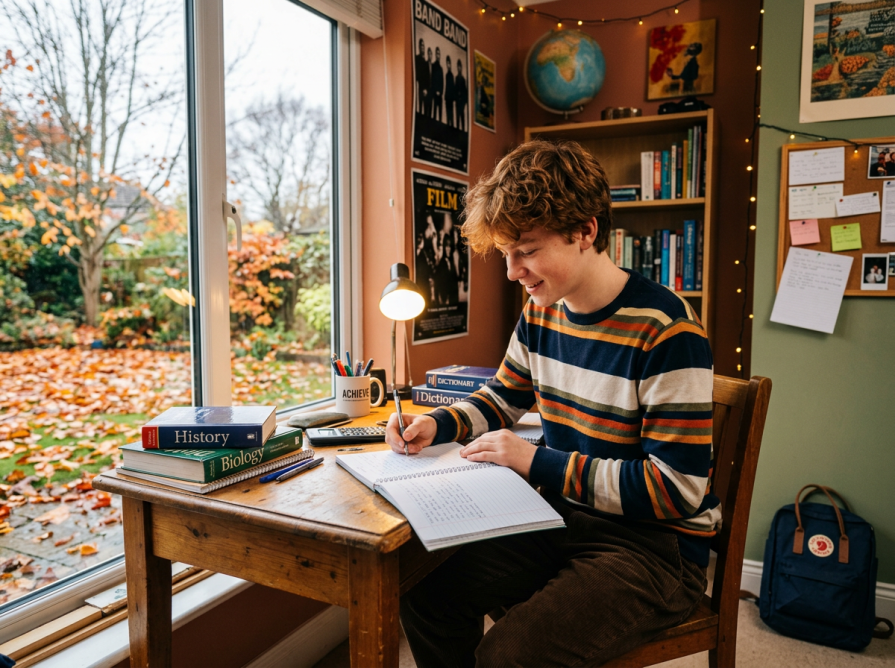
- Organizing the space: clear everything unnecessary from the desk — if toys are lying in the field of vision, the brain wastes precious energy ignoring them. Use cool white light (above 4000K) during study sessions for concentration, and soft, warm yellow light afterward — for relaxation.
How to Set Up the Whole System?
Learning depends greatly on the quality of literally every minute. By using these methods, you are not just helping prepare for lessons: you are giving your child the key skill of the 21st century — the ability to learn.
- Repeat at intervals: use the «Ebbinghaus curve» — review material after 10 minutes, after an hour, after a day.
- Drink water: the brain is 80% water, so mild dehydration is a frequent cause of "laziness" and loss of focus.
- Praise the process: focus not on the grade, but on how well the child handled the difficulty.
By implementing these scientifically grounded techniques, you help your child develop naturally and without overload. You have every chance of making studying a territory of achievement rather than a zone of conflict!