
The process of selecting an appropriate high school abroad for your child represents one of the most important choices that parents must make. The choice between public schools and private schools generates intense feelings in people, yet the suitable option for your family needs assessment of your child's individual requirements and your family's values and financial capacity. The two options require assessment through four essential aspects which include their academic performance, their available resources, their financial requirements and their results on student achievement after graduation.


Academics: Rigor vs. Reach
Public high schools operate within state regulations which require them to provide educational services to all students including those who need special education and those who want to study advanced material. The schools offer a broad range of academic programs which usually feature more than 40 different Advanced Placement AP and International Baccalaureate IB programs. Students must attend larger classes because teachers have restricted ability to change their teaching methods according to standard curriculum requirements.
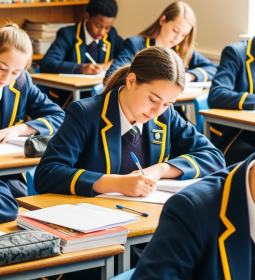
Private schools abroad do not need to follow state testing requirements because they operate independently from those regulations. The educational institutions have the ability to create their own challenging academic programs which include Montessori and classical and STEM-based curricula. Smaller class sizes enable students to participate in Socratic discussions while receiving personalized attention during their studies. Private schools can only establish their academic power through comparison with top public magnet schools which offer higher academic standards than some of their institutions. The actual course offerings and teaching methods at the school should receive evaluation, instead of merely assessing the institution's name.
Resources: Facilities, Teachers, and Enrichment
The resources of wealthy suburban public schools which operate as their own school systems match or surpass those of private schools because they possess advanced laboratories and athletic facilities and performing arts centers. The public schools in underfunded districts face difficulties because they lack current textbooks and have excessive student capacities and restricted afterschool activities.
Private schools typically maintain lower administrative costs which enable them to allocate tuition funds toward specific educational needs that include arts programs and technology resources and counseling services and college advising assistance. The standard of teaching is provided in two distinct categories. Public school teachers must hold state certification, while private school teachers often have subject-matter expertise but may lack formal teaching credentials. Private schools can also fire underperforming teachers more easily, but they rarely offer the same salary and pension benefits that attract veteran educators to public systems.

Costs: Free Tuition vs. Financial Sacrifice
This is the most straightforward differentiator. Public high schools operate as no-cost educational institutions which receive funding from property taxes and state government distribution. Private high schools charge tuition, which in the U.S. averages between $12,000 and $16,000 per year for day schools, and can exceed $50,000 for elite boarding schools.
Public schools abroad do not charge tuition but require students to pay for extracurricular activities which include sports and music and advanced placement exams and parking fees which total hundreds or thousands of dollars each year. Many private schools offer generous need-based financial aid and merit scholarships, making them accessible to middle-income families. The real question is whether the private school’s advantages—if they exist—justify the financial strain. Some families choose to spend their vacation and retirement savings for private school tuition while other families decide that the resulting anxiety costs them more than they gain.
Outcomes: College Admission and Beyond
Data on student performance reveals surprising nuances. Private school graduates have higher average SAT/ACT scores and college enrollment rates. However, when researchers control for socioeconomic status and parental education, much of that advantage disappears. In other words, private schools often succeed because they enroll students from privileged, motivated families, not because their teaching is inherently superior.
Where private schools do shine is in “college match” and graduation rates. They often provide intensive college counseling, helping students craft compelling applications and secure entering selective universities. Public schools, especially large ones, may offer minimal guidance beyond basic requirements. That said, top-tier public schools frequently outperform all but the most elite private schools in sending students to Ivy League colleges.
For long-term outcomes like career earnings and life satisfaction, the research is mixed. Some studies find a modest private school advantage in civic engagement and job satisfaction, while others conclude that a motivated student in a decent public school will do just as well as a private school peer.

How to Decide: A Practical Framework
Start by asking four questions:
-
What is your child’s learning style? If they need small classes and hands-on attention, private schools or small public schools are better. If they thrive in a large, diverse environment with many AP options, a strong public school may be ideal.
-
What is your local public school like? Visit it. Talk to current parents. If it has low violence, strong test scores, and active PTA, it may be “private school lite” for free. If it is chronically underfunded, private may be worth the cost.
-
Can you afford private school without sacrificing financial security? Do not take on debt or deplete an emergency fund for K-12 education. A stable, unstressed home life is a greater predictor of success than any school’s name.
-
What are the alternatives? Boarding schools, online public schools, and homeschooling blur the public-private line. Also, consider moving to a district with excellent public schools—that real estate premium often costs less than 12 years of private tuition.
Final Thoughts
There is no universal “best.” An elite private school will not fix a disengaged student, and a struggling public school does not doom a motivated child. Visit both types, speak to students and teachers, and ignore marketing hype. The right high school is the one where your child feels safe, challenged, and seen—whether that comes with a tax bill or a tuition check.