
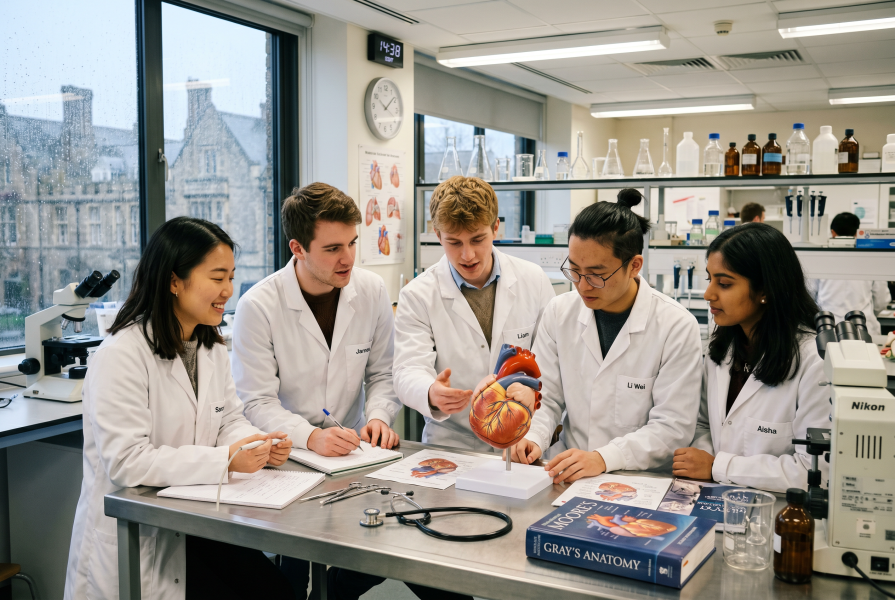
Medicine still feels like one of the most prestigious and rather cutthroat degree routes in the United Kingdom. Every year, lots of students submit applications for a small number of places at medical schools across England, Scotland, Wales, and Northern Ireland. However, beneath the surface of academic excellence there’s this annoying, lingering problem: social inequality when it comes to getting into medical education.
Even with all the widening participation schemes ongoing, people from disadvantaged backgrounds are still way less likely to be represented among those who actually apply for and then end up entering UK medical schools.


A Profession Dominated by Privilege?
Research keeps showing that students from higher socio economic backgrounds tend to aim for medical school more often. Applicants disproportionately come from independent (private) schools, higher-income households, families with professional or medical backgrounds, and places where average education is already higher.
And, as sector reports also suggest, students from private schools — even if they only make up a small part of the whole school population — still manage to end up with a disproportionately big share of both medical school applications and successful admissions.
Meanwhile, learners from low-income families, state schools in more disadvantaged areas, and underrepresented ethnic or regional groups tend to put in applications at much lower rates.
Barriers to Application
The inequality begins long before university admission decisions are made. Several structural barriers influence whether students even consider applying to medicine.
1. Academic Requirements and School Support
Medicine requires exceptional academic achievement, particularly in science subjects such as biology and chemistry. Students in under-resourced schools may face:
-
Limited access to advanced science courses
-
Fewer experienced subject specialists
-
Lower availability of extracurricular academic support
Students at independent or high-performing schools often benefit from dedicated university preparation programs, mock interviews, and structured UCAT/BMAT preparation support.

2. Financial Barriers
The whole application process for medicine can be a bit expensive, sometimes more than people expect. The costs might cover things like entrance exam fees (for example UCAT), and also travel costs for interviews. Then there are the preparation courses, plus work experience placements, so it can add up fairly quickly.
Although some financial assistance schemes exist, upfront costs can discourage students from lower-income households.
In addition, medical degrees are longer (typically five to six years), which increases overall student debt and financial pressure.
3. Access to Work Experience
Medical schools ask applicants to show that they have relevant work experience, or just enough exposure to healthcare environments. Students with family connections in the medical profession may find it easier to secure placements in hospitals or clinics.
Students without such networks often struggle to gain comparable experiences, which can weaken their applications or reduce their confidence to apply.
4. Cultural and Psychological Barriers
Social inequality also reflects differences in cultural capital and confidence.
Students from families without university or professional backgrounds may:
-
Lack awareness of medical career pathways
-
Feel medicine is “not for people like them”
-
Receive less encouragement to pursue competitive professions
Perceived exclusivity can shape aspirations long before students reach application age.
Geographic Disparities
There also are significant regional differences in how often people apply. Students from London and the South East are usually more likely to apply to medical school, than students from parts of Northern England, Wales or rural Scotland.
These disparities reflect broader patterns of educational attainment, school resources, and access to information about higher education pathways.

Widening Participation Efforts
In response to these inequalities, UK medical schools have implemented widening participation initiatives, including:
-
Contextual admissions policies
-
Foundation or gateway year programs
-
Outreach to disadvantaged schools
-
Reduced grade offers for eligible applicants
-
Free entrance exam preparation resources
The government and professional bodies such as the Medical Schools Council (MSC) have also committed to diversifying the medical workforce.
Progress has been made, but gaps remain. While admissions among disadvantaged students have increased modestly in recent years, application rates still lag significantly behind those of more affluent groups.
Why Representation Matters
Social inequality in medical school applications is not just a fairness issue — it has broader implications for healthcare delivery.
A more socio-economically diverse medical workforce can:
-
Improve patient trust and communication
-
Enhance understanding of community health needs
-
Reduce workforce shortages in underserved areas
Doctors from disadvantaged backgrounds are, based on statistics, more likely to come back and work in communities that are underrepresented.
So, expanding access counts as both an educational goal and a public health priority.

The Debate: Meritocracy vs. Structural Reform
Some critics argue that medical admissions are already merit-based and that academic standards must remain high. Others counter that “merit” is shaped by unequal access to opportunity.
The debate often centers on:
-
Whether contextual admissions lower standards
-
How to balance fairness with competitiveness
-
The role of early intervention at primary and secondary school levels
Most experts agree that widening access requires long-term structural change, not only adjustments at the admissions stage.
Looking Ahead
Addressing social inequality in medical school applications requires a multi-layered approach:
-
Improving science education in disadvantaged schools
-
Expanding financial support for applicants
-
Increasing transparent outreach programs
-
Reducing reliance on costly preparatory resources
-
Strengthening mentoring and role model initiatives
Sustainable change must begin earlier in the educational pipeline, ensuring that capable students from all backgrounds see medicine as an achievable career.
Conclusion
Social inequality in the count of applicants to medical schools in the UK is still a persistent challenge. Learners from affluent backgrounds keep showing up more in the application pools, while capable people from disadvantaged communities hit structural barriers, and it makes it hard for them to get in.
Even though widening participation initiatives have made some progress, there still needs to be deeper changes, because right now the pathways into medicine are not really fair.
And if the medical profession is supposed to mirror the society it serves, then access should be broadened — not only right at admission, but all the way through the whole educational journey as well.