
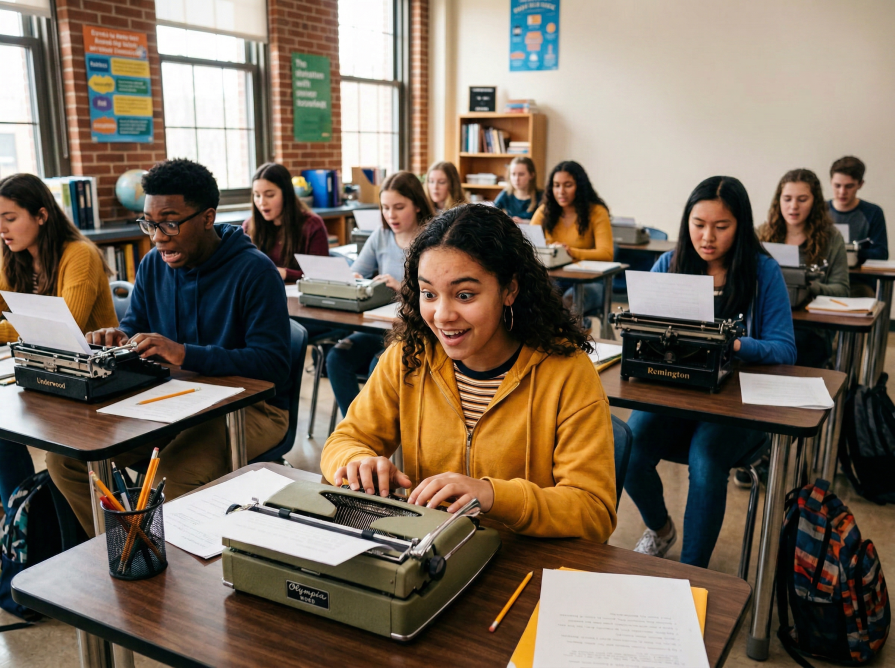
What would you do if students started submitting work written by neural networks en masse? Would you ban the technology? Tighten checks? At Cornell University, a teacher took a far more unexpected approach — and literally took her students back to the past without AI progress!
German language teacher Grit Matthias Phelps faced a problem familiar to many teachers these days: it has become difficult to understand where the student's work is and where the result of the neural network is. At one point, the texts of her wards began to look perfect: error-free, logically structured, but too "correct" to be alive and human.
The main question Phelps asked the students was, "Would you be able to write this yourself without a computer?" Without waiting for a definite answer, she decided to conduct an unconventional experiment: she bought old typewriters and put them in the classroom. Now, once a semester, her students write essays without laptops, without a network, and without AI bots-just their knowledge, thoughts, paper, and a mechanical keyboard.
For many young students, this technique has become a real cultural shock. One of the freshmen admitted that she had previously seen typewriters exclusively in films and did not understand how to use them at all. She and the rest of the guys had to learn from scratch: how to insert a piece of paper, how to move a carriage, what to do after the characteristic "tink" at the end of a line... And yes — do not forget that the machine does not have any "delete" or auto-check buttons!
The point of the Phelps experiment is not nostalgia and following the fashion for a vintage lifestyle: the main goal is to regain control of the students' real knowledge and understand what they are capable of without the help of technology. Of course, no one will bring back mass-produced typewriters in the classroom. But the approach itself is important in the current AI realities: if it is impossible to completely exclude neural networks from the lives of students, it is necessary to create formats where they will show the most real knowledge.
Perhaps, a more correct topical question sounds like this: not "how to ban neural networks," but how to teach new generations so that without them there would also be something to show.