
 For partners
 Higher education in Netherlands for international students
- The main advantages of studying at Dutch universities
- Bachelor's degree in the Netherlands
- Master's Degree in the Netherlands
- Doctoral studies in the Netherlands
- Higher education in the Netherlands for foreign students — tuition fees
- University admission requirements in the Netherlands for Foreign Students
- Literature and references
This content was developed and approved with active participation of Sam Jones, who is a Director of the International School of Bremen
In the process of preparing the material, we referenced the following sources:
- https://www.topuniversities.com/
- https://en.wikipedia.org/wiki/Academic_ranks_in_the_Netherlands
-
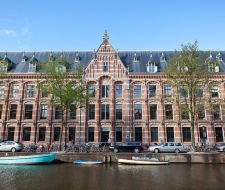 #15 in the Europe and #55 in the world
NetherlandsAmsterdamCurrently watching: 9from 10900 € / terms
#15 in the Europe and #55 in the world
NetherlandsAmsterdamCurrently watching: 9from 10900 € / terms -
 INTERNSHIPS AT NIKE, GOOGLE AND MICROSOFT
NetherlandsAmsterdamCurrently watching: 6from 7845 € / semesters
INTERNSHIPS AT NIKE, GOOGLE AND MICROSOFT
NetherlandsAmsterdamCurrently watching: 6from 7845 € / semesters -
 is in the Top 10 Countries to Study Abroad 2023
NetherlandsHagueCurrently watching: 5from 9405 € / terms
is in the Top 10 Countries to Study Abroad 2023
NetherlandsHagueCurrently watching: 5from 9405 € / terms -
 #4 in the Netherlands, #72 Worldwide
NetherlandsRotterdamCurrently watching: 5from 9300.00 € / year
#4 in the Netherlands, #72 Worldwide
NetherlandsRotterdamCurrently watching: 5from 9300.00 € / year -
 ranked 21st in the Netherlands
NetherlandsHagueCurrently watching: 3from 8634.00 € / year
ranked 21st in the Netherlands
NetherlandsHagueCurrently watching: 3from 8634.00 € / year -
 from 9250.00 € / year
 -
 ranking is #39 in the Best Global Universities list
NetherlandsAmsterdamCurrently watching: 5from 12500.00 € / year
ranking is #39 in the Best Global Universities list
NetherlandsAmsterdamCurrently watching: 5from 12500.00 € / year -
 Programs are accredited by NVAO and FIBAA
NetherlandsApeldoornCurrently watching: 6from 6200 € / terms
Programs are accredited by NVAO and FIBAA
NetherlandsApeldoornCurrently watching: 6from 6200 € / terms -
 from 8796.00 € / year
 -
 #34 In the Netherlands
NetherlandsGroningenCurrently watching: 2from 7900.00 € / year
#34 In the Netherlands
NetherlandsGroningenCurrently watching: 2from 7900.00 € / year
The Netherlands was the first country to introduce English—language courses in higher education institutions, although English was not the official language here. The first such programs appeared at local universities in 1950, and it was this event that marked a new stage in the development of education in Europe. Today, the country's universities offer a huge list of different specialties and directions: more than 1,500 study options in English, another option is to study in the official language, Every year, more and more applicants are interested in the Dutch direction, which is actively developing and improving taking into account modern trends.
Higher education in the Netherlands and academic degrees can be obtained by foreign students in two types of educational institutions: universities of applied sciences and research. Goals of universities in the Netherlands: offer bachelor's and master's degree programs, transfer knowledge for the benefit of society, to promote the development of those professions that education is aimed at, to pay attention to the personal development of students and to instill in them a sense of social responsibility, to improve the communication skills of Dutch students in the official language.
Alternative destinations
The main advantages of studying at Dutch universities
There are 3 main types of higher education institutions in the country: public, "legal entities providing higher education" and private. Individual universities that prepare future researchers include universities of applied sciences and research. Let's take a closer look at each of the types of universities.
Government agencies
- Two ministries are responsible for their financial condition: education, culture and science + economy, agriculture and innovation.
- It is possible to receive education in such universities both on a budgetary basis and for a fee.
- The cost of academic programs is set at the government level.
- Students can get bachelor's and master's degrees at state universities.
- All academic courses are accredited.
- There are a total of 50 universities in the Netherlands: 36 are professional institutions, 14 are universities.
Legal entities providing higher education
- Such educational institutions operate according to the rules of the unified Law on Higher Education and Scientific Research.
- Their financial support does not depend on ministries, but they have full freedom of choice in determining the amount of registration fees and admission rules for applicants.
- Applicants must submit to the university one of three documents that confirm the availability of school education: HAVO, MBO, VWO.
- Students can obtain scholarships and grants that will cover the cost of their education or living abroad.
- After graduation, students will have one of two degrees: Bachelor's or Master's degree.
- Educational programs of legal entities are subject to mandatory accreditation.
Private universities
- These may be branches of foreign universities and business schools.
- Independent institutions operate outside the Law on Higher Education and Scientific Research, they cannot be influenced by the requirements of the Dutch government.
- Students at private universities can take courses to obtain a bachelor's or master's degree.
- The academic performance of students is assessed by university staff using the ECTS credit system.
Research universities in the Netherlands
- These are higher education institutions that prepare specialized specialists in areas such as engineering and agriculture.
- There are 13 such universities in the country, and perhaps the most famous example is the Open University.
- The courses focus on narrow-profile disciplines.
- Students are prepared for their future careers in an interdisciplinary approach that combines theory and practice in different subjects, so the requirements here are quite strict.
- Most of the programs are offered in English.
- To get a bachelor's degree, a student must have completed at least three years of study, and industrial practice is not included in this period.
Universities of applied Sciences in the Netherlands
- These universities can be both general and narrow, where academic emphasis is placed on individual subjects.
- At an applied university, you can master a profession from such fields as theater, art, pedagogy, and agriculture.
- University courses in such institutions are professional education programs that lead students to higher education.
- All university programs are practice-oriented, so that after completing their studies, young professionals can immediately go to work.

What firstly should be considered when choosing a university?
It depends on the student - everyone determines the most important criteria for himself. I would advise you to take several rankings and compare them with each other, plus take into account the cost of the course, the location of the university and its scale, the percentage of graduates' employment. See where graduates continue their studies or where they go to work.
Bachelor's degree in the Netherlands
The bachelor's degree program mainly prepares students in academic disciplines: students obtain skills and special knowledge, analytical abilities.
Universities in the Netherlands have two types of bachelor's degrees: major and minor (similar to the US system). Narrow courses are aimed at a specific subject area. The broad Bachelor's degree is interdisciplinary (contains elements from several directions of study): Students choose the main subject (major) and a number of additional disciplines (minors). There are no special rules governing the system. Some educational institutions offer both broad and narrow bachelor's degree courses, but more and more people are choosing a broad option.
The research-oriented Bachelor's degree program requires 180 credits (three years), after which graduates receive a Bachelor of Arts, Sciences or Law (BA/BSc/LLB) degree in the Netherlands. In most cases, a bachelor's degree in Applied Arts and sciences requires 240 credits (four years).
A Bachelor's degree in the Netherlands is a highly qualified specialist who can work in international companies or move on to the next educational level — a master's degree.
Master's Degree in the Netherlands
Universities in the Netherlands offer master's degree courses to foreign students, which are academic in nature, lasting 1-2 years. Students are usually eligible for annual financial support.
A research-oriented master's degree program requires 60, 90, or 120 credits (one, one and a half, or two years). 120 credits are always required in engineering, agriculture, mathematics and natural sciences. Graduates receive a Master of Arts, Master of Science, or Master of Laws (MA/MSc/LLM) degree. A Master's degree awarded in applied arts and sciences requires completion of 60-120 credits.
Some Master's degree programs have a heavy academic load:
- Teacher preparation (usually 60-120 credits)
- Medicine (180 credits)
- Pharmacy (180 credits)
- Veterinary Medicine (180 credits)
- Philosophy of a particular discipline (120 credits)
- Some courses in engineering and agricultural sciences (with the title of "Engineer", 120 credits)
- Dentistry (180 credits).
Doctoral studies in the Netherlands
A doctoral degree is the highest academic qualification that can be obtained. The awarded title is doctor. The third cycle of higher education, leading to a PhD or a Professional Doctorate in Engineering (PDEng), is offered only by research universities.
To obtain a doctoral degree, a candidate must conduct doctoral research in an academic discipline and write a scientific dissertation. Most doctoral students conduct their doctoral research as university staff. They are usually appointed for a period of 4 years.
Higher education in the Netherlands for foreign students — tuition fees
University admission requirements in the Netherlands for Foreign Students
To access research-oriented bachelor's degree programs, students must have a VWO diploma (Dutch School Diploma sample) or complete the first year (60 credits) of a bachelor's degree program at the University of Applied Sciences. For the latter category of students, additional selection criteria may be applied — entrance tests, language exams, and tests. International students can also enroll in special pre-university preparation courses at their chosen educational institution or college.
The minimum requirement for admission to universities of applied sciences is a VWO diploma, a HAVO diploma, or an MBO diploma, subject to certain conditions. The VWO diploma not only grants access to universities of applied sciences in the Netherlands, but students can receive an exemption from one year of study based on this diploma. To access both types of higher education, students with a VWO or HAVO diploma must complete at least one of the subject blocks that meet the requirements of the relevant higher education program.
A quota — or numerus fixus — is used to access certain programs, primarily in the field of medical sciences. For Numerus Fixus programs, educational institutions are allowed to select the students they accept based on academic performance, personal motivation, essays, and portfolios of achievements.
Potential students over the age of 21 who do not possess one of the qualifications mentioned above can qualify for access to higher education based on an entrance exam and recognition of previous studies. To access certain programs, especially in the visual arts, students must demonstrate artistic ability.
Access to all Master's degree programs requires a bachelor's degree in one or more specific disciplines, in some cases combined with other requirements. Graduates with a bachelor's degree in applied arts and sciences usually have to complete additional requirements to enroll in a research-oriented master's degree program.
General statistics on education in the Netherlands-ratings, specializations, universities
Learning programs-summary information
| Name | Meaning | Equivalent | Min. age | Duration, years |
Next stage | Cost |
|---|---|---|---|---|---|---|
| GCSE | General certificate of secondary education | secondary education (non-accomplished) | 14 | 1–2 | A-Levels | 15,000 USD+ |
| A-Levels | Advanced level | secondary education (accomplished) | 16 | 2 | University | 15,000 USD+ |
| BTEC | Business and Technology Education Board | secondary special education | 14 | 2–3 | University/ work | 15,000 USD+ |
| Oxbridge Preparation | Preparing for Oxford and Cambridge | secondary education (accomplished) | 17 | 1 | University | 15,000 USD+ |
| International Baccalaureate | International baccalaureate | secondary education (accomplished) | 16 | 2 | University | 18,000 USD+ |
| Foundation/ Pathway Year | Preparatory year | admission to the 1st year of university | 17 | 1 | University | 14,000 USD+ |
| NCUK | The Northern consortium | 2 year university | 17,5 | 1 | 2 year University of NCUK | 13,000 USD+ |
| Special Preparation (Medics/Math/Business) | Specialized training | - | 14 | optional | optional | 4,000 USD+ |
| Academic English | Academic English | Language school | 8 + | 6–12 months | School or University | 8,000 USD+ |
Top 14 best universities in Switzerland 2026
| 1 | Glion Institute of Higher Education Switzerland |
| 2 | Les Roches International School Montana |
| 3 | César Ritz Colleges Switzerland |
| 4 | IHTTI School of Hotel Management |
| 5 | Ecole Hoteliere de Lausanne |
| 6 | Geneva Business School |
| 7 | HIM Hotel Institute Montreux |
| 8 | Swiss Hotel Management School |
| 9 | Webster University Geneva |
| 10 | Business and Hotel Management School |
| 11 | Luzern IMI |
| 12 | Swiss Hotel Management School (SHMS) Caux |
| 13 | International University in Geneva |
| 14 | Culinary Arts Academy Switzerland |
