
The Netherlands has remained one of the most attractive destinations for international education for many years. English-language programs, prestigious universities, a comfortable living environment, and good career prospects have made the country popular among students from all over the world.
However, recent statistics show that the period of rapid growth appears to have come to an end: in the 2025/26 academic year, the number of international students at Dutch universities and universities of applied sciences (HBO) declined slightly for the first time in a long time. The decrease was minimal — just 133 people, or 0.1%, but experts believe that the significance lies not in the number itself, but in what it may indicate about the beginning of a new phase for the country's higher education system.
The number of new foreign students in bachelor's programs has dropped by nearly 4%, marking the third consecutive year of declining interest in undergraduate programs in the Netherlands. Meanwhile, master's programs show the opposite trend: the number of new foreign students has grown at both research universities and HBO institutions.
However, part of this growth is explained by the fact that many foreign nationals already studying in the country are simply moving from bachelor's to master's programs. When such transitions are excluded, the picture looks less optimistic. Experts suggest that the total number of foreign students in the country may continue to gradually decline in the coming years.
One of the most widely discussed trends has been the sharp drop in the number of applicants from China: the number of new Chinese students fell by 28% over the year, and for the first time since 2006, China has dropped out of the top five largest sources of foreign students for the Netherlands. The reasons behind this trend extend well beyond Dutch educational policy. Chinese universities are becoming increasingly competitive on a global scale, occupying high positions in international rankings and offering students quality educational opportunities within the country. Similar shifts are now being observed in other European countries that have traditionally attracted large numbers of students from China.
Against the backdrop of declining interest from some non-European markets, the Netherlands is once again becoming more popular among students from Europe: after several years of decline, the number of applicants from Italy, Romania, Spain, and Poland has grown. Germany remains the leading source of foreign students, though there too a downward trend in new enrollments persists. Despite the overall decline in students from countries outside Europe, India remains one of the fastest-growing markets: the total number of Indian students increased by 3.5%, while the number of new master's students rose by as much as 16.5%. Notably, Turkey has already overtaken India in student numbers and has become the second largest source of students from countries outside the European Economic Area! Both countries are currently very close to each other on these indicators.
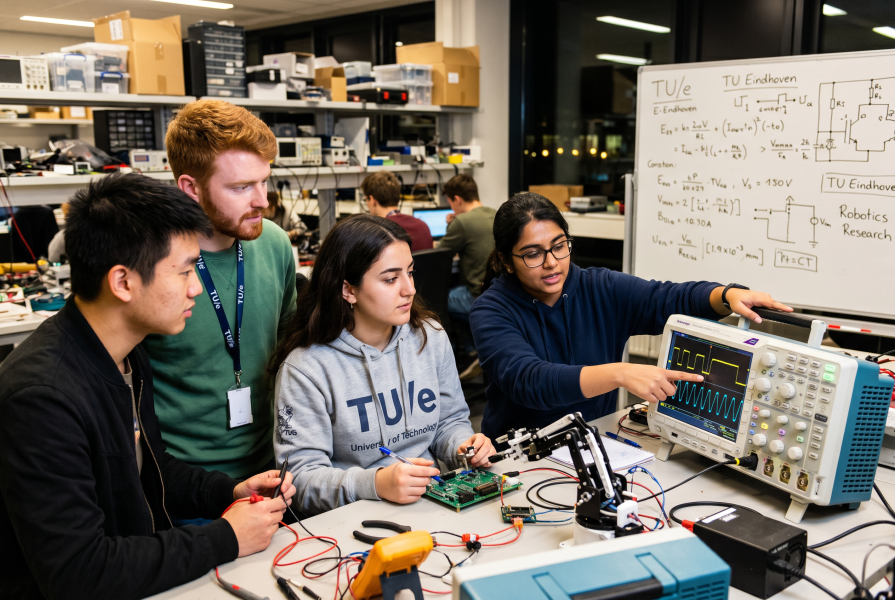
Even within the country, the situation is developing differently across regions. In Amsterdam, the number of foreign students declined for the first time — by 1.7%: for a city that has long been considered the main international education hub of the Netherlands, this is a rather unusual situation. At the same time, Eindhoven is showing impressive growth: the number of foreign students there has increased by 13%+ (largely due to high demand for engineering programs and the growing popularity of Eindhoven University of Technology).
Another important trend of recent years is the shift in students' own interests. The number of foreign students in engineering programs has grown by 11%, and engineering now ranks second in popularity among all fields of study, behind only economics. This reflects a labor market demand: many countries continue to experience high demand for engineers and specialists in technology and technical sciences.
In recent years, the country's authorities have actively debated the question of balancing internationalization with universities' capacity to accommodate a growing number of foreign students. As part of reforms, the government sought to slow the growth of international enrollment and strengthen the role of the Dutch language in the education system. Some of the more controversial restrictions were subsequently softened or lifted, but universities themselves have also begun to take a more considered approach to enrollment and aim to maintain a sustainable student community rather than pursue growth at any cost. University representatives emphasize that the country still needs qualified international specialists, particularly in fields where there is a shortage of personnel.