In the USA, schools are increasingly adopting artificial intelligence: from chatbots to full-fledged learning platforms. But against the backdrop of this trend, one major educational and economic player is still holding back — New York. While districts like Broward County in Florida are implementing Microsoft Copilot, and in Miami 100 000+ students are already using Google Gemini, the country's largest education system in New York is only preparing to make a decision. However, it could affect the future of more than a million students, so the caution is justified.
AI Education in New York: What's Happening Now?
Across America, schools are actively experimenting with AI: some give students access to ChatGPT, others are implementing specialized tools. For example, in Maryland they use an AI platform for graphic design, and universities like Duke and California State are giving students unlimited access to chatbots.
At the same time, New York itself still lacks a unified strategy — after the initial ban on ChatGPT in schools, the city has not moved toward large-scale implementation. Currently, authorities are only discussing what the next step should be. City Hall is deciding right now: integrate AI into education or take a pause. Pressure is coming from both sides:
- On one hand — technology companies that see New York as a huge market,
- On the other — parents and some experts who fear hasty decisions.

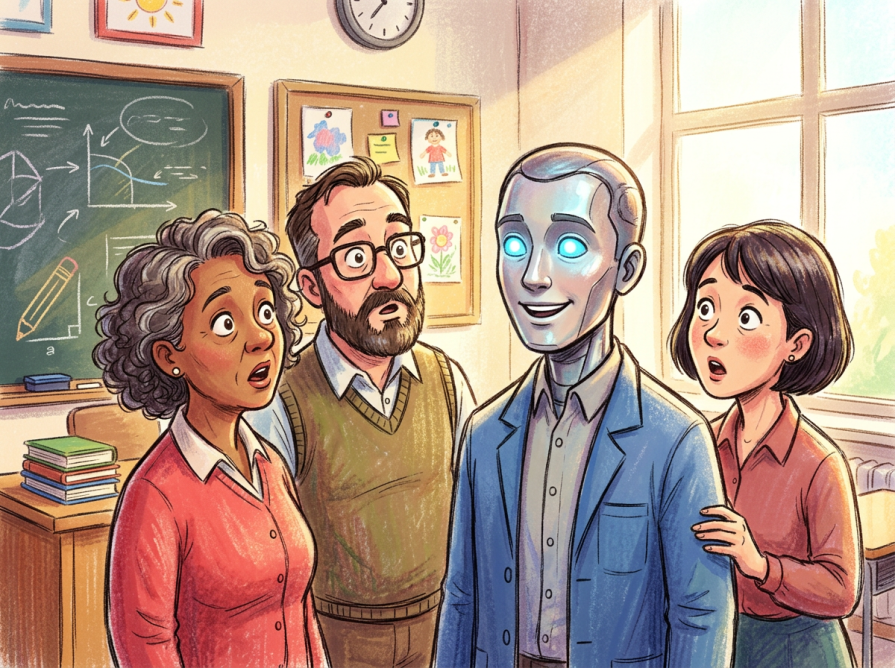
There are already proposals to introduce a two-year moratorium on the use of generative AI in schools, especially for younger grades. The main concern of parents and industry representatives is the lack of clear rules: without them, there is a risk of wasting large budgets or even harming the educational process. But even technology advocates point to an important limitation: AI can help, but not replace the teacher.
However, despite the lack of a common policy, individual New York schools are still testing artificial intelligence in the learning process. Some classrooms use tools like Mojo — it helps analyze student responses and shows typical mistakes; in elementary school they use Amira — a system that listens to children read and suggests where they are making errors. There are also more sophisticated solutions. For example, the Urban Assembly school network has developed a tool that analyzes lesson recordings and provides teachers with feedback, while the Counselor GPT platform helps students navigate their future careers.
Others' Mistakes — A Reason to Reflect
Parents' concerns are growing against the backdrop of failed examples. For instance, in Los Angeles a school district launched a chatbot called Ed, but the project quickly failed: the startup shut down, and its founder was accused of fraud. Such stories show that implementing AI without a clear strategy can lead to serious problems. That is why experts increasingly say that the issue is no longer about teaching the system to code. AI can write code on its own; what matters much more is understanding how technologies work and how to use them consciously. This means schools will have to rethink their approach to education and place emphasis on digital literacy and critical thinking.
What Comes Next?
Unlike Chicago, which already has detailed guidelines on using artificial intelligence in schools, New York still faces uncertainty. Teachers, students, and parents do not fully understand what is allowed and what is not. In the near future, city authorities promise to present a plan, but it is already clear: the question is not whether AI will come to schools, but how exactly it will happen and how carefully. Progress can only be resisted up to a certain point.