
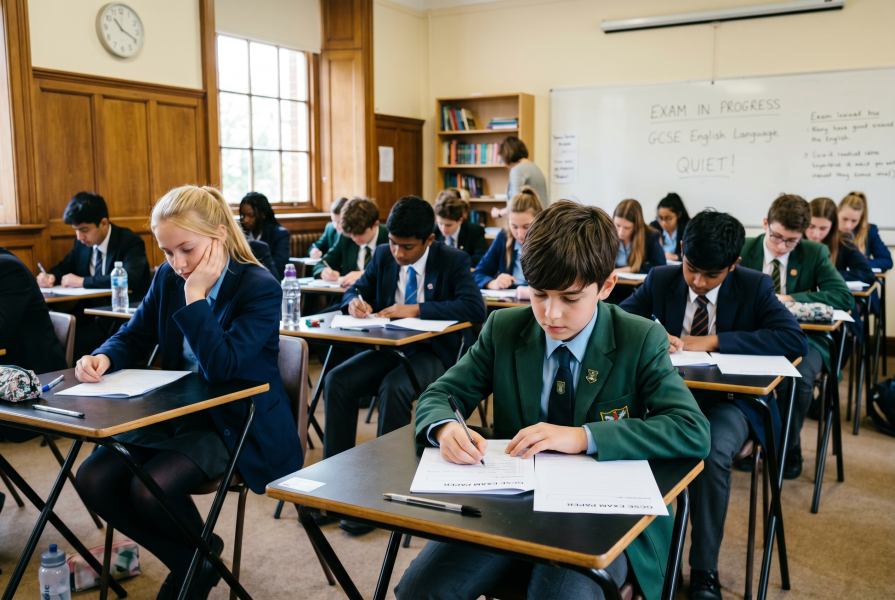
The 2025 GCSE exam season is kind of a big moment for thousands of students all over the UK. After years of preparing, this summer sort of wraps up secondary education, and then it opens the door to new chances. Below is most of what you need to know, including the main key dates, what results day will feel like, and what you can do afterwards.
Key Dates for GCSE Exam Season 2025
The Exam Period
So first, the GCSE exam window for 2025 runs officially from Monday May 5 to Friday June 20. A few sources say the exams might stretch a bit further, to June 24 or 25, but really the central chunk is still May and June. This schedule covers the big exam boards, AQA, Edexcel, OCR, and WJEC, all in the same general timeframe.
For the key subjects here are the main dates you should note down in your calendar, try not to leave this part until later.
English Language:
-
CCEA: Unit 1 - May 7, Unit 4 - May 20
-
AQA, Edexcel, OCR, Eduqas: Paper 1 - May 23, Paper 2 - June 6
English Literature:
-
AQA, Edexcel, OCR: Paper 1 - May 12, Paper 2 - May 20
Mathematics:
-
AQA: Paper 1 (Non-Calculator) - May 15, Paper 2 (Calculator) - June 4, Paper 3 (Calculator) - June 11
-
Edexcel: Similar pattern with Paper 2 on June 4 and Paper 3 on June 11
Sciences:
-
Biology: May 13 (across all major boards)
-
Chemistry: May 19
-
Physics: May 22
-
Further papers continue through June

It is essential to check your specific exam board's timetable, as dates can vary and may be subject to change.
Results Day
GCSE results day 2025 is Thursday, August 21.
Schools receive results on Wednesday, August 20, but students can typically collect their results from 8am on Thursday morning. Your school will provide specific instructions on collection times and procedures.
For students in Scotland, SQA Nationals results day is Tuesday, August 5.
Understanding Your GCSE Results
The 9-1 Grading System
In England, GCSEs are graded on a 9-1 scale, with 9 being the highest achievable score. The system works as follows:
-
Grade 9: Exceeds the old A* standard
-
Grades 7-8: Equivalent to the old A-A* range
-
Grade 6: Equivalent to a high B
-
Grade 5: A "strong pass" (the government benchmark)
-
Grade 4: A "standard pass" (equivalent to the old C grade)
-
Grades 3-1: Equivalent to old D-G grades
-
U: Unclassified (no grade awarded)
Many post-16 courses and sixth forms require at least a grade 4 in English and Maths, with some asking for grade 5 or higher.
Overall Performance in 2025

For 2025, the national results look fairly steady next to the last few years. Across the UK, 21.9% of entries landed at grade 7 / A or higher, versus 21.8% in 2024. The pass level at grade 4 / C and up was 67.4% , which is just a bit lower than 67.6% last year.
Regional differences are still there, with London continuing to sit at the top: 28.4% of students in London achieved grade 7 or above, while in the North East it’s 17.8%. And yeah, those gaps have grown quite a lot since 2019.
There are also gender gaps, but they narrowed slightly in 2025. 24.5% of female pupils achieved the highest grades, compared with 19.4% of males. That means the gap shrank from 5.7 percentage points in 2024, to 5.1 points this time.
What Comes Next: Post-GCSE Options
Your GCSE results open various pathways depending on your grades and aspirations. By law, you must stay in education or training until you are 18, but this can take different forms.
Full-Time Education
This is the most common route after GCSEs.
A-Levels are academic qualifications you study in sixth form or college, usually over a couple of years. Most courses want you to have at least five GCSEs at grade 4 or above. That includes English and Maths, obviously. Some subjects also have their own entry requirements, and for instance a lot of A-Level options ask for certain GCSE grades in the same subject area.
Vocational Qualifications : BTECs, Cambridge Technicals, and T-Levels tend to lean more toward practical and career-focused learning. T-Levels are two-year technical qualifications, and they often come with an industry placement component as well.
New Developments - V Levels: Starting in 2027, the government is rolling out V Levels as a new Level 3 qualification. It’s set up so that one V Level is equivalent to one A Level. The idea is to combine vocational and academic teaching, so students can mix and match subjects. The first ones being offered will be Digital, Education and Early Years, and Finance and Accounting.
Apprenticeships
Apprenticeships let you make money while you learn, kind of combining doing the job with study. You usually apply straight to employers and you get qualifications as well as serious hands on experience, in areas like engineering, IT, business, or even healthcare.

Work or Volunteering with Training
You can also work or volunteer for at least 20 hours a week while you’re studying part time. That can look like evening courses, traineeships, or other preparation programs, depending on what fits.
Special Educational Needs Support
If you have special educational needs or a disability, (SEND) there’s extra backing available. Local authorities, like Surrey, share Next Steps Guides, and they help you work out the post 16 options. The guides are clear about qualification levels, and entry requirements too, and they are shaped around the individual needs.
What If Things Don't Go to Plan?
Considering a Remark or Appeal
If you think a grade is way below what you expected, you should talk with your school about a review of the marking. Schools have to apply to the exam boards for students, and there are strict deadlines for when the requests need to be sent in.
Also, grades can rise, fall, or sometimes stay exactly the same after appeals. It’s worth looking into it if you genuinely think something went wrong, but it’s also good to be ready for different results.
Retakes
If you don’t reach at least a grade 4 in English or Maths, UK rules say you must keep studying those subjects until you pass. In most cases you can retake English and Maths in November 2025, while other subjects can be retaken in the summer of 2026.
Your school or college will guide you through the retake process. A lot of sixth forms let you carry on with other studies while you’re retaking the ones you didn’t pass, but only if you’re prepared for the extra workload, and you can actually manage it.

Special Consideration
If something truly extraordinary messed up your exam performance, like an illness, bereavement or some other serious situation, you might qualify for special consideration. In most cases this needs teacher support and some kind of evidence, and it also needs to be organized quickly after the exams finish.
Alternative Pathways
If your first college or sixth form application doesn’t go through, try not to panic. Have a chat with the colleges anyway, ask about alternative options. They might run almost the same course but with slightly different entry requirements. You can also look at other institutions, maybe ones that include more hands on vocational choices or different criteria for starting.
Keep Things in Perspective
GCSEs are a major milestone, but they are only one step in a longer journey. Lots of people who do well later on didn’t get perfect grades at 16. What really matters is learning from it, staying proactive, and exploring all the solid routes that can still get you to your aims.
Whatever your results end up being, give yourself a moment to process it, talk it through with trusted people, and then keep moving with a clear plan. Honestly, your options are broader than you might assume, and with the right support you can shape a successful future no matter where you started.