Acadia University










Programs and prices, tuition fees in Acadia University


Specify information on the training program on the official site of an educational institution.
Specify information on the training program on the official site of an educational institution.
Description of Acadia University
Acadia University (abbreviated as AU ) is an educational institution of the state type that has been active in scientific and academic activities in Canada since the beginning of the distant 1838.
- Location: Wolfville, Nova Scotia, Canada,
- Year of foundation: 1838,
- Language of instruction: English,
- Levels of study: bachelor's, master's, pre-university courses.
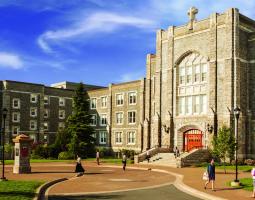
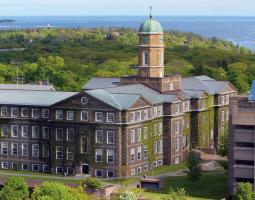
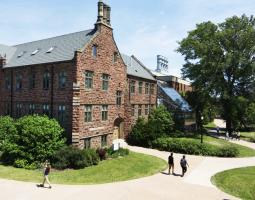
Acadia University — a Canadian university founded in 1838. The campus is located in the scenic Annapolis Valley, on the traditional lands of the Mi'kmaq people. The university places emphasis on applied liberal arts and real-world experiential learning, helping students develop critical thinking and global problem-solving skills.
Educational process
At Acadia University, the standard full course load is five courses per semester. Each course involves three classroom hours per week, totaling 15 credit hours.
Before course registration, students are assisted by Academic Advisors who guide course selection each academic year. Some programs (such as the School of Music) include weekly individual lessons with instructors. The program features a research track: high-achieving students may prepare an Honours thesis.
The university emphasizes practice-oriented learning: after the first year, students may hold paid positions as teaching assistants, tutors, or research assistants, gaining professional experience while still studying.
Faculties and colleges
Acadia University offers more than 200 program and specialization options across four faculties:
- Faculty of Arts (Arts),
- Faculty of Pure and Applied Sciences (Pure and Applied Science),
- Faculty of Professional Studies (Professional Studies),
- Faculty of Theology (Theology).
The university structure includes specialized schools and departments, among which are School of Music, School of Education, School of Kinesiology and School of Counselling. Available fields of study include: history, music, business administration, kinesiology, biology, chemistry, applied biology, applied sciences (engineering), computer science, environmental sciences, psychology, nutritiology, community development, gender studies, applied geomatics, and others.
Additionally, pre-university non-credit courses in chemistry (CHEM 0110) and mathematics (MATH 0110) are offered, which can be taken online at a convenient pace to prepare for university-level study.
Scientific achievements
Acadia University consistently ranks among the best undergraduate-focused universities in Canada, placing third in the country among primarily undergraduate institutions.
The university maintains active research work. The position of Provost and Vice-President Academic is held by Ashley Cunsolo — a globally recognized researcher, former Canada Research Chair holder, and Fellow of the Royal Society of Canada, whose work focuses on climate change and health. She has also co-authored chapters of the Intergovernmental Panel on Climate Change (IPCC) report.
Things to know about
- The university's authority is established by the Act of Incorporation, approved by the province of Nova Scotia back in 1891.
- The university welcomes guests and students in several languages, including a greeting in the language of the Mi'kmaq people — «Pjila'si».
- For students from the USA, tuition is cheaper than at comparable American universities, with the classic four-year bachelor's degree format.
Accommodation, meals, prices
Accommodation. First-year students at Acadia University are guaranteed a place in a student residence. Several residences are located on campus:
- Chase Court,
- Chipman House,
- Dennis House,
- Eaton House,
- Crowell Tower,
- Seminary House,
- 55 University Ave,
- War Memorial House,
- Whitman House,
- Christofor Hall,
- Roy Jodrey Hall.
Different room types are available — single rooms (including enhanced and suite-style), double rooms, as well as enhanced and premium options. Rooms and buildings are not mixed: male and female students are housed separately. Residences operate in accordance with academic semesters; summer accommodation is also available.
Dining. All students living on campus are required to purchase a meal plan. The main dining hall is Wheelock Dining Hall. During the summer period, the dining hall does not operate, and residents cook for themselves in the shared kitchens of the residences.
Advantages
This is a higher education institution in Canada, which is among the best in the country. Also, the university is famous all over the world, as it consistently defends its right to take a place among the TOP-5 percent of the best universities in the world.
Facilities and equipment at Acadia University
We are talking about a small Academy, where about 4000 people take a course each year. The academic staff of AU is about 300 teachers of the highest category. Academy students can, if they wish, take part in one of the available student exchange programs.
Infrastructure Acadia University
The university infrastructure includes a large library. In addition, the university provides students with affordable housing in a hostel. There are on the campus and convenient sports facilities. In addition, the university itself is famous for its membership in such reputable groups and associations as the Canadian University Society for Intercollegiate Debate (CUSID), the Association of Universities and Colleges of Canada (AUCC), as well as Canadian University Press (CUP) and Canadian Bureau for International Education (CBIE).
Admission dates and extra charges
The academic year is traditionally divided into two semesters — fall and winter, with an additional summer semester (intersession). Course registration takes place in the spring (for first-year students — from June, after accepting the offer of admission).
Additional fees and deposits:
- Registration fee upon application,
- One-time residence application fee,
- Non-refundable room reservation deposit,
- Deposit to confirm enrollment (enrolment/confirmation deposit),
- Mandatory meal plan for students living on campus.
Perspectives
The applied approach and wide range of disciplines help Acadia University graduates build careers in a variety of fields.
For example, graduates of history programs find themselves in law, journalism and research, education, archival and museum work, public policy, marketing and communications, business and management, publishing, and the non-profit sector. Graduates of music programs work as arts managers, composers, conductors, music educators and therapists, performers, producers, and creative project directors.
Honours programs prepare students for graduate school admission and research careers.
Entry requirements, how to apply, what is required to enrol
Every year the admission of freshmen to the university is conducted by a special selection committee, which in its decision relies on several criteria. First of all, we are talking about the results of exams passed by all applicants, as well as their past academic performance. According to statistics, about 70 percent of applications of applicants are approved. Both locals and visitors from different countries always apply for places at the university. In any case, when planning to enter a university, all information should be clarified in advance through the official website of the institution (website address https://www.acadiau.ca), as well as through pages on social networks: Linkedin, Facebook, Twitter, Youtube, Flickr, where You can learn more about the university.
Tuition fees at Acadia University
Each academic year at the university is traditionally divided into two semesters. Training is conducted on a fee basis. But each student can count on financial support in the form of a scholarship subject to good academic performance. For each semester, future graduates pay about $ 7,500. To obtain a diploma of this Canadian Academy, students can choose a full-time or distance learning system.
Scholarships Acadia University
The university offers entrance scholarships for applicants. Upon enrollment, eligible candidates automatically receive an initial entrance scholarship offer.
- To be considered for an entrance scholarship, the application must be submitted by March 1,
- the entrance scholarship decision is typically communicated by mid-April,
- additional scholarships are awarded by mid-March.
Institution on the map
Residence permits, citizenship and other services
- Guardianship services during the studies
- Student supervision
Review about Acadia University
Recommendations on when to apply
| Language courses, schools and children's language camps | Primary and secondary education - private schools | Preparation programmes for entering universities - higher education | Higher education (after completing accredited programs A-level, IB, High School) - Bachelor, Master, MBA |
| - we recommend to apply 6-9 months before the start of the course (some camps and schools offer discounts for early booking or for lengthy study programs) - there are some very popular and high demand children's camps, where the applications need to be submitted 1 year in advance (in particular Switzerland , Great Britain , USA , Canada , Austria) | - we recommend to apply one year before the start of the training program, - some schools have a specific time frame (September-November - please specify an individual school) - some schools require tests in several stages (UKISET, internal tests of the school: English, mathematics, logics, subjects, interview, some require a personal visit) | - we recommend to apply one year before the start of the program, - for Foundation and Pathway programs, IELTS and TOEFL certificates are usually required, respectively | - recommended submission one year before the start of the program, - the deadline normally closes in January, for TOP HEIs and, as a rule, in March in other universities - for a bachelor, a Foundation or Pathway preparatory program a completed A-level, IB, High School + IELTS / TOEFL are required - for Masters you need a graduated higher education, in some cases you need a pre-Masters program - MBA requires completed higher education, work experience preferably at least 2-3 years, etc. |