For partners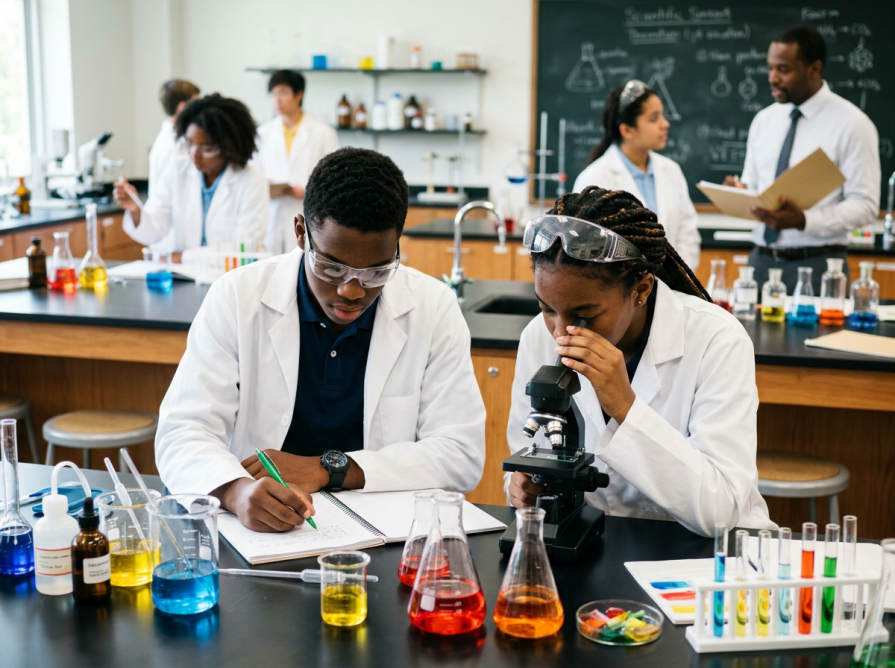
Scientists require more than scientific knowledge because the world now faces both technological progress and international problems and excessive flow of information. The ability to think critically enables students and professionals in science to assess and assess knowledge while they learn to apply what they know.
Scientific research requires critical thinking because it demands understanding the complete process which leads to correct answers while exploring other possible solutions. Educational institutions develop advanced problem-solving capacities in their students through their development of critical thinking abilities which enables students to solve contemporary global issues.


What Is Critical Thinking in Science?
Critical thinking in science involves:
-
Asking meaningful and precise questions.
-
Evaluating evidence objectively.
-
Distinguishing facts from assumptions.
-
Identifying biases and limitations.
-
Drawing logical conclusions based on data.
-
Remaining open to revising ideas when new evidence appears.
Science itself is built on skepticism and inquiry. From Galileo challenging established beliefs to modern researchers testing new hypotheses, progress depends on the ability to question and investigate systematically.
Why Critical Thinking Matters in Scientific Education
Moving Beyond Memorization
Students who want to succeed in traditional educational systems must learn to memorize formulas and definitions and procedural methods. Scientists acquire true scientific knowledge by applying their basic knowledge to novel situations which they encounter.
Students who think critically can:

-
Use data to create their own understanding.
-
Create their own experiments instead of following preexisting procedures.
-
Demonstrate their ability to link theoretical knowledge with practical situations.
Active reasoning proves to be an effective educational method which allows students to develop their own knowledge instead of passively receiving information.
Solving Real-World Problems
The most urgent worldwide issues of climate change and pandemics and energy sustainability and artificial intelligence ethics need solutions which extend beyond standard educational content. The solution requires multiple fields of study combined with precise examination of complex systems.
Critical thinkers in science can:
-
Evaluate competing hypotheses.
-
Weigh risks and benefits.
-
Make evidence-based decisions under uncertainty.
Such skills are essential not only for researchers but also for policymakers, engineers, healthcare professionals, and entrepreneurs.
Combating Misinformation
The current digital environment allows quick dissemination of false information. Scientific literacy combined with critical thinking enables individuals to:
-
Assess the credibility of sources.
-
Interpret statistics responsibly.
-
Recognize flawed reasoning.
-
Avoid confirmation bias.
By teaching students how to question evidence rather than accept information blindly, science education becomes a powerful defense against misinformation.

How to Develop Critical Thinking in Science Classrooms
Inquiry-Based Learning
When students develop their own inquiries and create research projects, it leads to deeper learning. Teachers should present open-ended problems to students instead of giving them detailed instructions for completing their tasks.
Data Analysis and Interpretation
Students need to develop three skills which include raw data analysis and pattern identification and conclusion drawing. Through their experience with actual datasets students learn about two concepts which are uncertainty and variability and the critical need for precise measurement.
Discussion and Debate
Scientific development depends on ongoing scientific discussions. Structured classroom discussions enable students to present their reasoning while they assess existing beliefs and develop their arguments through dialogue.
Reflection and Metacognition
The process of students explaining their thinking methods leads to better development of their analytical abilities. The practice of reflection helps students to discover their mistakes and develop methods which are essential for progress in scientific research.
The Role of Technology
Critical thinking skills can be improved through the effective use of modern tools which include simulations, artificial intelligence, and virtual laboratories. They enable students to conduct hypothesis testing and create models of complex systems while they investigate situations which cannot be simulated in standard classroom environments.

The purpose of technology exists to assist reasoning processes instead of becoming a substitute for them. The purpose of digital tools exists to help students investigate further rather than to provide them with an easy way to complete their work.
Critical Thinking and Future Careers
Employers consistently rank problem-solving and analytical skills among the most desirable competencies. Graduates trained to think critically are better prepared for careers in:
-
Scientific research
-
Engineering and technology
-
Medicine and healthcare
-
Environmental science
-
Data analytics
-
Policy and governance
More importantly, they are prepared for lifelong learning — adapting to new discoveries and evolving industries.
Challenges in Teaching Critical Thinking
Developing critical thinking skills needs both time and effort while some educational systems require a complete cultural transformation. The main challenges of the system include:
-
Overloaded curricula focused on standardized testing.
-
Limited opportunities for hands-on experimentation.
-
Fear of making mistakes in high-stakes academic environments.
The institutions need to establish inquiry and creative work and independent reasoning as their main educational goals to achieve educational success.
Conclusion
Critical thinking is the backbone of science. It transforms knowledge into understanding and curiosity into discovery. By embedding critical thinking into scientific education, schools and universities cultivate smarter problem-solvers — individuals capable of addressing complex global issues with clarity, logic, and creativity.
In a world increasingly shaped by science and technology, the greatest skill students can develop is not simply knowing the answers — but knowing how to question them.