
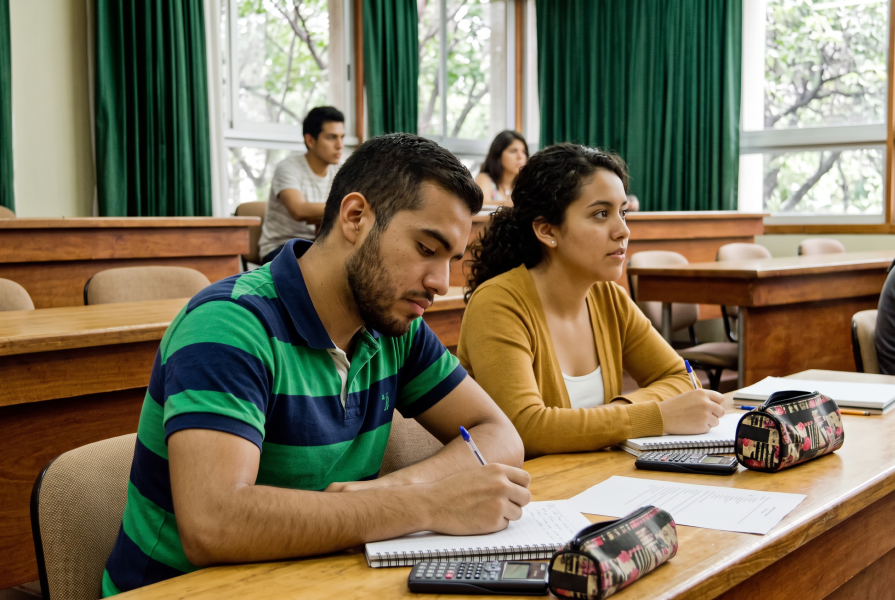
The National Autonomous University of Mexico (UNAM) held its entrance exam remotely for the first time in its history — and immediately annulled the results, requiring 58,000 applicants to retake the same exam in person.
The reason: abnormally high scores.
- In 2021–2025, only 3.5% of students (on average) scored 100 or more points (out of a maximum of 120) — in 2026, that figure turned out to be 16%.
- 5.5% of applicants scored 110 or more, whereas previously that share had never exceeded 0.9%.
- In the medical track, nearly 30% of test-takers scored 100 or more — compared with 9% the year before.
The results of 2% of applicants were annulled almost immediately: they were caught either impersonating someone else or using AI during the exam.
To allow enough time to recheck all applicants, the university's start of the academic year was pushed back to August 31.
The retake sparked protests
Clearly, applicants were unhappy with the decision, especially since many had taken the exam honestly and earned their high scores fairly. Hundreds of young people took to the streets of Mexico City, blocking several major thoroughfares in the south of the city in a protest march.
The scandal even acquired political resonance: Mexican President Claudia Sheinbaum stated that if crimes are identified, the prosecutor's office may become involved in the investigation. The university, for its part, has already filed a complaint with law enforcement, demanding that those who sold exam materials and distributed instructions for circumventing proctoring be held accountable.
Reasons for the failure
The university had worked hard to make the exam objective and fair: it established a proctoring procedure with webcams, face and voice recognition, and behavioral monitoring during the entire exam. However, a leak of exam materials had already been discovered (questions from the actual test appeared online in May–June), and schemes for bypassing remote monitoring were found circulating on social media…
At the same time, the concept of a remote exam is important and useful: it gives applicants from remote regions and small towns the opportunity to take the exam. In 2026, according to UNAM, nearly 160,000 people competed for 21,962 subsidized places.
The problem is global in nature: even sophisticated proctoring systems cannot guarantee protection against exam leaks, the use of AI, and other means of circumventing controls. For instance, in India, the results of 2.28 million applicants were annulled following a leak of materials from the medical school entrance exam. A balance must be found between exam accessibility and the reliability of assessment procedures — and it must be found as soon as possible. For universities, this is no longer just a technological problem but a reputational one: a single large-scale failure can call into question the results of an entire admissions cycle.