George Washington University (GWU)





Programs and prices, tuition fees in George Washington University (GWU)


Information on the program can be found on the official website of the school.
Information on the program can be found on the official website of the school.
Description of George Washington University (GWU)
- Undergraduate students: nearly 11,000,
- Graduate students: more than 15,000.
- Traditional undergraduate study: more than 75 on-campus majors at the Foggy Bottom and Mount Vernon campuses,
- Pre-college study: on-campus and online courses in arts, business, history, STEM, and other fields,
- Summer study: credit-bearing courses, summer institutes, and short-term study abroad opportunities.
GW also offers separate programs through the School of Nursing, School of Medicine and Health Sciences, and College of Professional Studies for students continuing or completing a professional degree or pursuing a second professional bachelor’s degree. Nonresidential programs may be hybrid, online, or based at a GW campus in Virginia.
Educational process
A full-time undergraduate course load ranges from 12 to 18 credits per semester. Undergraduates can choose from more than 15,000 internship and research opportunities at leading global organizations.
GW’s partnership with NASA creates research opportunities for students and faculty at Goddard Space Flight Center.
Faculties and colleges
The university’s academic structure comprises 10 schools and colleges. Together, they offer over 100 undergraduate options and more than 230 certificate, master’s, and doctoral programs.
Scientific achievements
The university has more than 35 cross-disciplinary research institutes. Projects receive support from the National Institutes of Health, the National Science Foundation, the Department of Defense, and other federal agencies.
Things to know about
- Students come from 140 countries.
Accommodation, meals, prices
During their first two years, students live in one of 26 residence halls on the Foggy Bottom and Mount Vernon campuses. Housing choices can reflect cost, amenities, location, and roommate preferences. Options include shared and single rooms, studios, suites, and apartment-style rooms with kitchens.
The dining plan can be used at more than 80 dining and grocery locations on or near the campuses. Vegan, vegetarian, and gluten-free options are widely available. Students can visit restaurants around the city, eat at an all-you-care-to-eat campus dining hall, or cook for themselves.
Subjects, specialties
Activities George Washington University (GWU)
GW has more than 450 clubs and student organizations in leadership, politics, arts and culture, athletics, and service.
Advantages
- 76% of undergraduates complete an internship or participate in research,
- the student-to-faculty ratio is 13:1,
- 71% of classes have 30 or fewer students,
- more than 150 study abroad programs are available in 60 countries.
Facilities and equipment at George Washington University (GWU)
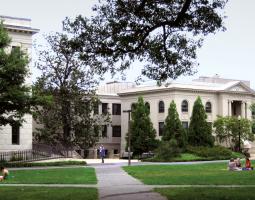
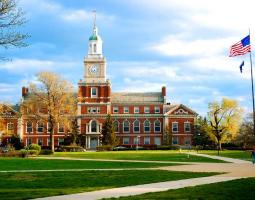
- Foggy Bottom Campus is next to the Foggy Bottom/GWU Metro station and a few blocks from the White House, U.S. State Department, National Mall, and research centers,
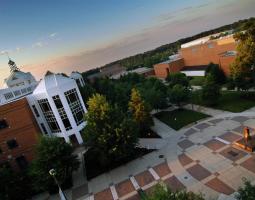
- Mount Vernon Campus spans 25 acres and includes athletic and recreation facilities, sustainability initiatives, and performing arts venues,
- Virginia Science and Technology Campus has facilities for STEM-H programs in health sciences, big data and analytics, and high-performance computing,
- new buildings and major renovation projects meet current accessibility standards, while university shuttles meet ADA accessibility and safe transportation requirements,
- GW Police Department patrols Foggy Bottom and Mount Vernon and oversees security at Virginia Science and Technology Campus.
Admission dates and extra charges
The monthly payment plan follows separate schedules for the fall, spring, and summer terms: August through November for fall, December through March for spring, and April through July for summer. Payments are due on the tenth day of each month.
- nonrefundable application fee: 80 US dollars,
- nonrefundable advance deposit for each entering or readmitted full-time undergraduate student: 800 US dollars,
- nonrefundable matriculation fee for each entering full-time undergraduate student: 350 US dollars,
- nonrefundable student government association fee: 3 US dollars per credit, up to 45 US dollars per semester,
- nonrefundable international student fee for students on F-1 or J-1 visas entering in or after 2016-17: 60 US dollars each fall and spring semester,
- nonrefundable off-campus or online registration fee: 35 US dollars,
- additional course fees, such as laboratory or material fees,
- nonrefundable activity fee for undergraduate students living in university housing: 50 US dollars each fall and spring semester.
Enrolment process
Prospective graduate students can attend in-person and online events to learn about GW, its graduate programs, graduate life, and ways to finance their education.
Perspectives
Within six months of graduation, 94% of graduates are employed or continuing their education. The early-career median salary for graduates with 0–5 years of experience is 78,000 US dollars.
Entry requirements, how to apply, what is required to enrol
Applicants to traditional undergraduate programs generally are not required to submit standardized test scores, except in certain situations. Applicants who choose to submit scores will have them considered with the rest of their application materials.
Institution on the map
Residence permits, citizenship and other services
- Guardianship services during the studies
- Student supervision
Review about George Washington University (GWU)
Recommendations on when to apply
| Language courses, schools and children's language camps | Primary and secondary education - private schools | Preparation programmes for entering universities - higher education | Higher education (after completing accredited programs A-level, IB, High School) - Bachelor, Master, MBA |
| - we recommend to apply 6-9 months before the start of the course (some camps and schools offer discounts for early booking or for lengthy study programs) - there are some very popular and high demand children's camps, where the applications need to be submitted 1 year in advance (in particular Switzerland , Great Britain , USA , Canada , Austria) | - we recommend to apply one year before the start of the training program, - some schools have a specific time frame (September-November - please specify an individual school) - some schools require tests in several stages (UKISET, internal tests of the school: English, mathematics, logics, subjects, interview, some require a personal visit) | - we recommend to apply one year before the start of the program, - for Foundation and Pathway programs, IELTS and TOEFL certificates are usually required, respectively | - recommended submission one year before the start of the program, - the deadline normally closes in January, for TOP HEIs and, as a rule, in March in other universities - for a bachelor, a Foundation or Pathway preparatory program a completed A-level, IB, High School + IELTS / TOEFL are required - for Masters you need a graduated higher education, in some cases you need a pre-Masters program - MBA requires completed higher education, work experience preferably at least 2-3 years, etc. |