
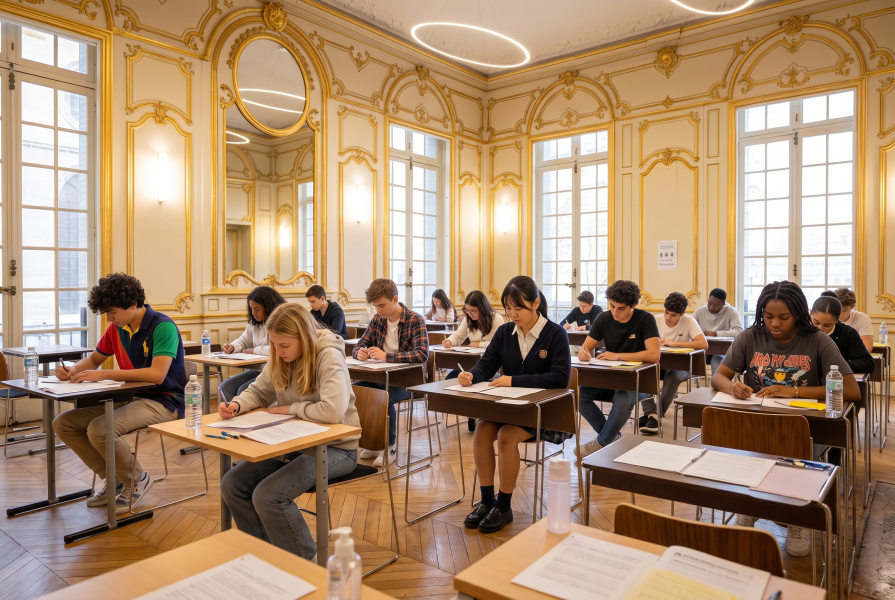
French schoolchildren are taking their Baccalaureate final exams under conditions that are becoming increasingly difficult — not only due to exam nerves. The country is preparing for a new wave of intense heat: in some regions temperatures may rise to 40°C, and schools are once again facing the question of how prepared they are for extreme weather conditions.
The problem is particularly noticeable during the examination period, which traditionally takes place in May and June. In late May, France already experienced an unusually early heat wave, when many students had to take exams in overheated classrooms without adequate ventilation, shade, or access to drinking water. The situation prompted the French Ministry of National Education to consider changing the organization of exams. Education Minister Édouard Geffray proposed moving exams in the future to cooler times of day — to the morning, when temperatures have not yet reached their maximum values. In an interview with France Inter radio, he noted that holding exams during the hottest hours of the day is becoming impossible. In his view, the optimal time for exams could be the period from 8:00 to 12:00 instead of the traditional daytime hours; in addition, he proposed airing out rooms before exams begin.
The current heat wave has not yet led to mass school closures, but such situations have already occurred: last summer, when temperatures in some parts of France exceeded 40°C, around 1,900 schools were forced to temporarily shut down.
France is not the only country where adapting the education system to climate change is being discussed. In the United Kingdom, the Climate Change Committee has previously proposed considering moving GCSE and A-level exams to cooler months: experts note that high temperatures in classrooms can negatively affect students' concentration and performance.
In its latest report, the CCC warned that the UK's infrastructure was built for a climate that no longer exists. According to forecasts, by 2050 temperatures in the country could regularly exceed 40°C (!), and the committee recommended gradually equipping buildings with cooling systems, including schools.
Experts draw attention not only to daytime heat, but also to so-called «tropical nights», when temperatures do not drop below 20°C: such conditions can worsen the quality of sleep for teenagers and reduce their ability to prepare for exams effectively. Research confirms the link between heat and academic performance. For example, a study by researchers from Harvard showed that rising temperatures are associated with a decline in school performance, and a later study focused on regions of Spain also found a deterioration in mathematics and science results when classroom temperatures exceeded 26.7°C.
In France, the heat continues to spread across the country, with temperatures in southern regions already reaching 37°C. According to Météo-Franc forecasts, high temperatures will cover most of the country in the coming days: many regions can expect between 32°C and 36°C. Cooler weather will only remain in coastal areas of the English Channel. The cause of the abnormal heat is an air mass that arrived from North Africa via Spain.