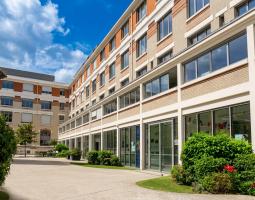
Collège de France


Programs and prices, tuition fees in Collège de France


Specify information on the training program on the official site of an educational institution.
Specify information on the training program on the official site of an educational institution.
Description of Collège de France
- Name: Collège de France,
- Location: Paris, France (main building in the capital),
- Year of foundation: 1530,
- Scientific activity: ongoing since 1530,
- Type of institution: public institution of higher education and research.
- Location: Paris, France,
- Year of foundation: 1530.
Collège de France is a higher education institution that is on the TOP 60 list of the best of the best French universities. Also, the university from year to year takes its place of honor in the list of TOP-60 popular French universities.
Collège de France is a public institution combining higher education and scientific research. It has the legal status of an établissement public à caractère scientifique culturel et professionnel, a public institution of a scientific, cultural and professional nature. It was founded in 1530, when François I appointed the first royal lecturers to teach disciplines that the university had not yet accepted.
Teaching focuses on emerging knowledge in literature, science, and the arts. Collège de France does not issue diplomas. Classes are linked to research, and its chairs address the following disciplines:
- Mathematics,
- Civilization studies,
- Physics,
- Chemistry,
- Biology,
- Medicine,
- Philosophy,
- Literature,
- Social sciences,
- Economics,
- Prehistory,
- Archaeology,
- History.
Educational process
Professors at Collège de France have complete freedom in their teaching. Most lectures take place in Paris, but professors may conduct some sessions in other major French cities and abroad. Each year, more than 50 foreign scholars are invited to give lecture series.
Attendance depends on available seating: seats cannot be reserved and are allocated on a first-come, first-served basis. The vast majority of lectures are recorded in full. Free recordings become available a few days later, including as podcasts.
Doctoral students at schools with an agreement with Collège de France may earn academic credit through regular attendance. Lectures, seminars, conferences, symposia, and thematic study days may count toward doctoral education. Each doctoral school validates credits under its own rules. Doctoral students and researchers receive a monthly newsletter about scientific events and available resources.
The Software Science course traces the development of formal approaches from a programmer's intuition to their mechanization. The Campus de l’innovation project organizes lectures and discussions in economics and social sciences and in life and Earth sciences across France and its overseas territories. These take place in high schools or at Collège de France, with topics aligned with school curricula. Sessions in life and Earth sciences are recorded in full on video. Recordings of previous sessions and text and video materials help teachers and students prepare for the lectures.
Materials in economics and social sciences for the three upper secondary school grades were developed by a group of 16 authors jointly led by professors Philippe Aghion and Pierre-Michel Menger and general inspectors Marc Montoussé and Marc Pelletier. The materials address basic concepts and methods of reasoning in economics, sociology, and political science. The economics component begins with microeconomics, then moves on to macroeconomics and modern international economics. Each chapter is supplemented with exercises and videos.
The PAUSE program helps participating researchers and artists integrate into professional life.
Faculties and colleges
The eight institutes at Collège de France bring together research chairs and laboratories. A professor appointed to a statutory chair may hold it for the rest of their career. A small number of thematic annual chairs welcome a new professor each year. The institution has no doctoral school of its own.
| Discipline | Number of chairs |
|---|---|
| Mathematics and computer sciences | 6 |
| Physics and chemistry | 8 |
| Earth and space sciences | 2 |
| Life sciences | 11 |
| History and archeology | 12 |
| Letters, arts, language, philosophy | 5 |
| Social sciences | 7 |
The Software Science course addresses formal semantics, program logic, deductive systems, program equivalences, and process calculi. The course in Soft Matter and Biophysics explores the quantitative description of biological systems, from cells to tissues, using soft matter and active matter theory.
The “Europe” lecture series focuses on rural Europe in 2026–2028. It offers four lectures by Olivier De Schutter on food sovereignty and the agroecological transition. They examine the emergence of food sovereignty in international law and its influence on reform of the European Union's Common Agricultural Policy in the context of the European Green Deal.
The “Migrations and Societies” seminar is for high school students and is closed to the general public. It is organized by the Avenir Commun Durable Chair and the Campus de l’innovation pour les lycées project.
Since 2026, the chairs have been held by Marc Fleurbaey in Sustainable Common Future, Olivier Borraz in Public Health, Tâm Mignot in Biodiversity and Ecosystems, Claire Denis in Movies, Olivier Hermine in Experimental medicine, and Lydéric Bocquet in Fluids and Energy.
- The annual Cinema Chair was established in partnership with France's National Center for Cinema and the Moving Image,
- The Computer Sciences and Digital Technologies Annual Chair was established in partnership with the research institute Inria,
- The Invention of Europe through languages and cultures Annual Chair was established in partnership with the French Ministry of Culture.
Course topics from previous years
| Chair | Academic year | Course topic |
|---|---|---|
| Software Science | 2021–2022 | Software Security: What Role Do Programming Languages Play? |
| Software Science | 2020–2021 | Program Logic: When Machines Reason About Their Software |
| Software Science | 2019–2020 | Mechanized Semantics: When Machines Reason About Their Own Languages |
| Software Science | 2018–2019 | Does Programming Equate to Demonstration? The Curry–Howard Correspondence Today |
| Chinese intellectual history | 2020–2021 and 2021–2022 | Is China (still) a civilization? |
| Chinese intellectual history | 2015–2016 – 2018–2019 | Universality, globality, cosmopolitanism (China, Japan, India) |
| Chinese intellectual history | 2014–2015 | Humanism and ritualism in ancient and contemporary China |
| Chinese intellectual history | 2013–2014 | Is Confucianism a humanism? |
| Chinese intellectual history | 2012–2013 | Confucius resurrected? A few hypotheses |
| Chinese intellectual history | 2008–2009 – 2011–2012 | Confucius revisited: old texts, new speeches |
| Soft Matter and Biophysics | 2021–2022 | Single-Cell Movement |
| Soft Matter and Biophysics | 2020–2021 | Tissue Mechanics and Growth |
| Soft Matter and Biophysics | 2019–2020 | Physics of Biological Tissues |
| Soft Matter and Biophysics | 2018–2019 | Active Ingredient |
Scientific achievements
Collège de France conducts fundamental research in partnership with CNRS, France's national center for scientific research, Inserm, France's national institute for health and medical research, and other scientific and cultural institutions. It hosts 13 joint research laboratories, either in full or in part, and several dozen teams working on short-term projects. Specialized laboratories and institutes bring researchers and young teams together for medium-term programs. The laboratories welcome doctoral and postdoctoral researchers from around the world.
Specialized colloquia and an interdisciplinary symposium on a major social issue take place each year. The Publishing Department releases around 20 new titles annually in print and digital formats. Its publications include the full texts of opening lectures, proceedings of colloquia, and lecture series.
The Directorate of Libraries, Archives and Collections leads projects in digitization, exhibitions, research tool modernization, and open science. Its partners include France's National Archives, the National Library of France, the National Library of Taiwan, the Louvre Museum, and the town of Montgeron. The Colligere research blog showcases the institution's collections and supports research into its holdings.
- Research at the Software Science Chair is conducted by Cambium, a team established jointly with Inria. Its work focuses on deductive program verification, type systems, type inference algorithms, and shared-memory parallelism. The team develops OCaml, a statically typed functional programming language and its implementation, and CompCert, a formally verified compiler for critical embedded software. In 2021, CompCert received the ACM Software System Award,
- The chair in Chinese intellectual history examines ancient materials and their reinterpretation in contemporary China and the wider world. It publishes bilingual editions of classical Chinese texts, digital research publications, proceedings of international colloquia, and books,
- The Soft Matter and Biophysics Chair uses soft matter physics and active matter theory to describe the physical properties of living systems. Research topics include active turbulence, orientation defects in cell monolayers, tumor tissue growth, cell motility, cilia beating, and factors that determine cell and nuclear volume.
Since 2022, the institution has presented the Collège de France Award annually to a young researcher for an outstanding scientific career and innovative contributions to public-sector research. The recipient is invited to deliver a public lecture and receives a bronze medal. The award alternates each year between mathematics, computer science, physics, and the natural sciences on the one hand, and the humanities and social sciences on the other.
The annual scientific awards were presented on November 4, 2026. The 2026 recipients included:
- Christophe Botella, a researcher in statistical ecology: the Collège de France Award for Young Researchers,
- Amanda Hirschi: the Peccot-Vimont Prize,
- Edwige Cyffers and Amanda Hirschi: the Claude-Antoine Peccot Lecture Series and Award,
- Sigolène Meilhac, Research Director at Inserm: the Antoine Lacassagne Award,
- Céline Borde, a microbiologist: the Delheim Award,
- Giada Di Giuseppe, a philologist: the Anna Caroppo Scholarship – Collège de France Foundation Fellowship,
- Adrien Zirah, a Hellenist, and Karla Negrete, a chemist: the Hugot Foundation Award for Young Researchers.
Raphaël Beuzart-Plessis was the recipient of the Peccot lectureship for 2016–2017.
The Agir pour l'éducation initiative is supported by the Collège de France Foundation and its patrons. The Biodiversity and Ecosystems Annual Chair is supported by the Jean-François de Clermont-Tonnerre Foundation, while the Avenir Commun Durable Annual Chair is supported by the Collège de France Foundation. Its major sponsors include Covéa.
Things to know about
- The motto of Collège de France is “teaches all things”,
- The focus of its chairs can change as science develops,
- New professors are elected by an assembly of all those currently in office. Candidates do not need a university degree: the importance and originality of their work are assessed,
- Since 1901, the institution's yearbook has published annual summaries of each professor's teaching,
- Europe's first chair devoted to Chinese studies was established here in 1814. Jacques Gernet held the Chair in the Social and Intellectual History of China from 1975 to 1992, and Pierre-Étienne Will held the Chair in the History of Modern China from 1991 to 2014. The Chair in Chinese Intellectual History was created in 2008 at Will's suggestion,
- Claude Bernard established experimental medicine as a science at Collège de France. Jacques Monod held the Molecular Biology Chair from 1967 to 1973,
- The annual Technological Innovation Liliane Bettencourt Chair was established in 2006 jointly with the Fondation Bettencourt Schueller,
- The Campus de l'innovation pour les lycées project was initiated in 2016 by Philippe Aghion, holder of the Economics of Institutions, Innovation and Growth chair,
- The national PAUSE program has supported researchers and artists in exile since 2017. It is run by Collège de France with support from the French Ministries of Higher Education and Research, the Interior, Europe and Foreign Affairs, and Culture. The institution's Administrator chairs the program's Executive Committee. Collège de France hosts the program and manages its administration and budget,
- The appointment of Jean-François Joanny as President of the Fondation du Collège de France was announced in December 2023,
- In 2024–2025, Franck Courchamp held the Biodiversity and Ecosystems Chair, and François-Marie Bréon held the Avenir Commun Durable Chair,
- In 2025–2026, Sandra Lavorel held the Biodiversity and Ecosystems Chair, Maria Melchior held the Public Health Chair, and Claude Grison held the Sustainable Common Future Chair,
- The Delheim Award was established through a bequest made to Collège de France by Mrs. Delheim in 1956,
- The Hugot Foundation of Collège de France was established in 1979 through a bequest from Hélène and Jean-Pierre Hugot,
- The Antoine Lacassagne Award was established in 1977 to support young French and foreign researchers in biology,
- An annual prize for young mathematicians in honor of Claude-Antoine Peccot has been awarded since 1885 through an endowment from his family.
Activities Collège de France
Collège de France offers free guided tours for professional groups, primary and secondary school groups, and higher education students accompanied by their lecturer. These visits require booking. Individual visitors can join tours led by a professional tour guide and organized in partnership with Grand Palais Rmn.
One component of the Campus de l’innovation project is a national competition in economics and social sciences for students in the penultimate year of a French lycée.
Advantages
- Collège de France is an associate member of PSL University.
Facilities and equipment at Collège de France
The main Marcelin-Berthelot Site has public lecture halls and classrooms, the heritage library, a museum collection, the Research Services and Online Resources Department, and the Archives Department. The Cardinal Lemoine site, home to the Institute of Civilizations, and the Ulm site are reserved for research.
The library and documentation network consists of 12 specialized libraries, an archives department, interlibrary loans, bibliometric services, and online resources. The humanities and social sciences libraries at the Institute of Civilizations are grouped into four clusters near the chairs and research teams. They are open to researchers and students at the master's level and above.
The institution has a rare book collection and specialized libraries for professors, its own researchers, and outside specialists. The heritage library and archive services are open to the general public, including lecture visitors. The collections hold scientific instruments and works of art. Tens of thousands of hours of audiovisual archives are freely available.
Security checks take place before public lectures. When attendance is high, visitors may be directed to a broadcast room. The entire visitor route and all temporary exhibitions are accessible to people with reduced mobility.
Admission dates and extra charges
The annual lecture program begins in October with an interdisciplinary colloquium. During the academic year, the institution is open Monday through Friday from 9:00 a.m. to 7:00 p.m., except on public holidays.
The Marcelin-Berthelot Site is open to visitors on weekdays from 9:00 a.m. to 6:00 p.m. It is closed on Saturdays, Sundays, public holidays, and during the spring and Christmas school holidays in Zone C.
The “Migrations and Societies” seminar is scheduled for November 18, 2026, from 14:00 to 16:00 in the Maurice-Halbwachs Amphitheater at the Marcelin-Berthelot Site.
Entry requirements, how to apply, what is required to enrol
Public lectures are open to everyone: enrollment, advance registration, and confirmation of qualifications are not required to attend.
Scholarships Collège de France
Financial support at Collège de France consists of awards, research fellowships, and funding for scientific and educational initiatives.
- The Peccot lectureship is awarded annually to mathematicians under 30 who have distinguished themselves in their discipline,
- The Antoine Lacassagne Award recognizes the research of young biologists and supports their scientific careers,
- The Delheim Award supports young biologists continuing their work in Collège de France laboratories on major challenges facing humanity,
- The Anna Caroppo fellowship offers talented young female researchers the opportunity to continue their research-based preparation for one year within the institution's humanities teams,
- The Hugot Foundation Award recognizes two young researchers who collaborate with Collège de France chairs,
- Candidates for the Collège de France Award for young researchers must have defended their dissertation within the past seven years and work at a public research laboratory in France.
The PAUSE program provides incentive funding for higher education, research, and cultural institutions in France to host scientists and artists in exile.
Institution on the map
Residence permits, citizenship and other services
- Guardianship services during the studies
- Student supervision
Review about Collège de France
Recommendations on when to apply
| Language courses, schools and children's language camps | Primary and secondary education - private schools | Preparation programmes for entering universities - higher education | Higher education (after completing accredited programs A-level, IB, High School) - Bachelor, Master, MBA |
| - we recommend to apply 6-9 months before the start of the course (some camps and schools offer discounts for early booking or for lengthy study programs) - there are some very popular and high demand children's camps, where the applications need to be submitted 1 year in advance (in particular Switzerland , Great Britain , USA , Canada , Austria) | - we recommend to apply one year before the start of the training program, - some schools have a specific time frame (September-November - please specify an individual school) - some schools require tests in several stages (UKISET, internal tests of the school: English, mathematics, logics, subjects, interview, some require a personal visit) | - we recommend to apply one year before the start of the program, - for Foundation and Pathway programs, IELTS and TOEFL certificates are usually required, respectively | - recommended submission one year before the start of the program, - the deadline normally closes in January, for TOP HEIs and, as a rule, in March in other universities - for a bachelor, a Foundation or Pathway preparatory program a completed A-level, IB, High School + IELTS / TOEFL are required - for Masters you need a graduated higher education, in some cases you need a pre-Masters program - MBA requires completed higher education, work experience preferably at least 2-3 years, etc. |