For partners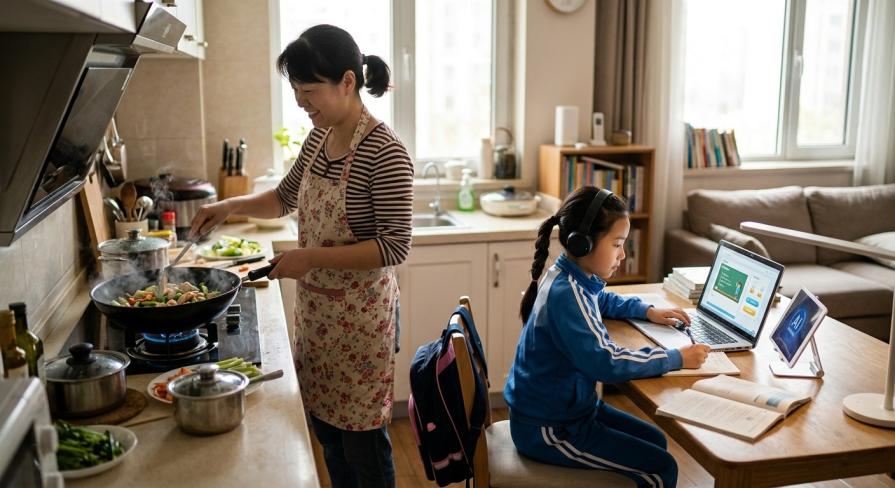
Artificial intelligence has become an integral part of our lives in recent years. Everyone finds their own use for it, and one of the most popular functions is delegating routine tasks. For example, schoolchildren's homework, and it's not only the children and teenagers themselves who do this, but also their parents.
The Chinese education system is known for its fierce competition and increased level of difficulty, which is why many parents strive to give their children an advantage and actively use technologies such as chatbots, AI-powered gadgets, and educational platforms. Today, these tools are an important part of everyday life for families in China, despite all the concerns of experts about their impact on critical thinking and other potential risks for children.


How do parents of schoolchildren in China use new technologies? The most popular chatbot assistants
According to the results of the KPMG 2025 global study, 90%+ of Chinese people are optimistic about the use of AI in education.
For comparison: in the USA, just over 50% support this approach.
These statistics are due to the fact that many parents in China believe that neural networks can both simplify and accelerate the learning process, while Americans, on the contrary, fear that artificial intelligence may impair the cognitive abilities of children and teenagers.
The most striking example of how AI helps parents of schoolchildren in educating their children is the use of chatbots and interactive educational platforms. Adults are increasingly purchasing devices with built-in neural networks and subscribing to online courses to master modern technologies and help their children not only complete homework but also improve skills that they will need for future employment and self-fulfillment in the global world. Chinese chatbots, such as the popular Doubao by ByteDance, are equipped with cameras, so they can assist in learning, for example, by identifying plants or explaining grammar rules. In addition, Doubao allows uploading photos of completed assignments for automatic error checking and receiving feedback — thanks to this, it saves time that parents previously spent on additional lessons and tutoring.

For many parents, the use of such AI technologies in the home learning process has become a real lifesaver. According to them, parents increasingly trust this process to an AI chatbot. It explains rules in detail and can repeat information as many times as needed — unlike teachers who often move on to the next topic too quickly, and parents who are limited in time, energy (and patience) to study with their child for long periods. According to many parents, since the introduction of AI into their daily lives, children's grades have improved, as have their relationships — there is no longer a need to spend hundreds of dollars on tutors, and arguments over homework have disappeared.
How AI helps with language learning

For many Chinese parents, especially in remote regions, the problem of learning foreign languages, such as English, is particularly acute. Today, for them it is both an academic task and a way to give their children a competitive advantage in the international job market. To solve the problem, they use an AI-powered device that trains conversational practice. For example, there are already gadgets in the form of a face mask that translates Chinese speech into English using built-in technology. Such devices allow children to practice language in an interactive format, giving them more opportunities for communication than traditional textbooks.
In addition, new technologies allow Chinese parents to create personalized learning materials for their children. For example, the DeepSeek chatbot can create an interactive English language learning game purely through vibe coding.
The potential of AI in global education

Already today, artificial intelligence is leveling the playing field for parents across China: this way they can significantly reduce spending on tutors and provide their children with access to resources that were previously available only in major cities. The main advantage of Chinese AI is that it helps children not only learn but also develop skills necessary for the future, such as critical thinking and adaptability to technological changes. In the future, Chinese AI technologies may be implemented in other countries as well, and China's experience in education with neural networks is quickly becoming an example for other nations seeking to modernize their educational systems. Such cases open new horizons for international students who want to use innovative technologies to develop their language and academic skills and prepare for studying abroad. However, how safe and effective this innovative path truly is, we will only find out with the passage of time.