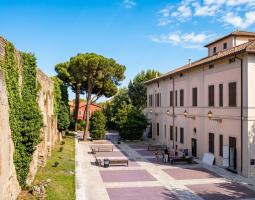
Sapienza University of Rome


Programs and prices, tuition fees in Sapienza University of Rome


Information on the program can be found on the official website of the school.
Master's Degree
- Landscape architecture
- Architecture-Urban regeneration
- Nanotechnology Engineering
- Management of enterprises
- Organization and marketing for business communication
- Sciences of development and international cooperation
- Science and Technology for the Conservation of Cultural Heritage.
Available Courses on Laurea Magistrale
- Architettura (Restauro)
- Ingegneria gestionale
- Scienze delle amministrazioni e delle politiche pubblich.
Available and popular Bachelor's Degree directions are:
- Architecture - Urban regeneration
- Artificial Intelligence and Robotics
- Atmospheric Science and Technology
- Business Management
- Chemical Engineering
- Clinical Psychosexology
- Cognitive Neuroscience
- Computer Science
- Control Engineering
- Cybersecurity
- Data Science
- Design, Multimedia and Visual Communication
- Development and International Cooperation Sciences
- Economics
- Economics and Communication for Management and Innovation
- Electrical Engineering
- Electronics Engineering
- Energy Engineering
- Engineering in Computer Science
- English and Anglo-American Studies
- European Studies
- Fashion Studies
- Finance and Insurance
- Genetics and Molecular Biology
- Health Economics
- Landscape Architecture
- Management Engineering
- Mechanical Engineering
- MSc Environmental and Sustainable Building Engineering
- Nanotechnology Engineering
- Physics
- Product and Service Design
- Science and Technology for the Conservation of Cultural Heritage
- Space and Astronautical Engineering
- Statistical Methods and Applications
- Transport Systems Engineering.
Duration of studying is 2 years.
Available and popular specialties in English are:
- Applied Computer Science and Artificial Intelligence
- BSc Sustainable Building Engineering
- Classics
- Global Humanities.
The duration of studying is 3 years.
Description of Sapienza University of Rome
- Every year, Sapienza welcomes thousands of international students and faculty members for study, research, and teaching,
- 8 bachelor's programs and 45 master's programs are taught entirely in English.
- Location: Rome,
- History: more than 720 years,
- Enrollment: more than 125,000 students.
Sapienza (L'Università degli Studi di Roma La Sapienza), or Uniroma1 for short, is an Italian public university in Rome. It is one of the oldest universities in the world: its history begins in 1303, when Pope Boniface VIII ordered the creation of the ecclesiastical educational institution Studio Urbis. His task was to train theologians and specialists for the papal administration. In 1660, Studio Urbis was moved to a new building and was named Sapienza (Latin for "wisdom"). Since 1870, the university has ceased to be a pontifical university and has been developing as a secular educational institution. In 1935, the Citta universitaria campus, which occupied 429,000 m2, was completed in the center of Rome near Termini Station, designed by architect Marcello Piacentini. This is the main campus of the university, where the main faculties and buildings are located.
Sapienza University of Rome describes itself as Europe's largest university. Its academic structure includes 58 departments, 11 faculties, a school with special status, and a school of advanced studies.
Approximately 8,000 faculty and staff members work at the university. Sapienza emphasizes expertise, innovation, knowledge sharing, and interdisciplinary work in research, with a focus on results that have a strong social impact.
Sapienza holds leading positions in all international rankings among Italian universities, and according to the QS World University Rankings, it ranks first in the world in terms of "Classical Studies" and "Ancient History", surpassing English Oxford. Sapienza is also one of the top 100 universities in the world.
Sapienza University of Rome is inextricably linked with the history of Italy. Several generations of Italians and many representatives of the country's political elite studied here. Many outstanding scientists teach at this university. In 2021, Giorgio Parisi received the Nobel Prize in Physics.
Educational process
The CIAO service provides students with general information, while student affairs offices handle administrative matters. Many procedures can be completed entirely online.
Sort centers advise students on schedules, classes, exams, and study plans. The Foundation Year includes 400 hours of classroom instruction.
Faculties and colleges
Sapienza's catalog of bachelor's and master's programs covers the following fields:
- architecture and design — 12 programs,
- economics, finance, and management — 17 programs,
- geography and territorial studies — 3 programs,
- information engineering — 24 programs,
- construction, civil, and environmental engineering — 14 programs,
- industrial engineering — 20 programs,
- literature, culture, philosophy, and history — 17 programs,
- languages, intercultural mediation, and interpreting — 7 programs,
- agri-food sciences — 4 programs,
- archaeology, art, performing arts, and fashion — 11 programs,
- biology, chemistry, earth sciences, and cultural heritage conservation technologies — 19 programs,
- biotechnology and pharmacy — 17 programs,
- education and social work — 6 programs,
- communication and publishing systems — 6 programs,
- medicine — 9 programs,
- dentistry — 3 programs,
- preventive healthcare professions — 6 programs,
- rehabilitation healthcare professions — 23 programs,
- nursing and midwifery — 39 programs,
- technical healthcare professions — 29 programs,
- psychology — 15 programs,
- physical activity — 1 program,
- legal studies — 6 programs,
- mathematics, physics, and computer science — 22 programs,
- political and social sciences — 11 programs,
- statistics — 8 programs.
Scientific achievements
- A Sapienza researcher received an MSCA Postdoctoral Fellowship for the AQUAFRAME project,
- AQUAFRAME is developing technologies that use metal-organic frameworks to extract drinking water from atmospheric moisture,
- The AQUAFRAME project received European funding through the Marie Skłodowska-Curie Actions,
- The first experimental session of the APHRODITE system on the International Space Station was completed successfully.
Things to know about
- The research component of Sapienza's third mission covers intellectual and industrial property, academic entrepreneurship, and technology transfer,
- the public service component of its third mission focuses on cultural heritage, public health, science education, and cooperation with schools and community organizations,
- the university's fourth mission focuses on inclusion, reducing inequality, and supporting diversity.
Accommodation, meals, prices
Sapienza offers free assistance with finding housing on the private market and has agreements with residences.
Students have access to canteens, cafés, snack points, and vending machines.
Activities Sapienza University of Rome
SapienzaSport's athletic facilities cover 100,000 m². Students can participate in:
- soccer,
- swimming,
- yoga and fitness,
- martial arts and archery,
- tennis, track and field, and team sports.
Cultural and community activities include:
- MuSa's classical, jazz, and ethnic orchestras and choir,
- ancient theater and acting through the Theatron project,
- opportunities to work as hosts and directors at the university's RadioSapienza,
- free participation in workshops, conferences, and arts events organized by student associations.
Advantages
- Sapienza provides annual funding for joint research and teaching by visiting international professors,
- students can study and complete internships abroad,
- the university runs 8 Piani Lauree Scientifiche and 16 orientation and mentoring programs,
- a dedicated service supports students with disabilities, learning differences, and special needs,
- Stai bene con Sapienza brings together services supporting students' physical and emotional well-being,
- the university's museums contribute to research, teaching, and public education and are open to the general public.
Facilities and equipment at Sapienza University of Rome
Among the attractions can be noted:
- Botanic Garden — Orto Botanico dell'Università di Roma "La Sapienza",
- SantIVO alla Sapienza is a Catholic church in Rome, built in 1642-660 by architect Francesco Borromini,
- The monastery of San Pietro in Vincoli (part of the engineering school),
- Villa Mirafiori: a neo–Renaissance palace built in the 19th century. Some rooms are decorated with beautiful frescoes. The Faculty of Literature and Philosophy is located in this building.
Enrolment process
The admission process for international applicants depends on their citizenship, whether they need a study visa, and whether they live in Italy. Applications to programs taught entirely in English undergo a preliminary online assessment. This online selection is also required for 9 master's programs with Italian-language curricula.
Perspectives
After successfully completing the Foundation Year, international students can apply to Sapienza's bachelor's or single-cycle degree programs. Applicants from outside the EU do not need to take a separate Italian language exam in this case.
Entry requirements, how to apply, what is required to enrol
Foundation Year requirements:
- applicants must hold a secondary school diploma obtained abroad after 11 years of schooling,
- applicants who have completed 12 years of schooling may also apply to strengthen their academic or language preparation,
- applicants must have English proficiency at level B2 or equivalent, but no previous knowledge of Italian is required,
- students must attend at least 75% of classroom sessions.
Requirements for Bachelor's degree applicants
- 12-year completed education.
Requirements for applicants to the Master 's degree
- Bachelor's degree.
All documents must be translated, apostilled and legalized with a consular certificate Dichiarazione di valore in loco.
Language requirements for studying in Italian:
Level B2 and above for studying in English: IELTS, TOEFL, Cambridge B2, TOEIC certificate (exact requirements depend on the program).
If the applicant does not have a certificate at the time of application, he can take the Italian exam at the university (usually held in September, but the exact dates need to be clarified).
Applicants to medical courses take the IMAT test. For closed- and open-access programs, a TOLC exam may be required.
Deadlines for submission and acceptance of applications
Applications are generally accepted from December, and Italian courses are available from June to July. Before applying, you must register on the university's portal.
Scholarships Sapienza University of Rome
Sapienza offers tuition reductions and exemptions to support families and reward merit. Student scholarships are managed by the regional agency Disco Lazio.
The internal scholarship of the university is 4300 €, which are paid in two installments per year.
Requirements:
- SAT Certificate
- foreign citizenship (scholarship not for Italian citizens)
- 15 years of education (of which at least 3 are at the university)
- age up to 26 years.
Regional scholarship of the organization Discolazio = 5200€ per year.
Requirement: provision of documents on the financial condition of the student and / or his family.
Students with ISEE less than €24,000 are exempt from university taxes, as are Discolazio scholarship holders. If iseE from 24 001 to 40 000 €, then taxes are reduced.
Literature and references
-
Sapienza University of Rome — Wiki

-
Sapienza University of Rome : Rankings, Fees & Courses — QS
-
Sapienza University Rome in Italy — U.S. News & World Report
-
Sapienza University of Rome — Times Higher Education
-
Sapienza University of Rome Ranking 2022-2023 — CWUR
-
Sapienza University of Rome Ranking & Overview 2024 — uniRank University Ranking
Institution on the map
Residence permits, citizenship and other services
- Guardianship services during the studies
- Student supervision
Review about Sapienza University of Rome
Recommendations on when to apply
| Language courses, schools and children's language camps | Primary and secondary education - private schools | Preparation programmes for entering universities - higher education | Higher education (after completing accredited programs A-level, IB, High School) - Bachelor, Master, MBA |
| - we recommend to apply 6-9 months before the start of the course (some camps and schools offer discounts for early booking or for lengthy study programs) - there are some very popular and high demand children's camps, where the applications need to be submitted 1 year in advance (in particular Switzerland , Great Britain , USA , Canada , Austria) | - we recommend to apply one year before the start of the training program, - some schools have a specific time frame (September-November - please specify an individual school) - some schools require tests in several stages (UKISET, internal tests of the school: English, mathematics, logics, subjects, interview, some require a personal visit) | - we recommend to apply one year before the start of the program, - for Foundation and Pathway programs, IELTS and TOEFL certificates are usually required, respectively | - recommended submission one year before the start of the program, - the deadline normally closes in January, for TOP HEIs and, as a rule, in March in other universities - for a bachelor, a Foundation or Pathway preparatory program a completed A-level, IB, High School + IELTS / TOEFL are required - for Masters you need a graduated higher education, in some cases you need a pre-Masters program - MBA requires completed higher education, work experience preferably at least 2-3 years, etc. |