Dundalk Grammar School


Programs and prices, tuition fees in Dundalk Grammar School


About the educational program: specially designed for international students aged 15-16 years, the Transition Year course is a pride and the main feature of the Irish educational system. This is a soft, smooth transition to a high school where the student, besides general educational subjects, will have to work in the social sphere, to take part in public and charitable projects, to actively participate in sports and creativity. This is an ideal start for foreign students who want to study abroad.
List of disciplines:
- Art;
- Housekeeping;
- English;
- History;
- Music & Music Technology;
- Mathematics;
- Accounting;
- French;
- Geography;
- Business;
- Spanish.
Additionally, international students can learn Irish, but this course is not strictly required.
Quick overview: The high school course for pupils from 16 to 18 years provides for a prestigious certificate of Leaving Certificate. Students choose from the general list 7-8 subjects, which are passed exams at the end of the course:
- Applied Mathematics;
- Agricultural sciences;
- Physics;
- Mathematics;
- Accounting;
- Music art;
- German;
- LCVP - professional internships;
- English;
- History;
- Design and graphics;
- Biology;
- Geography;
- Art;
- Construction and architecture;
- Spanish;
- French;
- Business;
- Chemistry;
- Economics;
- Construction teaching.
Additionally, international students can learn Irish, but this course is not strictly required.
Description of Dundalk Grammar School
- Location of Dundalk Grammar School: Dundalk, County Louth, Ireland,
- Pupil ages: 4–18,
- International pupils can board from age 12,
- Accommodation: residence with five-day boarding,
- Format: coeducational, with day and boarding school options,
- Leadership: Director Kirill Drury and Vice-Rector Trevor Patterson,
- Enrollment: approximately 550 pupils, including 295 boys and 205 girls.
- Location: County Louth, Ireland,
- Enrollment: approximately 550 pupils, including 100 boarders,
- Format: coeducational day school with five-day boarding.
Dundalk Grammar School offers coeducational day education and five-day boarding. From Monday through Friday, boarders attend classes and live in the on-campus residence. They spend weekends at home or with host families.
The school is located near the Irish Sea coast in County Louth. Belfast is 84 kilometers away, while Dublin International Airport is 75 kilometers from the school. A major railway station is about a five-minute walk from campus, which makes student travel, excursions, and transfers easier.
Pupils come from Ireland, the United Kingdom, Australia, China, Germany, Hong Kong, Japan, Korea, Russia, Spain, and Ukraine. During the 2012–2013 academic year, the school had four pupils from Russia. Each year, 80% of graduates earn the highest marks in their final examinations, and at least 96% continue their studies at universities and colleges.
Classes have no more than 20 pupils. Groups become smaller in the senior years so that teachers can give each pupil more individual attention.
Faculties and colleges
- Junior School is a private, coeducational day school for children ages 4–12,
- Secondary School follows a six-year cycle,
- Junior Cycle is intended for pupils approximately ages 12–15, covers three academic years, and concludes with the state Junior Certificate Examination,
- Senior Cycle is intended for pupils approximately ages 15–18, includes compulsory Transition Year followed by Fifth Year and Sixth Year, and concludes with the state Leaving Certificate Examination.
Things to know about
- Boarding has been part of Dundalk Grammar School since the school was founded,
- Junior School pupils can transition to Secondary School without changing campuses or leaving their familiar surroundings.
Accommodation, meals, prices
Dundalk Grammar School's five-day boarding house occupies a renovated 19th-century building on campus. Boys and girls have separate sections and entrances. The boarding population is split approximately 50:50 and totals about 100 pupils. Rooms accommodate 5–10 pupils, with smaller groups for older students. Each floor has bathrooms, kitchens, game rooms, and lounges with televisions and DVD players.
The headmaster and eight qualified residential staff members oversee the boarding house. The residence is next to the academic buildings, so pupils can reach their classes within a few minutes. Boarding runs from Sunday evening through Friday. Pupils who live nearby may return on Monday morning.
The shared dining hall serves varied, balanced meals with plenty of fresh fruit and vegetables. The menu features mainly traditional Irish cuisine, includes dietary options, and changes regularly. On Fridays, international pupils go to host families for the weekend, where they have private furnished bedrooms and receive three meals a day. Most families live in quiet areas of Dundalk.
Subjects and sports
Activities Dundalk Grammar School
Dundalk Grammar School offers soccer, hockey, basketball, badminton, tennis, rugby, cricket, volleyball, and athletics. Transition Year pupils can also participate in horse riding, aqua aerobics, fitness, and sailing. School teams take part in friendly matches, regional events, and interschool competitions. Many electives, studios, and clubs are open to all pupils.
The creative program includes vocal and theater ensembles, an orchestra, junior and senior choirs, debating, watercolor, acrylic, and gouache painting, drawing, design, poster making, pottery, ceramics, sculpture, and photography. Separate classes in speech and acting are available. Artistically gifted pupils can exhibit their work at local and regional exhibitions. More than 200 pupils study piano, violin, cello, percussion, guitar, and woodwind instruments. Specialized lessons in piano, wind instruments, and strings are available at an additional charge.
Pupils stage plays and musicals, go on tours, perform at competitions and festivals, participate in Feiseanna, and win prizes. The Gaisce program has operated at the school for many years.
The school arranges field trips in science, geography, and history, as well as visits to theaters, museums, art galleries, concert halls, and archaeological sites, including the Boyne Valley. Overseas trips take place annually. Destinations have included the United States, France, Germany, Italy, and Belgium.
Advantages
- Leaving Certificate students can choose from 20 subject options,
- The school prepares pupils for examinations in instrumental and vocal music, speech, and drama,
- The Computer Department prepares candidates for the European Computer Driving Licence,
- Pupils can earn a first-aid qualification recognized by the Red Cross,
- A sailing qualification recognized by the Irish Sailing Association is available,
- Pupils can earn a horse-riding qualification recognized by the British Horse Society.
Facilities and equipment at Dundalk Grammar School
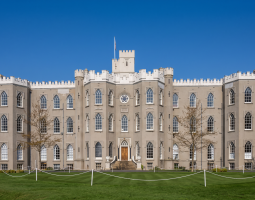
The Dundalk Grammar School campus covers 10 acres. Its facilities include the main building—an 1817 mansion with an interior courtyard—academic buildings, a sports center, a residence, a full-size floodlit astroturf pitch, an all-weather hockey pitch, three artificial-grass tennis courts, gardens, and lawns. Soccer and rugby pitches are located on neighboring grounds.
Classrooms are equipped with computers, projectors, and interactive whiteboards. A new building opened in November 2013 with creative and craft workshops, a library, a multimedia room, and science laboratories.
Admission dates and extra charges
Tuition fee includes:
- Five-day boarding;
- Family accommodation on the weekend.
Tuition fee does not include some services and they are paid additionally:
- Registration fee;
- Academic deposit (refundable);
- Visa fees and services;
- Consular fee (paid at the Embassy);
- Transfer in both directions;
- For students of the Transition Year - excursion program;
- Medical insurance;
- Additional fee for accommodation during the Christmas and Easter holidays (if necessary);
- School uniform;
- Teaching aids, books and materials;
- Courier delivery of the original invitation;
- Air tickets in both directions.
Enrolment process
A separate induction program is available to first-year pupils.
Entry requirements, how to apply, what is required to enrol
New pupils are encouraged to visit the school several times before enrollment.
Applicants must provide:
- A recommendation from an English teacher at the applicant's previous school,
- Report cards covering the previous two years of study,
- Confirmation of sufficient English proficiency: an IELTS score of 4.5, a TOEFL score of 450, or equivalent.
Scholarships Dundalk Grammar School
- All pupils entering the first year of Secondary School may participate in the annual scholarship selection held in March,
- Scholarship candidates complete papers in Irish, English, and Mathematics.
Institution on the map
Residence permits, citizenship and other services
- Guardianship services during the studies
- Student supervision
Review about Dundalk Grammar School
Recommendations on when to apply
| Language courses, schools and children's language camps | Primary and secondary education - private schools | Preparation programmes for entering universities - higher education | Higher education (after completing accredited programs A-level, IB, High School) - Bachelor, Master, MBA |
| - we recommend to apply 6-9 months before the start of the course (some camps and schools offer discounts for early booking or for lengthy study programs) - there are some very popular and high demand children's camps, where the applications need to be submitted 1 year in advance (in particular Switzerland , Great Britain , USA , Canada , Austria) | - we recommend to apply one year before the start of the training program, - some schools have a specific time frame (September-November - please specify an individual school) - some schools require tests in several stages (UKISET, internal tests of the school: English, mathematics, logics, subjects, interview, some require a personal visit) | - we recommend to apply one year before the start of the program, - for Foundation and Pathway programs, IELTS and TOEFL certificates are usually required, respectively | - recommended submission one year before the start of the program, - the deadline normally closes in January, for TOP HEIs and, as a rule, in March in other universities - for a bachelor, a Foundation or Pathway preparatory program a completed A-level, IB, High School + IELTS / TOEFL are required - for Masters you need a graduated higher education, in some cases you need a pre-Masters program - MBA requires completed higher education, work experience preferably at least 2-3 years, etc. |