King's College School, The British School of Madrid (La Moraleja), King's College in La Moraleja






Programs and prices, tuition fees in King's College School, The British School of Madrid (La Moraleja), King's College in La Moraleja


Pre-Pre Nursery / Pre-Nursery
- Age of students: 1+.
- Duration: up to 2 years, depending on the age of entry.
- Language: English.
The nursery stage combines Pre-Pre Nursery for children from 12 months and Pre-Nursery for children approximately aged 2 to 3 years. The school day runs from 09:00 to 17:00. The main goal of this stage is to help the child comfortably adapt to school life: to meet teachers and peers, get used to English speech, daily routines, shared play, and first expressions of independence.
The program is based on Early Years Foundation Stage and Arc Pathway. The approach draws on Reggio Emilia ideas: the classroom and play areas function as a «third teacher», and adults do not simply give tasks but observe the child's interests and build short exploratory situations around them. Young children touch materials, sort objects, move freely, draw, listen to music, play with water, sand, and textures, try out first words, and learn to express requests.
In the youngest groups, a Spanish-speaking staff member works, which makes adapting to an English-language environment more comfortable: children are immersed in English daily while retaining the ability to receive support and explanations in a familiar language. Great attention is given to the development of motor skills, speech, emotional well-being, and the ability to interact with peers. Teachers record observations of each child's development in the Arc Pathway electronic system, using photographs, notes, and the results of daily observations.
Nursery
- Age of students: 3+.
- Duration of study: 1 year.
- Language: English, with Spanish support.
Nursery is designed for children aged 3–4, occupying an intermediate position between the nursery group and the preparatory Reception. During this period, the child begins to engage with a more structured activity format: learning to work in a group, understand and follow instructions, participate in joint discussions, try first academic activities, and communicate in English more freely in everyday situations.
The programme follows Early Years Foundation Stage and uses Arc Pathway for observing the child's development. Teachers record speech, play, independence, motor skills, interests, and first academic steps in the electronic journal. Studying is based on Reggio Emilia principles, where exploration of the surrounding world, free play, and the child's active participation in the learning process play an important role. Children work with various materials, experiment, create projects, develop imagination, and learn to find solutions independently; during the day they can build, engage in creative activities, explore natural objects, play role-playing games, and discuss their discoveries together with teachers.
The first academic elements begin to take shape.
- The White Rose Maths approach is used to introduce mathematics: children learn to distinguish shapes, compare quantities of objects, understand size and sequence, consolidating new concepts through play and practical tasks.
- Daily Read Write Inc. Phonics sessions help develop phonemic awareness, introduce sounds and letters, and gradually prepare children for reading.
- In addition, children engage in music, creative activities, and physical activity, spend a lot of time outdoors, and participate in projects related to the surrounding world and nature.
- Spanish language support eases adaptation and helps children feel comfortable in an English-language environment.
Reception
- Age of students: 4+.
- Duration: 1 year.
- Language: English.
Reception completes the early development stage and helps children transition to learning in Year 1 of primary school. The program is designed for children aged 4–5, who gradually adapt to a more structured activity format: developing attention and concentration, learning to work in small groups, understand and follow instructions, tackle tasks step by step, communicate confidently, and actively use the English language.
The program is based on Early Years Foundation Stage and uses Arc Pathway to observe the child's development. Teachers track speech, writing, counting, play, independence, motor skills, social skills, and emotional state. The approach continues to draw on Reggio Emilia principles: the child explores space, materials, natural objects, stories, and their own questions, and the classroom functions as an active part of learning.
Special attention is given to preparation for school lessons in reading, writing, and mathematics.
- Every day children do Read Write Inc. Phonics: they learn sounds, combine them into words, read short phrases, and try writing meaningful captions. Phonics groups are formed according to the child's level.
- White Rose Maths is used for mathematics: children return to key concepts several times throughout the year, consolidating them through play, objects, diagrams, and practical tasks.
- The literacy block includes Drawing Club: children work with books, fairy tales, illustrations, and weekly stories, draw characters, invent plot details, and gradually begin to write down their ideas in words and short sentences.
Primary School
- Age of students: 5+.
- Duration of study: 6 years.
- Language: English and Spanish.
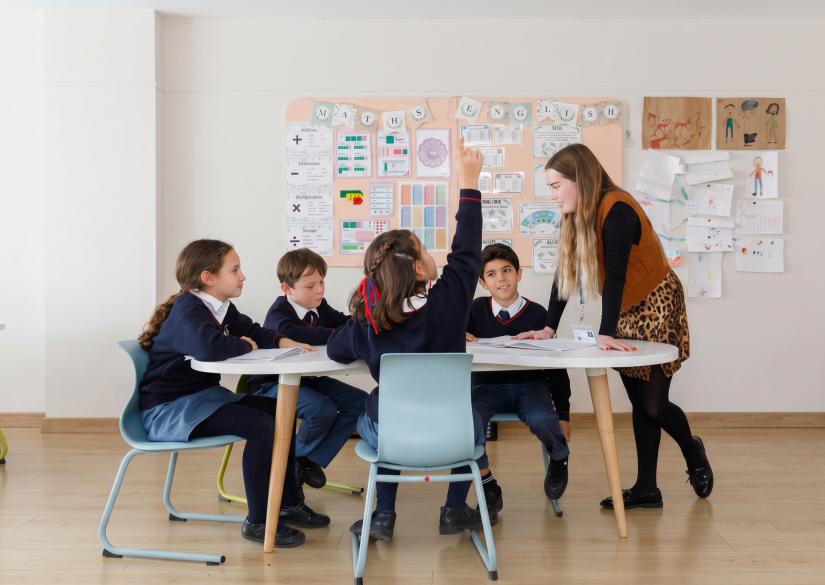
Primary School covers Years 1–6 and is designed for children aged 5–11. In the first two years, pupils transition from the play-based approach of Reception to a more formal schedule: they read, write, and do arithmetic in English, work on short assignments, discuss topics in groups, and gradually get accustomed to independent work. In Year 1 and Year 2, a teaching assistant works alongside the class teacher, helping children adapt to the learning process and receive additional support at the start of primary school.
The core of the curriculum comprises English, mathematics, natural sciences, history, geography, computing, music, drama, design and technology, physical education, and health fundamentals. From Year 1, children study Spanish and social sciences in Spanish; pupils without Spanish citizenship may study Spanish as a second language. In the upper years of primary school, French is introduced, while Chinese and German are available through additional classes.
Teachers place emphasis on hands-on practice. In mathematics, children explore fractions and decimals through games, investigative tasks, and «treasure hunts»; in natural sciences they conduct simple experiments — for example, investigating tyre wear and connecting the topic to real life. In Coding Club, pupils learn Python and robotics by solving applied problems. In Year 6, Leadership Development Days, Pupil Voice, Wellbeing Team, and House Captain roles are added. In Year 5, children move from the junior campus to the main campus, where they gain access to the IT zone, 3D printers, laboratories, and music and art rooms.
Secondary School
- Age of students: 11+.
- Duration of study: 5 years.
- Language: English + Spanish.
Secondary School covers Years 7–11 and is designed for students aged 11–16. At this stage, studying is organized by subject: classes are taught by specialist teachers, and the curriculum includes English language, mathematics, sciences, Spanish language and literature, social sciences, humanities, foreign languages, art, music, drama, and sport. Students with Spanish citizenship study compulsory subjects in accordance with the requirements of the Spanish Ministry of Education, while the others study Spanish as a foreign language.
In Year 9, the science course is divided into three separate subjects: biology, chemistry, and physics. Students study French, while German and Chinese can be chosen as additional languages. For students who need support in improving English level, the English as an Additional Language program is available.
One of the key features is the combination of the British academic curriculum, the High Performance Learning approach, and project-based learning. In class, students develop critical thinking skills, learn to speak confidently in front of an audience, argue their point of view, work effectively in teams, and participate in school House life. In Years 7–9, each term students can choose additional enrichment options, including entrepreneurship, filmmaking, creative writing, STEM subjects, and more.
The technology offering is notably stronger than typical school clubs: Coding Club covers Python, robotics, the fundamentals of software engineering, and machine learning.
IGCSE
- Age of students: 14+.
- Duration of study: 2 years.
- Language: English + Spanish.
The program is designed for students aged 14–16 and follows the Pearson Edexcel International GCSE system. After Year 11, students typically move to the senior level at King's College Soto de Viñuelas, where they continue their university preparation.
The course combines compulsory subjects and electives. All students study mathematics, English language, and natural sciences, then add several areas of interest: biology, chemistry, physics, geography, history, economics, French, Spanish, English literature, computer science, art and design, drama, music, physical education, and advanced mathematics. Most students pass at least eight IGCSE subjects. Spanish nationals additionally study Lengua and Ciencias Sociales, while international students prepare for the Spanish language examination.
As studies progress, the emphasis gradually shifts towards independent preparation and personal responsibility for results. Students develop academic writing skills, learn to use subject-specific terminology, complete research and practical assignments, and form portfolios for subjects where this is required, such as Art & Design. Language subjects include oral examinations, while in Drama and Physical Education part of the assessment depends on practical work.
The High Performance Learning methodology promotes the development of analytical thinking, confidence, communication skills, and the ability to work effectively on long-term projects. Among the subjects in which students traditionally achieve high results, the school highlights mathematics, biology, and French.
Description of King's College School, The British School of Madrid (La Moraleja), King's College in La Moraleja
- Year of foundation: 2007
- Location: Madrid, Spain
- Number of students: 900
- Type of study: mixed
- Type of institution: private British day school
- Language of instruction: English
King's College School La Moraleja is part of the international network King's College Schools, which has been operating in Spain since 1969. The campus in La Moraleja was opened in 2007 and is located in a prestigious northern suburb of Madrid, not far from Alcobendas; it accepts children aged from 12 months to 16 years, providing a continuous cycle from early development programs to preparation for exams at the Year 11 stage.
The school has two campuses: one is designed for the youngest pupils, the other for the upper years of primary and secondary school. The educational process is based on the British curriculum with an in-depth study of English, integration of a Spanish component, use of modern digital technologies, active development of sport, music, theatre arts, and programs supporting children's emotional well-being.
Educational process
Education is organized according to the British model with an emphasis on English and the practical acquisition of knowledge. At the early stages, learning is conducted through play, creativity, music, movement, and communication; children participate in small projects that help develop curiosity and skills for exploring the world around them.
In primary school, the main focus is on English, mathematics, natural and social sciences, arts, music, and physical education. From Year 1, Spanish and social sciences in Spanish are included in the curriculum, allowing students to simultaneously follow the British program and meet the requirements of the Spanish educational system.
In secondary school, the role of independent work increases, and learning is already structured around individual subject disciplines. Students learn to analyse information, draw well-reasoned conclusions, conduct their own research, and express their thoughts freely in English. La Moraleja's primary focus is on high-quality academic preparation, the development of responsibility, and the skills for working effectively both independently and as part of a team. The educational process combines traditional academic classes with practical assignments, projects, and extracurricular activities, helping students prepare for the next stage of education and make an informed choice of their future academic path.
Things to know about
- The elementary school campus has a creative science workshop — a space where children implement projects combining elements of science and art.
- Early development groups hold daily sessions with elements of role-playing games, which help children develop speech, imagination, communication skills, and self-confidence.
- A Coding Club with Python and robotics is available for primary school students.
- In music classes, students not only learn to play instruments but also work with Sibelius and Cubase software, creating their own musical compositions.
- One of the important events in the school calendar is the traditional Summer Fair, which is conducted in June and brings together students, parents, and staff.
Accommodation, meals, prices
King's College School La Moraleja is a day school, so students live with their families/guardians and come to classes daily. The campus is located in the prestigious La Moraleja district in northern Madrid — a green and quiet suburb with well-developed infrastructure, sports clubs, and rich leisure opportunities. Nearby are the well-maintained and green areas of Alcobendas and Encinar de los Reyes.
Bus routes across Madrid and the nearest suburbs are organized to transport students to and from school. The route network is divided into two zones: the inner zone, which covers La Moraleja, Soto de La Moraleja, and Encinar de Los Reyes, and the outer zone — for other areas. Staff accompany children during trips. Parents can arrange both daily two-way transfers as well as morning-only or after-school-only trips.
Meals are organized on campus in specially equipped dining halls. The in-house Nexalia Catering team prepares dishes in the school kitchen and composes menus together with nutrition specialists. A mandatory hot lunch is provided for all students; bringing food from home instead of the school meal is not permitted. When composing the menu, La Moraleja takes into account food allergies, medical indications, and individual dietary restrictions of students.
For young children who remain at school for a full day, breakfast and lunch are additionally provided.
Activities King's College School, The British School of Madrid (La Moraleja), King's College in La Moraleja
La Moraleja offers a well-thought-out and varied system of extracurricular activities and electives. At the primary level, children participate in a STEM club, debates, musical productions, Chinese language and culture classes, dance, theatre, football, judo, swimming, chess, and gymnastics. For Key Stage 2 students, there is a weekly Enrichment program: the schedule includes additional classes in science, technology, creativity, languages, and sports, which help develop interests beyond core subjects.
In secondary school, the range of activities expands considerably: students can explore entrepreneurship, develop business ideas, learn to plan projects and present them to an audience, and attend clubs in guitar, creative writing, filmmaking, art, and foreign languages. For technology enthusiasts, there are coding and digital project tracks, while those who prefer intellectual pursuits have access to chess and historical documentary projects. The sports block includes women's football, cricket, and yoga.
Students also participate in the international Duke of Edinburgh Award program, which develops leadership skills, teamwork, and independence, and in the Shakespeare Schools Festival — one of the largest theatre projects for school students.
Educational trips and excursions form an important part of life at La Moraleja: students visit Cantabria, Barcelona, Valencia, Cádiz, and Berlin, take part in ski programs, and explore museums, theatres, historical sites, and natural areas. Such trips help broaden horizons, deepen understanding of academic material through practical experience, and introduce students to the cultural and historical heritage of different regions. The program regularly includes themed excursions and events linked to subjects being studied.
A special place is held by Careers Day, when students meet with alumni, parents of pupils, and invited professionals from various fields. Guests have included surgeons, lawyers, geologists, entrepreneurs, technology specialists, and digital content creators, who talk about their work, answer questions, and share professional experience. These meetings help students gain a clearer sense of direction when choosing a future career and further education.
Advantages
- Part of King's College Schools and draws on the experience of a network that has been working in British education in Spain for more than 50 years.
- Received High Performance Learning World Class School status; the High Performance Learning approach is integrated into the academic process, extracurricular activities, and project work.
- Students from Year 3 to Year 11 use the Century Tech platform, which helps personalise learning and track academic progress in key subjects.
- Great emphasis is placed on foreign language studying: in addition to English and Spanish, the curriculum and elective system include French, German, and Chinese.
- Sports training is conducted by experienced specialist coaches, including a specialist from the Atlético de Madrid academy, judo coaches with high dan grades, and a rhythmic gymnastics instructor.
Facilities and equipment at King's College School, The British School of Madrid (La Moraleja), King's College in La Moraleja
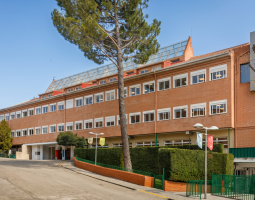
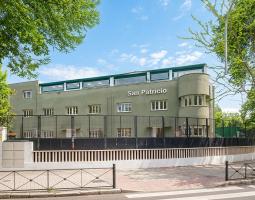
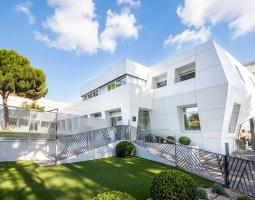
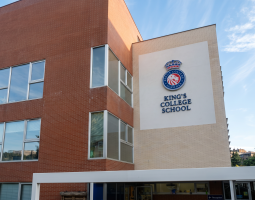
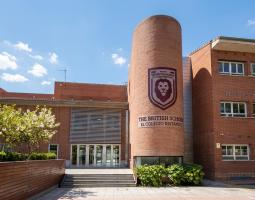
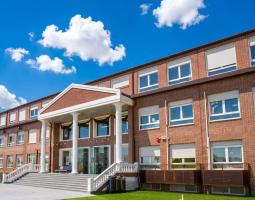
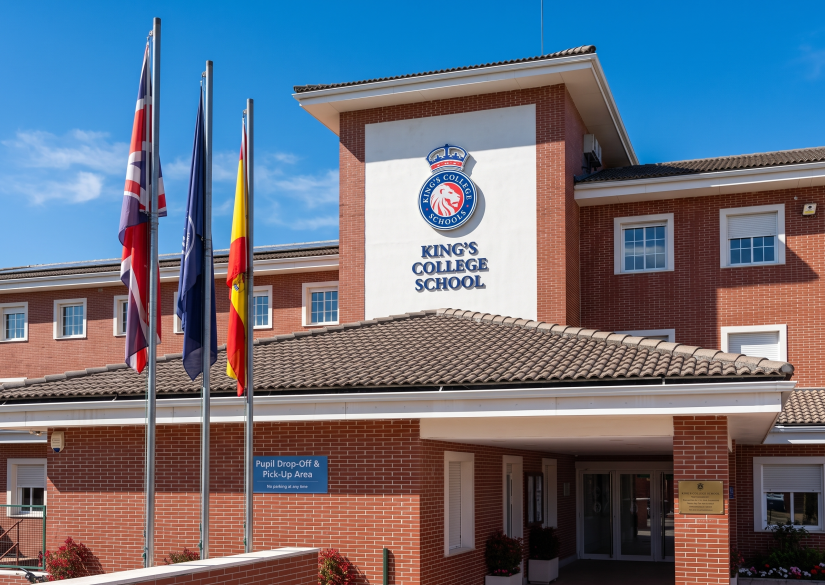
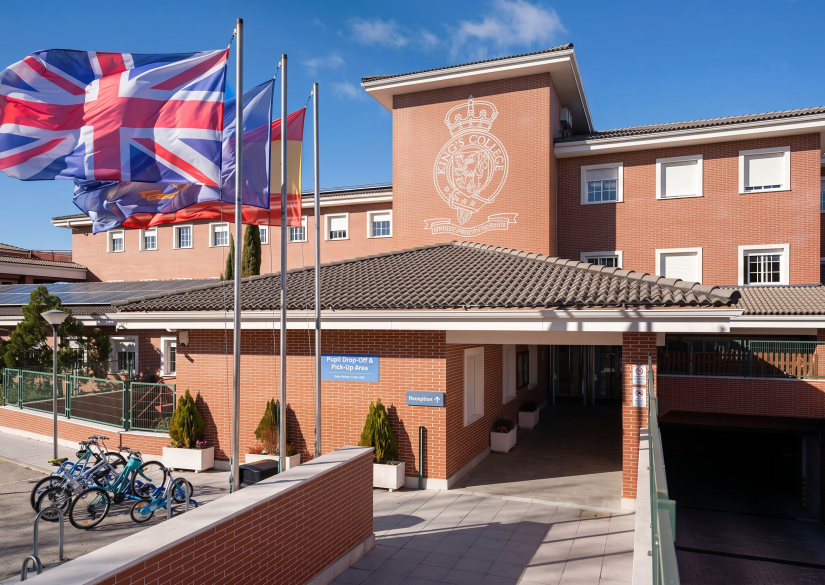
The complex includes two campuses located close to each other.
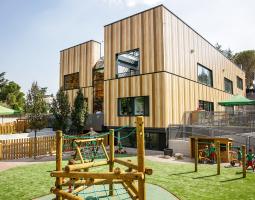
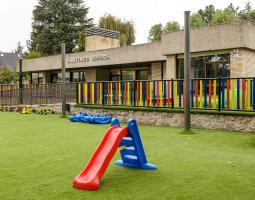
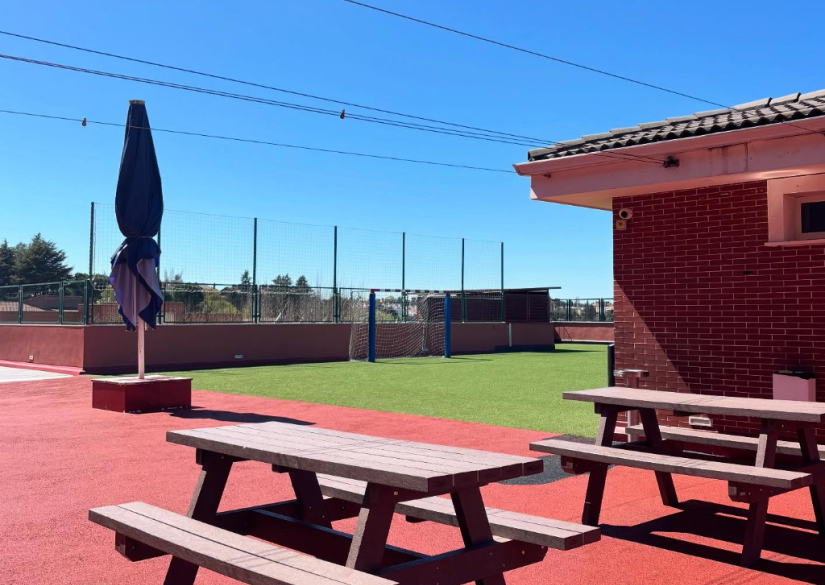
- Infant Campus is designed for young children and lower grades. It has age-appropriate classrooms, play areas, a covered courtyard, outdoor activity spaces, a training pool, a medical office, and areas for music, art, and creative projects.
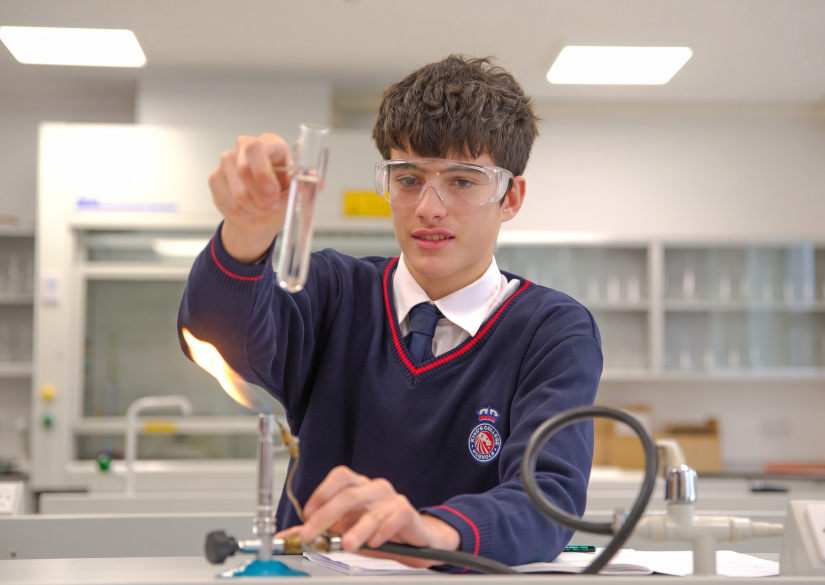
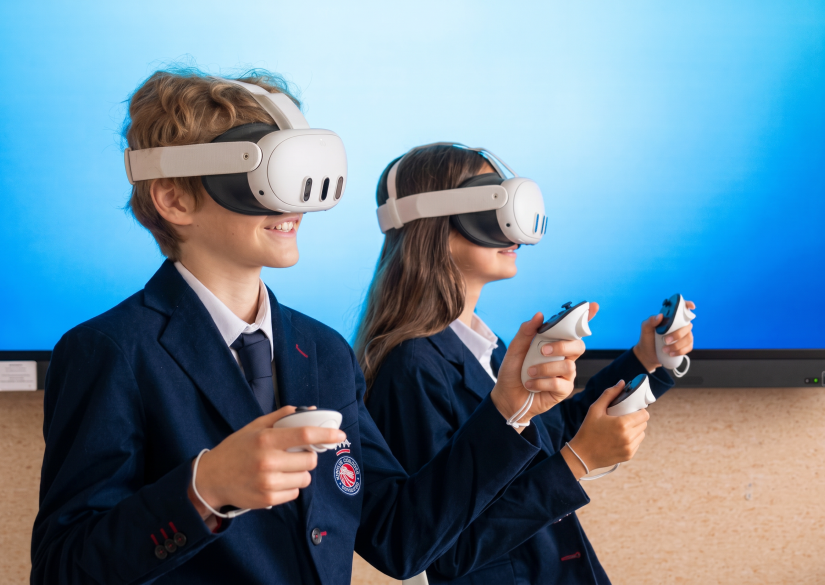
- The main campus on Paseo de Alcobendas is designed for upper primary and middle school students: it features modern classrooms with interactive technology, IT spaces, robotics and programming areas, 3D printers, and access to the Adobe Creative Suite package. Biology, chemistry, and physics laboratories are available for natural sciences. For creative activities, there is an art studio, music classrooms, individual instrument practice rooms, and rehearsal rooms. Concerts, performances, and other events are conducted in a dedicated hall with professional sound equipment.
For sports, the school primarily uses publicly available multipurpose courts, a swimming pool, and the external sports complex José Caballero in Alcobendas: classes are held here in football, basketball, swimming, rhythmic gymnastics, judo, cricket, and yoga. Students participate in matches, tournaments, and school competitions during the academic year.
Admission dates and extra charges
The academic year is traditionally divided into three terms: autumn, winter-spring, and spring-summer.
Additional costs include:
- Registration fee,
- Meals, accommodation,
- School bus,
- Morning and evening supervision (wraparound care),
- Additional English language lessons for students who require EAL support,
- External examination fees,
- Electives, clubs and extracurricular activities,
- School trips, excursions and educational outings.
The school accepts payment by term.
Enrolment process
First, you need to submit an application and receive an invitation to an entrance test, after which the child gets acquainted with the school and undergoes an age-appropriate assessment. Candidates for Year 3 and above take an entrance exam, and in some cases additionally attend an interview.
For younger children, the school conducts an observation meeting during which it assesses the level of speech development, independence, readiness for classes, and adaptation to the daily routine. After reviewing the results, the school sends the family an offer of admission, parents confirm the place and complete the registration formalities.
Perspectives
After Year 11, students often continue their education at King's College Soto de Viñuelas, where they complete the upper school stage. Preparation for this transition begins well in advance: students attend the IGCSE program, study Spanish subjects, participate in career fairs and other events, receive guidance in choosing their academic subjects, and are supported in discovering their strengths and interests.
Graduates of King's College schools go on to study at universities in the UK, the USA, Spain, and other countries, including prestigious Russell Group and Ivy League institutions.
Entry requirements, how to apply, what is required to enrol
For admission, the child must meet the age requirements of the chosen level of education and demonstrate readiness to study within the British curriculum.
For admission to Year 3 and higher year groups, it is necessary to successfully pass an entrance assessment; in some cases, La Moraleja also conducts an interview. When enrolling younger children, attention is paid to speech development, level of independence, social skills with peers, and readiness for the school routine.
When transferring from another school, it is necessary to provide report cards, academic progress reports, and other documents relating to previous studies. For pupils transferring from other schools in Spain, previously studied subjects and the alignment of the completed curriculum with the requirements of the Spanish education system are taken into account.
The school does not guarantee priority admission for siblings of current pupils.
Scholarships King's College School, The British School of Madrid (La Moraleja), King's College in La Moraleja
Inspired schools offer the Nsouli Scholars Programme — one of the network's main scholarship initiatives. It is designed for talented students who demonstrate high academic performance, show leadership qualities, or achieve notable success in sports, arts, music, technology, and other fields. At any one time, 50 students from various Inspired schools around the world receive the scholarship, and it can fully cover the tuition for the entire period of study, making it particularly attractive for families considering long-term enrollment in the network's schools. Selection takes into account academic performance, recommendations, personal achievements, motivation, and potential for further development. The primary goal is to support the most promising students and give them the opportunity to receive a quality international education.
Institution on the map
Residence permits, citizenship and other services
- Guardianship services during the studies
- Student supervision
Review about King's College School, The British School of Madrid (La Moraleja), King's College in La Moraleja
Recommendations on when to apply
| Language courses, schools and children's language camps | Primary and secondary education - private schools | Preparation programmes for entering universities - higher education | Higher education (after completing accredited programs A-level, IB, High School) - Bachelor, Master, MBA |
| - we recommend to apply 6-9 months before the start of the course (some camps and schools offer discounts for early booking or for lengthy study programs) - there are some very popular and high demand children's camps, where the applications need to be submitted 1 year in advance (in particular Switzerland , Great Britain , USA , Canada , Austria) | - we recommend to apply one year before the start of the training program, - some schools have a specific time frame (September-November - please specify an individual school) - some schools require tests in several stages (UKISET, internal tests of the school: English, mathematics, logics, subjects, interview, some require a personal visit) | - we recommend to apply one year before the start of the program, - for Foundation and Pathway programs, IELTS and TOEFL certificates are usually required, respectively | - recommended submission one year before the start of the program, - the deadline normally closes in January, for TOP HEIs and, as a rule, in March in other universities - for a bachelor, a Foundation or Pathway preparatory program a completed A-level, IB, High School + IELTS / TOEFL are required - for Masters you need a graduated higher education, in some cases you need a pre-Masters program - MBA requires completed higher education, work experience preferably at least 2-3 years, etc. |