For partners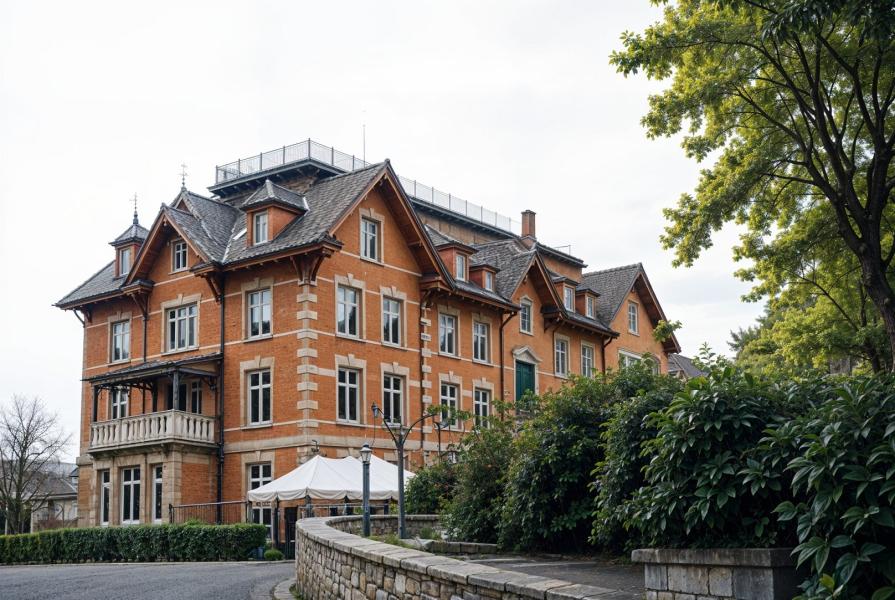
St. Gallen is a quiet and unassuming Swiss city where the streets smell of freshness and coffee, and the houses look like they've just been painted and varnished. On one of the hills, among the old villas, there is a school where the children of diplomats, businessmen and royal families dream of going. The entrance is carefully guarded, alumni lists are not published anywhere, and tuition costs about 160 thousand Swiss francs per year. This is how the Institut auf dem Rosenberg gained a reputation as the most expensive school in the world.
However, it is hardly just a matter of price. Rosenberg is not an empty demonstration of luxury, but an attempt to create an ideal educational environment where the child is taught to live, think and work in a future that does not yet exist. There are no pretentious facades, but there is pedantic silence, strict form and a complete absence of fuss. It's a place where the school day is more like a carefully choreographed play, and each student knows their role – until they start writing their own.


How it all began
Rosenberg appeared in 1889, when the German educator Ulrich Schulte decided to open a school in Switzerland "for the children of Europe" - without national barriers and class differences. The idea was decades ahead of its time: at that time, elite boarding schools formed future officers and politicians, and not free-thinking researchers.
For the first decades, the school remained a small private gymnasium: children were taught in German, ideal manners and the ability to conduct a discussion. After World War II, Rosenberg switched to English and became truly international. Since then, children from more than 50 countries have studied here.

The main quality is continuity. The school has been run by one family for four generations, and this is a rarity even for stable Switzerland. The modern leader, Bernhard Gatz, has retained the old principles of individual attention, multilingualism, a combination of classicism and innovation. Rosenberg still appreciates strict order: students write by hand, discuss news at a common table, observe the dress code, but behind this tradition there is a modern philosophy - the school teaches not just knowledge, but responsibility and independence.
Campus: Private world on a hill above St. Gallen
The school is located just above the center of St. Gallen, a city known for its library, university and neat, almost museum-like architecture. The school occupies an area of about 10 hectares, where old villas coexist with new laboratories and sports pavilions. From the hill there is a view of the Alps and Lake Constance - a picture as if descended from a postcard.
The campus is a self-contained world thought out to the smallest detail: narrow paved paths, hundred-year-old trees, fountains, green lawns and terraces for outdoor activities. The educational buildings are united by passages so that students can move between buildings even in winter, when the snow is knee-deep.
Residential buildings resemble mini-hotels: small rooms for two, a recreation room, a curator on each floor. But even in this comfort, you can feel a strict rhythm - the schedule is made up almost by the minute, from morning exercises to evening reading.
How much does it cost to study and what do they pay such money for?

150-160 thousand Swiss francs a year is an amount that seems exorbitant until you find out what is behind it. This is not just studying, but a full cycle: accommodation, meals, consultations, tutors, medical and psychological support. Each student has a personal mentor who monitors their studies, physical condition and emotional balance. Rosenberg does not have standard classes: there are no more than eight people in classes, and there are two students per teacher. Teachers are project curators, many with experience in universities and companies, and practical courses are taught by specialists — engineers, architects, designers, economists.
The price also includes extracurricular life: dozens of clubs, theater, robotics, art studios, ski trips and summer internships - all this creates an environment where study and life are inseparable.
The Swiss say: Rosenberg is not an "expensive" school, but a school, where education, safety, medicine and culture are combined under one roof.
For comparison: some British premium boarding schools cost about 60 thousand pounds, but work according to the same template, while in Rosenberg each of their students develops a personal plan - from nutrition to sports goals.
The high price here acts as a filter: families for whom education is not a prestige, but an investment. There is no ostentatious wealth in school: elitism is manifested in culture, attention and style, and not in golden handles on doors.
How Rosenberg Teaches: Individual Trajectories and Laboratories of the Future
The main principle of Rosenberg is that you need to prepare not for exams, but for life. For each student, an individual trajectory is drawn up based on international programs: British, American and diploma. The plan is formed together with the curator, and the student learns to prioritize from the first day. Classical disciplines coexist with courses in design, architecture, sustainable development and digital technologies. The mandatory part is projects where students solve real problems, for example, create models of a "smart city".
In 2019, Rosenberg Future Park was opened on campus, an innovative campus with courses in programming, robotics, 3D modeling, and media design: here, schoolchildren work together with engineers and entrepreneurs, defending their projects in front of experts. There is also the Creative Lab, a laboratory of ideas where art objects, short films, and architectural models are created; The task is to teach you to think and not be afraid of mistakes.
A separate block is devoted to personal development: classes on ethics, teamwork and social responsibility. Every high school student participates in volunteer initiatives, from helping the elderly to charity fairs.
Alumni, reputation and the phenomenon of closure

At the same time, Institut auf dem Rosenberg is one of the most closed schools in Europe. There is a strict privacy policy: no names, no photos without family consent. This is not a posture, but a principle that has earned the school a reputation for respecting privacy. From time to time, the media mention the children of diplomats, businessmen, sheikhs, but the school itself does not comment on such data. Among the graduates there are both scholarship holders and children of middle-level entrepreneurs, most of them go to Oxford, Cambridge, Stanford, ETH Zürich.
For 130 years, the school has survived wars, crises and reforms, maintaining a course towards personal education. Its closeness is not snobbery, but respect for boundaries and silence. In an era when schools compete in advertising volume, Rosenberg remains an example of quiet but influential and persuasive leadership.