
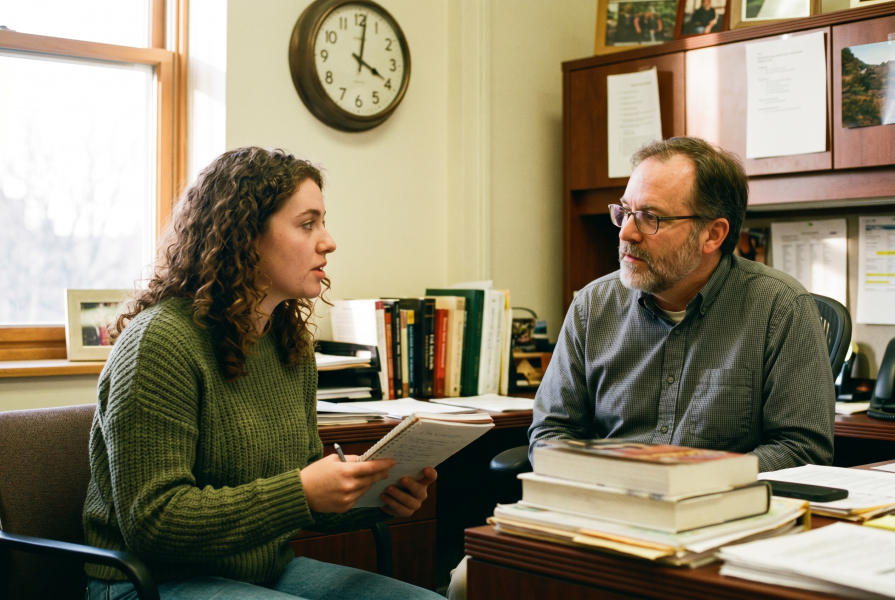
Let’s be honest: asking for a reference letter feels uncomfortable. You worry you’re imposing, or that the teacher barely remembers you. But here’s the secret: most teachers expect to write references. The awkwardness disappears when you ask professionally, at the right time, and provide everything they need.
Here is exactly how to do it—without the cringe.


When to Ask: Timing Is Everything
The golden rule: give at least 2–4 weeks of notice. Asking like a week before the deadline is basically the fastest route to a generic, rushed letter (or a careful “no” ).
-
For a university application: ask 4–6 weeks ahead of time, especially if it’s your first request of the semester, and you should assume their schedule is already full.
-
For a summer program abroad or internship: 3–4 weeks is usually the safe zone.
-
For a job: 2 weeks minimum, but honestly more is better, because it gives people time to reflect.
Pro tip: try not to ask during exam week , right before winter break, or the day after report cards are due. If you can pick, a calm Tuesday or Wednesday morning works best.
What to Send Your Teacher (The “Reference Packet”)
A teacher might have 150+ students. They probably will not recall your specific project from two years ago, even if you felt it was obvious. So you send a “reference packet” — kind of a short, organized email with attachments, and you keep it clean.
Here’s what to put inside:
-
A list of your achievements – Bullet points. Keep it to one page. Add GPA (if it’s strong), awards, leadership roles, and the key projects you’re actually proud of.
-
Relevant subjects and grades – Mention the class(es) you took, your grade , and one vivid little memory like “I really enjoyed our discussion on climate ethics in March.”
-
Competition papers or projects – Attach a PDF of your best piece (a science fair paper, an essay, a coding project, etc.). Do not dump 20 files. One or two strong examples are plenty, rather than a whole shelf.
-
Volunteering and extracurriculars – Only include them if they truly match the application. Emphasize steady commitment (ex: “Tutored math for 2 years”) instead of listing everything you ever did, because focus feels more thoughtful.
-
Links to your portfolio – A clean link to a personal website, GitHub, Behance, or LinkedIn. Make sure it’s public and up to date.
-
The deadline & submission method – Say exactly: “The letter is due by March 15th. It can be uploaded via this link (attached) or emailed to admissions@university.edu.”
-
Your resume or CV – Even if they know you well. It saves them time.

Don’t forget: A stamped, addressed envelope if it’s a paper letter (rare now, but some programs still ask).
A Short Message Template (Copy and Paste)
Subject: Reference request for [Your Name] – [Program/Job Name] – deadline [Date]
Dear [Teacher’s last name],
I hope you’re doing well. I’m applying for [specific opportunity], and I was wondering if you would feel comfortable writing a strong reference letter for me.
I really enjoyed your [subject name] class last spring, especially the [mention a specific unit or project]. If you agree, I’ve attached a reference packet with my achievements, a relevant paper, my resume, and a link to my portfolio.
The deadline is [date], and the letter can be uploaded here: [link]. I’d be happy to meet during office hours to discuss this further.
Thank you so much for considering this.
Best,
[Your full name]
[Your student ID/class period if needed]
Typical Mistakes (And How to Avoid Them)
| Mistake | Why it’s bad | Fix |
| Asking too late | Teacher rushes or declines. | Ask 3+ weeks ahead. |
| No “invoice” (instructions) | Teacher doesn’t know where to send the letter or the format. | Provide the submission link, word limit, and format (PDF, Word). |
| Being too general | “Can you write a letter for college?” – For which college? Which program? | Name the specific opportunity and deadline. |
| Sending nothing | Teacher has to dig for your grades or projects. | Send the packet in the first email. |
| Asking via hallway ambush | Puts teacher on the spot, no time to check notes. | Always ask via email first, then follow up in person. |
| Forgetting a thank-you | Teacher feels used. | Send a thank-you note after they submit the letter, and let them know the outcome. |
The Golden Rule
Make it easy for them. A teacher is far more likely to write a detailed, enthusiastic letter if you hand them a clear folder (physical or digital) with your story inside. When you remove the guesswork, you remove the awkwardness.
So ask confidently, send the packet, and don’t forget to say thank you. You’ve earned that letter.