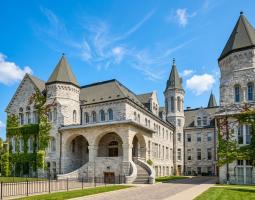
University of Ottawa


Programs and prices, tuition fees in University of Ottawa


Information on the program can be found on the official website of the school.
Information on the program can be found on the official website of the school.
Description of University of Ottawa
One of the largest universities in Canada is the University of Ottawa (University of Ottawa). It is a state higher educational institution, which was founded in 1848. Initially it was Baytown College, but in 1866 the institution was given the status of a university.
- Languages of instruction: English and French.
Postgraduate education includes micro-programs, diplomas, short-term master's programs, master's degrees, and doctoral studies. The university offers professional programs in law, education, medicine, and pharmacy.
86% of students participate in practical training.
Educational process
University of Ottawa has the fifth largest paid co-op program in Canada. It involves more than 3,600 students, and more than 4,000 employers work with the university.
During work terms, students apply the knowledge gained in class. The university partners with internationally recognized hospitals and healthcare organizations.
Scientific achievements
In 2025, the university received more than 500 million dollars for research. In Canada, the University of Ottawa ranks 5th in research intensity, 7th in the volume of research funding, and 3rd in faculty awards and recognition.
Research covers artificial intelligence, healthcare innovation, social justice, quantum physics, and climate change solutions.
Things to know about
- The university employs 12,000 teachers, researchers, and other staff,
- the alumni community numbers 300,000 people.
Accommodation, meals, prices
University residences offer more than 4,100 spaces for new and continuing students. Accommodation options include standard and upgraded rooms, suites, studios, and apartments.
University residences include Annex, Hyman Soloway, 45 Mann, 90 University, Friel, Stanton, Leblanc, Marchand, Thompson, Henderson, and Rideau. The housing service desk operates around the clock.
Students with disabilities or medical conditions can request support and accommodations when applying for housing.
Subjects, specialties
Activities University of Ottawa
More than 300 student clubs operate on campus.
Advantages
The University of Ottawa is known throughout the country for its research work in the field of medicine. The strongest areas here are chemistry and neuroscience. In Canada, the institution is included in the top 15 best institutions. And in the international rating at the moment is at 241 positions.
Most popular destinations:
- Art;
- humanitarian sciences;
- engineering and technology;
- life sciences and medicine;
- natural Sciences;
- Social sciencies;
- management;
- chemistry.
On the quality of teaching, the institution is included in the list of the top 300 institutions in the world. This is due to a large number of specialists from abroad. Graduates of the university quickly find a job without any difficulties . They are happy to invite employers of international firms.
Outstanding graduates
Among graduates of the University of Ottawa there are many scientists, professors, politicians, businessmen, journalists, writers, actors and representatives of other professions. For example:
- Philip Landry (Franco-Ontario playwright, author of the drama "Return to Pripyat");
- Alex Trebek (TV journalist, the leader of popular entertainment TV programs);
- Dalton James Patrick McGinty Jr. (politician and lawyer, Prime Minister of Ontario);
- Louise Charron (current judge of the Supreme Court of Canada);
- Louise Arbor (United Nations High Commissioner for Human Rights);
- Wilbert Keon (talented heart surgeon);
- Paul Edgar Philip Martin (Canadian politician and businessman);
- Carol Ann Shields (writer and poet, laureate of the Pulitzer Prize);
- Liza LaFlamme (television journalist, currently editor in chief of CTV National News);
- Allan Rock (lawyer, former Canadian politician, diplomat and president of the University of Ottawa);
- John Paul Manley (lawyer, businessman, politician);
- Samantha Jamie Bi (actress, comedian, screenwriter, film producer, journalist and TV presenter);
- Paul Demaré (a Canadian businessman and billionaire who is the fourth Canadian in the 2011 Forbes rating).
- Gérald Tremblay (Quebec and Canadian statesman);
- Doug Falconer (Canadian-American producer and former professional football player of Canada).
Famous teachers include Fedor Parfenevich Bogatychuk (Soviet teacher of the medical faculty, chess champion) and Georgy Nikolayevich Chavchavadze (military, taught at the Faculty of Natural Sciences).
Facilities and equipment at University of Ottawa
The main university campus is territorially located in the capital of Canada (the city of Ottawa). The university is a member of such associations as:
The structure of the educational institution includes a large student library, a comfortable hostel for foreign citizens, sports complexes, research centers and laboratories, cafes and canteens. The university is equipped with everything necessary to create a pleasant atmosphere for students in education and living.
Admission dates and extra charges
The first work term of the paid Co-operative Education program usually begins after two years of study. Four-month work terms start in January, May, and September, and in certain programs the work period can last 8 or 12 months.
Enrolment process
Participation in the paid co-op internship program is voluntary, and admission depends on the student's academic performance. Smapse specialists are guaranteed to support you at every stage of enrollment.
Enrolment statistics
The average grade of students in the paid co-op internship program is almost 80%.
Perspectives
Six months after graduation, 90% of University of Ottawa graduates are employed.
Entry requirements, how to apply, what is required to enrol
For admission, the applicant must provide a certificate that confirms academic performance at the previous place of study. His score should be above average. You will also need to provide a certificate of language (English or French). But it is worth noting that the conditions of admission can vary depending on the chosen direction.
The University has nine faculties and one business school:
- Engineering;
- Civil law;
- Common law;
- Faculty of Arts;
- Pedagogical;
- Social Sciences;
- Faculty of Health Sciences;
- Medical;
- Faculty of Exact Sciences;
- Talfer Management School.
Actual information on the rules for filing documents for a particular direction should be specified on the official website of the university.
Features of education
The University of Ottawa has more than 35,000 students and 2,000 teachers. On enrollment not only local, but also foreign citizens can claim. They make up about 15% of the total number of students. The academic year is divided into semesters. The cost of the undergraduate program is 5000 USD per year, and the magistracy is 7000 USD per year. Students have the opportunity to participate in the scholarship program, which will save money spent. Thanks to cooperation with prestigious medical centers, students can be educated there. Also, thanks to the student exchange program, it is possible to get a part of the education in another prestigious institution. Education in the university can be obtained remotely.
Scholarships University of Ottawa
The University of Ottawa provides $194 million in scholarships and financial aid. The university, the federal government, the government of Ontario, and external organizations annually allocate more than $41 million to graduate students in scholarships and financial assistance.
The scholarship program takes into account achievements prior to admission and progress during studies.
Institution on the map
Residence permits, citizenship and other services
- Guardianship services during the studies
- Student supervision
Review about University of Ottawa
Recommendations on when to apply
| Language courses, schools and children's language camps | Primary and secondary education - private schools | Preparation programmes for entering universities - higher education | Higher education (after completing accredited programs A-level, IB, High School) - Bachelor, Master, MBA |
| - we recommend to apply 6-9 months before the start of the course (some camps and schools offer discounts for early booking or for lengthy study programs) - there are some very popular and high demand children's camps, where the applications need to be submitted 1 year in advance (in particular Switzerland , Great Britain , USA , Canada , Austria) | - we recommend to apply one year before the start of the training program, - some schools have a specific time frame (September-November - please specify an individual school) - some schools require tests in several stages (UKISET, internal tests of the school: English, mathematics, logics, subjects, interview, some require a personal visit) | - we recommend to apply one year before the start of the program, - for Foundation and Pathway programs, IELTS and TOEFL certificates are usually required, respectively | - recommended submission one year before the start of the program, - the deadline normally closes in January, for TOP HEIs and, as a rule, in March in other universities - for a bachelor, a Foundation or Pathway preparatory program a completed A-level, IB, High School + IELTS / TOEFL are required - for Masters you need a graduated higher education, in some cases you need a pre-Masters program - MBA requires completed higher education, work experience preferably at least 2-3 years, etc. |