
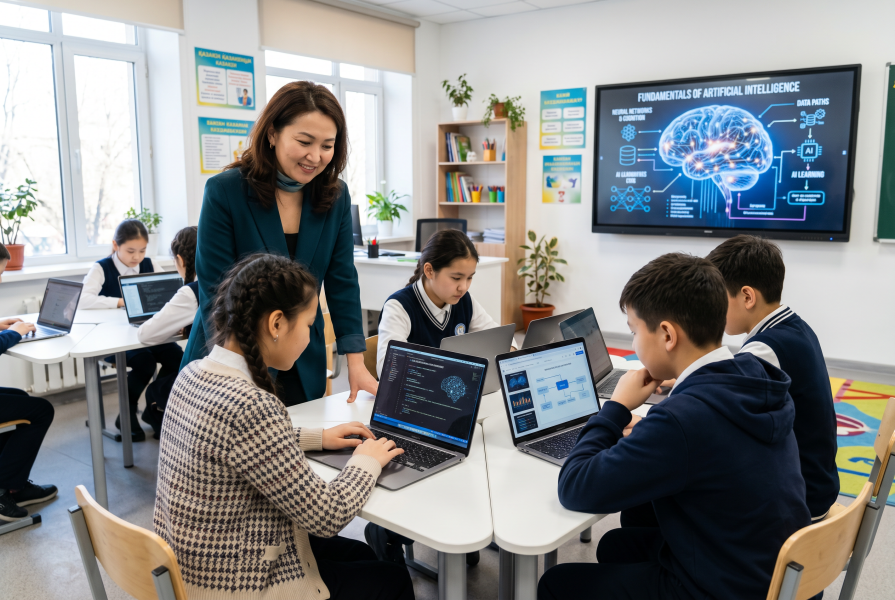
Imagine a school where assignments adapt to each student's abilities, and the curriculum takes into account not only the child's age, but also their learning pace, strengths, and topics they find difficult. Sounds good, right? This is exactly the kind of educational model Kazakhstan is striving for. The country is launching a large-scale program to introduce artificial intelligence into school education: as early as September 2026, the first schools will begin using AI tools in the studying process, and by 2027, the project will cover 500 educational institutions across the country.
The Kazakh authorities emphasize that this is not about introducing yet another digital service, but about a deeper modernization of the entire educational system. At the heart of the reform is the idea of personalized learning. Artificial intelligence will help adapt the educational process to the individual student. If a student struggles with a particular topic, the system will be able to offer additional explanations and practical exercises. If a student masters the material faster than their peers, they will receive more challenging tasks for further development. This approach is intended to make studying more effective and help each student reach their full potential.
The first participants in the program will be small rural schools in the Pavlodar and Kyzylorda regions. After the pilot phase, the number of participants will gradually increase: first, another 50 schools will join the project, and then another 440 educational institutions. Ultimately, the new system will operate in 500 schools across the country. In the first phase, the technologies will be tested in fourth-grade classes. Artificial intelligence will be used in the study of the Kazakh language, mathematics, and digital literacy.
One of the main goals of the project is to reduce the gap between urban and rural education. In many small settlements, schools face a shortage of teachers and limited access to educational resources. The use of modern digital tools is aimed at making quality education more accessible regardless of where a student lives. Before launching the project, the authorities have already assessed the readiness of schools: they checked the quality of internet connections, the availability of equipment, and staffing resources. Work on developing infrastructure will continue in parallel with the introduction of new technologies.
In effect, this is about preparing a new generation of specialists who will work in a world where artificial intelligence technologies are becoming a familiar part of everyday life.