 Portugal
Nobel International school of the Algarve


Programs and prices, tuition fees in Nobel International school of the Algarve


Brief information: an educational program of middle school (7-9 grades) is designed for international students.
About the educational program: After successfully completing this course and passing the exams, students receive a prestigious IGCSE diploma attesting to incomplete secondary education, and can continue their studies on IB and A-level programs, more complex and in-depth.
List of subjects to study:
- Compulsary:
- Information and communication technologies;
- English and Literature;
- Biology;
- Physics;
- Mathematics.
- Optional:
- French;
- Economics;
- English (as a second language);
- Thai language;
- History;
- Spanish;
- Geography;
- Chemistry;
- Chinese;
- Graphic design;
- Mathematics;
- Drama art;
- Russian language;
- Dutch Language;
- Business of science;
- German;
- Portuguese;
- Music art;
- Art;
- German;
- Physics.
About the educational program: The high school program (10-12 grades) is designed for international students. This is the time for specialized, effective and qualitative preparation for the passing of the final school examinations (Cambridge or Edexcel, at the student's choice).After successfully completing the program and passing the exams, students receive an A-level certificate, highly regarded throughout the world.
Also, senior students are offered the opportunity to take part in the "Week of labor experience", where they can try:
- Take a vacancy in various industries;
- Finally decide on the desired direction of career development and future specialization.
List of subjects to study:
- English literature;
- Art;
- Physics;
- Biology;
- Tourism industry;
- French;
- Drama art;
- Sociology;
- Mathematics;
- Government and politics;
- History;
- Rights;
- Travel industry;
- Business of science;
- Geography;
- Graphic design;
- Chemistry;
- Portuguese.
Description of Nobel International school of the Algarve
- Accomodation type: Guesthouse
- Location: Lagoa, Portugal
The international school of the International School of the Algarve was established in 1972 and today is considered to be an educational institution with quality, balanced teaching programs and excellent conditions for study and living.
All classes are conducted in English, the national Portuguese is available as an elective or a second language. Classes are formed by medium - up to 16 people in each - which gives the teacher the opportunity to implement a personal, individual approach, more closely monitor the academic success of each student. On the A-level program, the classes are even smaller - up to 6 people.
Children are admitted to the International School of the Algarve, starting from 3 years: for each class a teacher and his qualified assistant are assigned. The youngest students learn in cozy and bright classes (without sharp corners), together with soft toys, colourful educational books and manuals. All communication and studying is also conducted in English. Each new student receives a special curator, who not only monitors his progress, but also helps to adapt in the new school.
According to statistics, 99.4% of graduates successfully enroll in selected universities around the world, including prestigious universities in the US and the UK.
The international school of the Algarve is located in Lagoa, a 40-minute drive from the airport. There is a bus service (school personal transport), to the following cities:
- Albufeira
- Lagos
- Bolikheim
- Silvish
- Faro
- Budensh
- Vilamoura
- Messinesh
- Loulé.

What details do parents consider first when choosing a school, apart from academic success?
Culture of the school, location, price, curriculum, local rating, word of mouth, fees, facilities, type of school.
Educational process
The school uses a hands-on, experiential approach that develops curiosity, independence and critical thinking. Teamwork and communication skills are central to all educational programs. Students explore social, ethical and environmental issues and develop an informed awareness of them. The PSHE program addresses personal and social development, health and economic education. All educators in the Portuguese program are fully qualified and Portuguese-trained.
From age 3, children take part in The Journey, an outdoor education program embedded in the curriculum. It develops resilience, leadership, character, and social and emotional skills. Shared activities strengthen children's connection with nature and develop teamwork.
From Year 7, students are introduced to Unifrog to explore careers and university options. Parents are invited to speak to secondary school students. Tailored presentations help students choose their IGCSE, BTEC and A-Level disciplines. An annual fair brings universities from other countries to the campus. Students also receive support to attend major university fairs in the Algarve and Lisbon. Individual guidance addresses personal statements and applications to universities in the UK and other countries.
The school psychologist supports children with additional needs, including Autism Spectrum Disorder and dyslexia, and helps with anxiety, emotional difficulties and concentration. The nurse provides day-to-day care for minor injuries and ailments and administers medication when needed.
Globeducate works with LEGO Education to support its interdisciplinary STEAM program. Teachers in the network take part in professional development through regional and international learning communities.
Faculties and colleges
The English curriculum is divided into the following stages:
- Early Years Foundation Stage — preschool education for children ages 3–5, with Nursery and Reception groups. Children learn through play, developing social and communication skills,
- Key Stage 1 — Years 1–2 for children ages 5–7. The focus is on reading, writing, math foundations and creative education,
- Key Stage 2 — Years 3–6 for children ages 7–11. Students strengthen reading, writing and math skills and explore science and the humanities,
- Key Stage 3 — Years 7–9 for students ages 11–14. Students explore a wider range of disciplines, develop critical thinking and begin to learn about careers,
- Key Stage 4 — Years 10–11 for students ages 14–16, with preparation for IGCSE exams,
- Sixth Form — upper secondary education in Years 12–13 for students ages 16–18. Students prepare for A-Level exams, BTEC diplomas and university education.
The Portuguese curriculum has four stages:
- First cycle — 1º to 4º ano, four years of education, usually for children ages 6–9,
- Second cycle — 5º and 6º ano, two years of education, usually for children ages 10–11,
- Third cycle — 7º to 9º ano, three years of education, usually for children ages 12–14,
- Upper secondary education — 10º to 12º ano. These three-year courses may prepare students for employment or further education.
Two vocational diplomas are available at Lagoa:
- BTEC Diploma in Travel and Tourism,
- BTEC Diploma in Sport, Business and Management.
Things to know about Nobel International school of the Algarve
- Students wear their school uniform every day,
- The Globeducate network brings together more than 70 bilingual and international schools in 12 countries. They educate 42,000 students,
- Globeducate partners with WWF to offer awareness-raising events in person and online,
- Globeducate schools aim to obtain Eco-Schools environmental certification,
- The Study Abroad program offers students in the network the opportunity to study and stay at Globeducate boarding schools.
University destinations
Graduates continue their education in the following disciplines:
- Biological Sciences,
- Aerospace Engineering,
- Neuroscience,
- Pharmacy,
- Law,
- Politics and International Relations,
- Mechanical Engineering,
- Real Estate Finance,
- Biology,
- Chemical Engineering,
- Management,
- Illustration,
- Practical Film Making,
- Economics and Business or Finance,
- Econometrics,
- Business,
- Business Administration,
- Liberal Arts and Sciences,
- History,
- Economics and Finance,
- Communications and PR,
- Medicine,
- International Economics and Finance.
Accommodation, meals, prices
The International School of the Algarve offers tuition on a boarding basis, with a permanent residence on campus. For this purpose, comfortable rooms with private bathrooms are equipped: pupils 12-14 years old live in pairs, students from 15 years and older can prefer a private bedroom. Accommodation is charged per academic year.
The canteen provides hot meals every day for students who sign up for school lunches. Children can bring a packed lunch instead. All students eat together in the canteen.
Meals are usually not provided during holiday programs or activities outside school hours and off campus.
Subjects and sports
Activities at Nobel International school of the Algarve
Various leisure and entertainment events, show programs and theme parties, sports games and friendly matches, relay races, intellectual contests and quizzes are constantly arranged for pupils.
Lagoa offers more than 35 extracurricular activities. The extracurricular program is open to all students.
Sports activities:
- Badminton,
- Capoeira,
- Cricket,
- Hockey,
- Netball,
- Running club,
- Rugby,
- Artistic Gymnastics.
Creative and practical activities:
- Art Attack Kids,
- Ballet,
- Ceramic Club,
- Choir Club,
- Craft Club,
- Culinary Club,
- Dance Club,
- Nobel Urban Sketchers,
- Rhythmic Gymnastics,
- The Little Carpenters.
Language clubs:
- English Club - Cambridge Exam Preparation,
- French Club - DELF Preparation,
- Mandarin Club,
- Russian Club.
Academic, technology and environmental clubs:
- Business Kids,
- Chess Club,
- Minecraft,
- Python & Game Development Club,
- RoboThink,
- RoboThink Junior,
- The Eco Explorers Club,
- The Inventors.
Students can participate in the Duke of Edinburgh’s Award scheme. Globeducate organizes international sporting, cultural and academic events for students and staff. Lagoa students have opportunities for international exchanges.
Education outside the classroom involves school assemblies, cultural events and educational trips. The student council meets regularly to discuss issues affecting school life and the wider community.
Advantages
- Ranking by the results of 2017 is the following: A-level: 27% of students received marks A - A*,
- IGCSE: 21% of students received grades A - A*,
- Nobel Algarve Lagoa is part of the Globeducate network and the Globeducate British International Schools (GBIS) cluster.
Facilities and equipment at Nobel International school of the Algarve
On the campus there is a spacious outdoor pool, studios for art classes, drama and theater clubs, design studios and an information technology center. There is a school cafeteria, a small shop, and a medical center. There is also a developed sports infrastructure: a large number of fields and grounds (you can play football, basketball and volleyball), a karate hall and a gym, tennis courts and special roller tracks. There is a separate music room equipped with the latest technology.
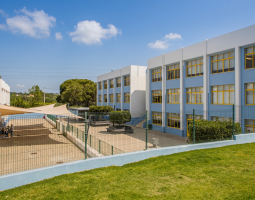
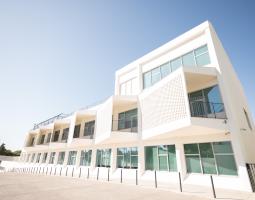
The Lagoa campus occupies extensive grounds in the countryside, with easy access to the Algarve's main towns and Faro airport. Extended and renovated school facilities opened in 2025.
The campus has fully equipped science laboratories. Classrooms and laboratories are air-conditioned. New classroom blocks are complemented by communal areas for socializing. A new dining hall has been built, and the new facilities also offer a multi-purpose gymnasium and performance space.
The preschool has indoor and outdoor space for children. The campus has dedicated outdoor education zones. School uniforms are sold in the school shop. A specialist company supplies the buses used for school transport.
Admission dates and extra charges
Tuition categories cover preschoolers (1 year), classes 1–5, classes 6–8, classes 9–10, classes 11–12 and students ages 12–18.
The indicated cost already includes:
- Studying on the selected program,
- Branded certificate after the end of the program,
- The initial testing of the level of knowledge,
- Accommodation and meals (Twin Ensuite room),
- Guardianship provision (Full time & Weekly Boarders),
- Laundry,
- Health Insurance,
- Supervision,
- Personal assistance,
- Nursing services,
- Boarding facilities,
- Three Return transfers from Faro airport.
Families should budget for admission fees, school transport, canteen lunches and extracurricular activities. Enrollment is finalized with payment of the initial fees.
The following course expenses are not included and are paid separately:
- Consular fee paid at the embassy,
- Boarding Expense Deposit,
- School uniform per annum,
- School books (Y8-Y13) per annum,
- School materials (Y8) per annum,
- Registration fee (including Annual Insurance),
- Round trip air tickets,
- Round trip transfers (Lisbon Airport).
Transfers from Lisbon Airport are charged each way.
Extras:
- Registration fee (for a programme/course) 255 EUR
- Deposit for a course/programme 400 EUR
- Deposit on accommodation 2500 EUR
Enrolment process
The admissions process involves an in-person or virtual meeting with the head of the relevant school campus and section. Families can explore the campus on a personalized tour lasting about an hour. A virtual tour is available for families who cannot visit Lagoa in person.
If no places are available, a child can be placed on a waiting list at the family's request.
Admissions at Lagoa are open year-round, subject to available places.
Entry requirements, how to apply, what is required to enrol
Admission requires:
- Student details and reports from the previous school,
- A copy of the child's identification document,
- A copy of the child's medical information or medical record, including vaccination records,
- Copies of parents' or guardians' identity cards, or passports for foreign citizens,
- Copies of both parents' fiscal numbers,
- For foreign citizens, a copy of the parents' or guardians' Portuguese residence permit,
- Confirmation of both parents' addresses, such as an electricity bill or bank statement.
The Portuguese program accepts children of any nationality.
Literature and references

Institution on the map
Residence permits, citizenship and other services
- Guardianship services during the studies
- Student supervision
Review about Nobel International school of the Algarve
Recommendations on when to apply
| Language courses, schools and children's language camps | Primary and secondary education - private schools | Preparation programmes for entering universities - higher education | Higher education (after completing accredited programs A-level, IB, High School) - Bachelor, Master, MBA |
| - we recommend to apply 6-9 months before the start of the course (some camps and schools offer discounts for early booking or for lengthy study programs) - there are some very popular and high demand children's camps, where the applications need to be submitted 1 year in advance (in particular Switzerland, Great Britain, USA, Canada, Austria) | - we recommend to apply one year before the start of the training program, - some schools have a specific time frame (September-November - please specify an individual school) - some schools require tests in several stages (UKISET, internal tests of the school: English, mathematics, logics, subjects, interview, some require a personal visit) | - we recommend to apply one year before the start of the program, - for Foundation and Pathway programs, IELTS and TOEFL certificates are usually required, respectively | - recommended submission one year before the start of the program, - the deadline normally closes in January, for TOP HEIs and, as a rule, in March in other universities - for a bachelor, a Foundation or Pathway preparatory program a completed A-level, IB, High School + IELTS / TOEFL are required - for Masters you need a graduated higher education, in some cases you need a pre-Masters program - MBA requires completed higher education, work experience preferably at least 2-3 years, etc. |