For partners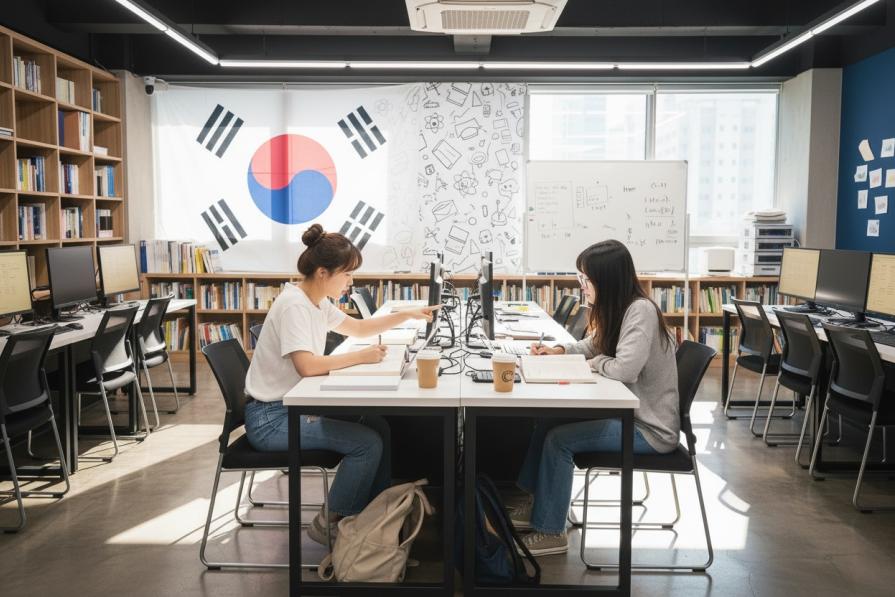
In South Korea, the conversation about education has long ceased to be limited to school and university. More and more often it begins in kindergarten, and sometimes even earlier! Hagwon, private educational institutions, have become not just an addition to the state system, but a parallel reality in which children are immersed from the age of 2-5. This model brings impressive academic results, but at the same time creates chronic stress for both children and parents.


Education as a social elevator and a measure of success
Almost half of South Korean children attend private preschools, most often English-speaking hagwon. An ironic and disturbing expression has long been entrenched in public discourse: "children who take exams in diapers." There is no big exaggeration in it - most children begin to attend hagwon at the age of five, and in some families education starts at the age of two.
In such academies, preschoolers work with textbooks designed for American high school students, and younger students master complex mathematics and academic English long before these topics appear in the state curriculum. As a result, children have little time for free play and spontaneous learning, the very processes that build cognitive flexibility and resilience to stress at an early age.
Preparation is ahead of school

This educational race creates a paradoxical effect. Well-prepared students do not see value in conventional school lessons that seem slow and formal to them, and this, in turn, fuels public criticism of public schools, which are increasingly credited with "poor quality education".
Lim Wong, a professor at the Yonsei University Graduate School of Education, draws attention to the physiological limitations of early learning. According to him, despite the cult of early development, the child's brain is not always ready for such a load: a seven-year-old child is able to master the multiplication table in a few months, while at an earlier age it can take more than a year. Formally, the result will be achieved, but at the cost of overwork and a decrease in internal motivation.
Parental expectations and the price of "investment"
Many South Korean parents genuinely believe that diligent early education guarantees success in adulthood. Often, without realizing it, they project their own fears and unfulfilled ambitions onto children – the stress of expensive education is neatly packaged in the rhetoric of care, but in practice is transmitted to the child in the form of anxiety, exhaustion and a sense of constant duty.
In some families, financial support for education is perceived as an investment that should "pay off" with gratitude and obedience – even in adulthood. This logic links learning with guilt and obligations, pushing the child's personal interests and inner purpose into the background.
The Hagwon Economy

Hagwon become a serious financial burden for most families. Tuition costs affect not only family budgets, but also the real estate market: housing near elite Khagwon is steadily becoming more expensive and in high demand. Areas like Gangnam are turning into educational clusters, where quality of life is directly linked to access to the best academies.
The state has repeatedly tried to limit the influence of the Hagwon, but direct bans have not worked. As a result, a curfew was introduced: after 22:00, special patrols check whether the academies have closed, whether children continue to study there. However, the demand for private education remains high, and restrictions are often circumvented through online formats and in-person classes.
Why does the system continue to exist?
The Hagwon are famous for their strict selection of teachers and strict quality control of education, which is often associated with the high results of South Korean students in international studies, including PISA. However, at the level of higher education, the opposite trend is observed: many experts note a decrease in the independence and academic initiative of students who are accustomed to constant external control.
Hagwon for adults

Modern hagwon have long gone beyond school education: there are academies for retaking entrance exams, transferring to other universities, preparing for public service, and finding work in large corporations. Competition in the labor market makes such courses especially in demand, and lectures on behavior at interviews or writing a resume are perceived as a mandatory stage of career. A separate niche is occupied by professional and creative hugwons: from schools for future esports players to hip-hop academies, the popularity of which has grown after television music shows. Even self-study places in Korea are institutionalized! Reading rooms and study cafes, formally referred to as hagwon, provide silence, workspaces, and infrastructure for concentration. In recent years, they have evolved into stylish spaces reminiscent of European libraries and have become another element of a culture of continuous learning.