
Choosing between a host family and a hotel is one of the key questions when sending a teenager to a language camp abroad. To put it briefly: for language progress and adaptation, staying with a family more often wins out, while a hotel or student residence is better for comfort and independence.
In 2026, most language schools — say, in Malta — offer both options. There is no universal answer to "what is better": the same format can produce completely different results depending on the child's age, language level, personality, and the goals of the trip. For example, for some, staying with a family will be a strong language boost, while for others it will be a source of stress due to unfamiliar rules and way of life.


Differences, pros, cons
The difference between staying with a family and staying in a hotel or residence is not in the level of comfort, as people often think, but in the type of experience the teenager gets. In essence, it is a choice between full language immersion and a more familiar, camp-like environment.
Host family

Staying with a host family is a format of maximum immersion. The teenager becomes part of everyday life: shared dinners, household conversations, watching TV, small requests and dialogues — all of this happens in English. It is precisely this format that provides the fastest progress, because the language is used not only in class but constantly, in a real-life context. Added to that is the cultural experience: the teenager sees the country from the inside rather than as a tourist, and adapts to the new environment more quickly.
But this format has its flip side. First, there is always an element of uncertainty: even with good matching, not every family will be compatible with the child in terms of personality. Second, constant communication in a foreign language can create pressure, especially for shyer or younger teenagers. Add to that the house rules, schedule, and restrictions — and for some this feels like a loss of freedom.
Residence (dormitory)

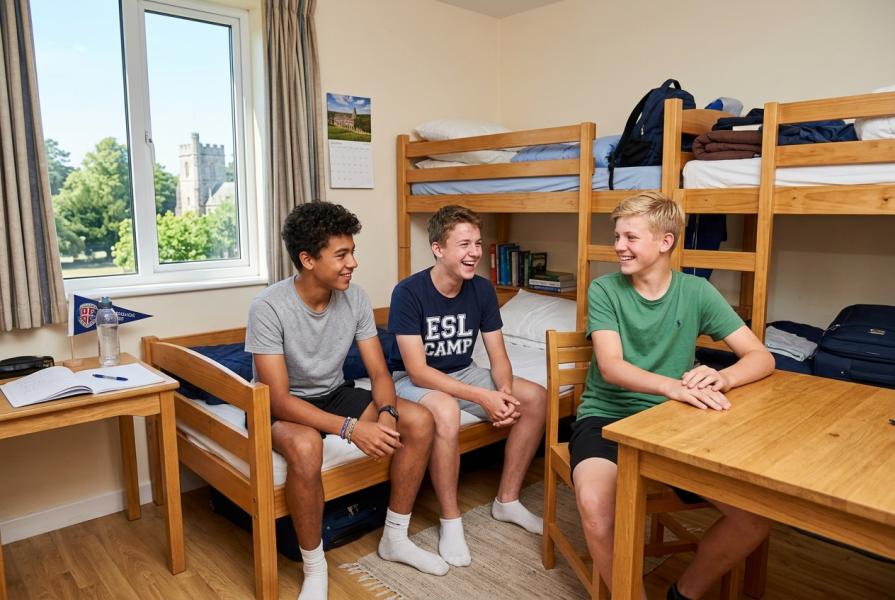
Hotels and residences operate on a different logic: here the teenager lives among peers, in a familiar and social environment. This reduces stress, makes it easier to make friends, simplifies adaptation, offers more activities, providing a constant sense of "I am not alone."
However, there are nuances here as well. The main risk is the so-called "language bubble": teenagers from the same country often communicate with each other in their native language, which reduces the level of immersion. As a result, progress can be slower than when living with a family, especially if the school does not monitor the language environment outside of class.
To summarize, a family is about language, adaptation, and stepping outside the comfort zone, while a residence or hotel is about a social environment, security, and a gentle start. It cannot be said that one option is objectively better than the other.
When should you choose a family, and when a hotel or residence?

The host family format is usually chosen when the purpose of the trip is not just leisure but maximum language immersion. It is especially suitable when it is important to:
- Accelerate conversational English through constant practice,
- Overcome the language barrier,
- Gain a "real life" experience in the country,
- Understand the culture more deeply, not just its tourist side.
In 2026, staying with a family is still considered one of the most effective ways of language practice for teenagers. Who is it suitable for?
- Teenagers aged 13–17 with established basic independence,
- Those who are not afraid of new rules and everyday adaptation,
- Students for whom rapid language progress is important.

Staying in a residence or hotel is more suitable if:
- The teenager is going abroad without parents for the first time,
- Emotional comfort is more important than maximum language load,
- The child finds it easier to study and communicate among peers,
- A more structured, camp-style format of living is needed.
Host family is suitable for younger teenagers and those foreigners for whom group support and the familiar rhythm of a camp are important.
In short, both options work, but they produce different results. Fortunately, in 2026 schools in Malta continue to offer both formats, making it possible to choose accommodation to suit a specific teenager.