Burgess Hill Girls


Programs and prices, tuition fees in Burgess Hill Girls


Quick overview: an educational program of middle scholl (7-9 grades) is designed for international students and provides high standards of education.
About the educational program: At this stage, students learn a wide range of subjects. It helps to more accurately realize student's strengths, abilities and talents, to decide on the disciplines that they would like to study at more challenging levels of GCSE and A-level.
List of subjects to study:
- Geography;
- Natural sciences:
- Chemistry;
- Biology;
- Physics;
- Latin language;
- Mathematics;
- Religious studies;
- Art;
- Music;
- Additional languages from the 8th grade - German and Spanish;
- ICTs;
- English;
- Design and technology (textiles and resistant materials);
- History;
- Physical Culture;
- Drama;
- French.
Quick overview: a GCSE program (10-11 grades) is designed for international students.
About the educational program: This level of education is a universal general GCSE program. Some disciplines are compulsory, the lessons are attended by all students without exception. You can also prepare for the ILETS exam or take a comprehensive course in the natural sciences instead of studying individual subjects and get two Double Award exams.
List of compulsory to study:
- Mathematics;
- English and literature;
- Chemistry;
- Physics;
- Biology.
For a personal curriculum, each student chooses an additional 4 subjects according to his / her taste. Most often the students are guided not only by their own interests, but also by the requirements of the chosen university, the specificity of the future profession.
The list of subjects to choose from is quite extensive and consists of different blocks:
- Humanities and technical sciences;
- Aesthetic directions;
- Modern and classical languages and "English as a foreign language".
Lessons of the French language and mathematics are held in several groups - students are divided according to their own level of knowledge, training and abilities (more in-depth study or a simpler course).
Public services, religious studies, vocational guidance and health education are provided as electives. Exams in these areas do not surrender. A lot of time students devote to sports and active leisure, physical development.
Brief information: an A-Level course for international students, is also known as a Sixth Form (Lower Sixth and Upper Sixth).
About the educational program: On the A-level course, the student can choose subjects at personal discretion from a fairly extensive list (25 different subjects). On the Lower Sixth (first year) 4 disciplines are studied at the AS level, and the second year of training (Upper Sixth) marks a deep, thorough study of 3-4 directions at the complex A2 level.
In addition to the basic subjects (the list is presented below), students can also add Greek and Chinese (at the GCSE level) to their personal curriculum, study ECDL's European computer rights, or engage in the EPQ course (writing, developing and presenting an extended research project).
List of basic subjects to study:
- Mathematicsl;
- Geography;
- English literature;
- Spanish;
- Computer science;
- History;
- Classical civilization;
- Theatrical studies;
- Physics;
- Latin language;
- Design and technology;
- Religious studies;
- Higher mathematics;
- Biology;
- Physical Culture;
- Resistance of materials, textiles;
- Music;
- French;
- Economics;
- Psychology;
- German;
- Art;
- Chemistry;
- Media education;
- Basis of business.
Future Explorers
- Student age: 8-13 years.
- Arrival on Sundays, departure on Saturdays.
- Duration: 2-5 weeks (a minimum three-week course is recommended).
- Number of students: up to 60 per session (national quotas apply).
- Intensity: 18.5 hours of language classes per week, weekly tests to check knowledge.
- Up to 14 people per class.
- Required starting level: any, from A0 to C2. A level test is held on arrival to place students in the appropriate group.
The summer program doesn't just reinforce English skills — it nurtures curiosity, a thirst for knowledge, and leadership qualities in children. Lots of outdoor projects, relevant modern topics, group classes — all of this will help your child come back from summer school a literally different person!
Course content
- English lessons. General understanding of written and spoken language, vocabulary expansion, grammar study, accuracy, correctness and fluency of speech, pronunciation correction.
- Mission Possible. Dynamic «mission» lessons that develop creativity, the ability to collaborate and solve problems together, and communication skills. This comprehensively develops all the skills needed for effective learning in a modern school: fluent English, emotional and physical resilience, interpersonal relationships, motivation, empathy.
- Explorations. Lessons using the CLIL methodology (Content and Language Integrated Learning) — simultaneously improving English and strengthening inner curiosity. Children are offered topics in natural sciences, geography, art, history, design and technology (according to age).
- Afternoon activities. Here students enjoy sports and entertainment activities: this helps them pick up new vocabulary while trying their hand at a new sport or creative pursuit. Badminton, basketball, benchball, circuit training, cooking, costume design, cricket, dance, drama, football, gymnastics, hockey, modeling, mosaic, netball, origami, painting, rounders, singing, swimming, table tennis, tag rugby, tennis — the choice is huge!
- Evening activities. Every day a new exciting adventure awaits students: a disco, a fashion show, karaoke, a mini-Olympics, a music quiz, laser tag, a pool party, a talent show — there's no chance of getting bored!
- Excursions.
- Half-day trips are scheduled for Wednesdays: sights of the nearest town, local events — a beach volleyball tournament, bowling, a park outing, a climbing wall, walks along the pier, a visit to a street market or a museum.
- Full-day excursions take place on Saturdays. This is usually a trip to London (the British Museum, the London Dungeon, the London Eye, Buckingham Palace, London Zoo, Madame Tussauds, the National Gallery, Westminster Abbey, the Science Museum, the Tower of London, the Natural History Museum, Thorpe Park).
- A leisurely, relaxed excursion is organized on Sundays. For example, a trip to the seaside towns of Worthing, Brighton, or Chichester, time on the beach, or shopping.
- Academies Programme. The so-called Academies allow students to dive as deeply as possible into a direction that interests them:
- Art of communication,
- Film and animation,
- LEGO & Coding,
- E-Kart Racing
- Horse riding,
- Tennis.
Available at any English level. Students are offered to choose 1 activity per week: Academy classes are held in the afternoon instead of the standard afternoon entertainment and activities.
At the end of the course, each student will receive:
- A certificate of summer school attendance,
- A full academic report,
- If studying at an Academy — a certificate of completion for the relevant course,
- Any personally earned awards and prizes.
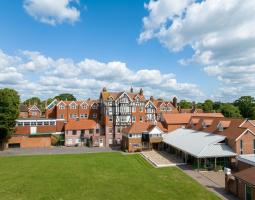
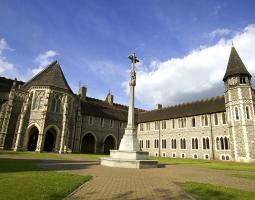
Summer camp students will have the entire main grounds of Burgess Hill to themselves, in a protected green area right in the heart of West Sussex. A wooded setting, spacious fields and training grounds, beautiful historic buildings, modern infrastructure, convenient transport links to London and Brighton, comfortable living conditions — what more could you wish for for the perfect summer?
Description of Burgess Hill Girls
- Location: Burgess Hill, West Sussex,
- Student ages: 4–18,
- School type: independent school for girls,
- Accommodation: on-site boarding.
Burgess Hill Girls is a private school for girls offering daytime education and boarding. The foundation year was 1906, it was the initiative of the responsible parents of the small city of Burgess Hill. The school implemented the system of separate education in the 1920s, and since 1931 it is located at the present place, in the territory of the large national park of Saunts Downs. The school occupies a 14-acre campus in a conservation area close to the center of Burgess Hill in Mid Sussex. 5 minutes separates the campus from the railway station, 16 kilometers from the large seaside resort of Brighton, 50 minutes from central London and 20 minutes from Gatwick International Airport.
The grounds include open playing fields and natural woodland.
Burgess Hill Girls is a large educational complex that divides teaching into several levels:
- Kindergarten (mixed education, 2,5-5 years)
- Junior school (grades 3-6)
- High School (7-11 grades)
- Sixth Form (12-13 grades).
Among the most famous and well-known alums, the following female names:
- Two-time world champion Caroline Atkins
- Model and TV presenter Holly Willoughby
- Kim Sears
- Members of the British cricket team
- Artist, friend of the famous Scottish tennis player Andy Murray.
Girls from all over the world can enter the British boarding school from 11 years old and over (Grade 7), the majority of foreign women enter the 9,10,12 classes. Classes start traditionally in September, but applications are accepted year-round - if vacant places still exist, a girl can be accepted for a course outside the main stream.
The basis for the creation of the Burgess Hill Girls for Girls was the ideas of Charlotte Mason, which in many ways survived to this day. She developed a progressive educational model, which is now used in a variety of US schools, and at the turn of the 19th century was simply revolutionary. Following the basic postulates of this model, in girls the characteristics are brought up kindness, punctuality, truthfulness, accuracy, attentiveness and other useful habits and valuable social qualities. Many parents note that after school, girls have impeccable manners and excellently know the etiquette. The motto of the school is "I am, I can, I have to, I will do it."
Each foreign student on admission is tested, determining his level of English. If it is not high enough, the student is invited to attend an additional supportive course EAL (English as a foreign language), as well as additional lessons for a fee. All classes are conducted in small groups, which positively affects the dynamics of learning and the speed of educational progress. In the 9th grade there are 3 additional lessons per week. In the 10th grade, teachers determine whether the student is ready to surrender the GCSE and fully absorb the material in English classes and literature. If the knowledge is not enough, 6 English lessons are given every week (instead of basic English classes and literature at the GCSE level). On the supporting course, you can also effectively prepare for the IELTS international test (it is conducted in the 11th form in the spring trimester). The results of this exam are highly appreciated all over the world, recognized by the universities of Britain, Canada, and Australia. Participants in the Six Form programs prepare for the IELTS test for 2 lessons per week.
Academic classes are held from 8:30 to 15:50, students of Six Form are engaged a little longer, until 16:25. The second half of the day is devoted to facultative, extra-curricular and sports activities. Until now, the institution adheres to the rules and principles created by Charlotte Mason. In particular, it concerns a balanced curriculum and the compulsory study of several foreign languages. Much attention is paid to the subjects of aesthetic orientation: in the 7th to 9th grade, students necessarily engage in music (once a week 70 minutes) and drama (twice a week). These subjects can be studied at a more in-depth level of A-level and GCSE in the UK, taking individual lessons for an additional fee.
Beginning with the 9th grade, the students attend classes dedicated to career counseling and a special course "Life Skills": psychology of communication, first aid, cooking, self-defense, night hikes, thematic lectures, meetings and master classes.
Educational process
Senior School and Sixth Form hold regular age-appropriate sessions on mental health. Prep School holds weekly sessions focused on children's well-being.
From Reception through Year 6, girls receive support from class teachers, teaching assistants, and other staff. Additional help includes targeted sessions, small-group work, short-term interventions, and individual mentoring. Girls with specific learning needs may attend paid individual sessions with a dyslexia specialist.
One Page Profiles are developed with students, teachers, and parents and updated each term. During the first two years of Senior School, girls belong to consistent tutor groups that form the basis of most classes. Each student is assigned a mentor from the teaching or support staff for regular meetings.
Faculties and colleges
- Years 7 and 8 make up the Lower School within the Senior School.
Things to know about
- The oldest buildings on campus date to 1704. The architectural complex combines Victorian, Edwardian, and contemporary buildings,
- The school incorporated the Halo Code into its uniform policy and removed restrictions on afro-hairstyles for Black students.
University destinations
- A BOLD Award recipient went on to study French and Politics at Bristol University.
Accommodation, meals, prices
Two residences of Burgess Hill Girls are located directly on campus, one is across the street, a short walk away. Most of the students at the board are foreign students. Junior students live in rooms for 3-4 people, high school students occupy separate bedrooms. In residences there are cozy common living rooms for rest, laundry and kitchens, computer and game classes, access to wireless internet, studios for playing piano and practicing music. Kitchens also have all the necessary equipment to prepare a light dish or snack: microwave ovens, toasters, refrigerators and dishwashers. Laundry services are provided to pupils of 7-11 class, participants wash their clothes themselves. Each hostel is surrounded by a beautiful picturesque garden - it is especially nice to relax and take a walk on a fine day, have a picnic or barbecue.
In each residence there is a tutor and three of his assistants: they monitor the order and discipline, keeping cleanliness, guarantee the complete safety of girls. Necessary things and household trivia can always be bought at any city store.
The meals are organized according to the full boarding scheme - three times a day the schoolgirls gather in a spacious common dining room. The diet includes hot dishes, salads, snacks and desserts, fresh fruit, often organized themed days, in which cooks prepare dishes of different peoples of the world. Vegetarian, dietary dishes, as well as dishes for representatives of strict religions (for example, Islam or Judaism) are provided. In the hostels there are also drinks and snacks - girls can have a snack in the evening or have a cup of tea or coffee with friends.
Each student has her own class teacher - she meets with him twice a day and at any time if necessary: he is responsible for her progress and successes, guarantees comfort and safety of stay on campus, stimulates active out-of-class activities and participation in electives. Pupils of grades 7-10 do homework with the teacher, while high school students enjoy greater freedom.
Parents constantly receive interim reports on the progress, extracurricular successes and behavior of their children, and at the end of the year an additional final, detailed report. Burgess Hill Girls website and school magazine also provide enough information (including online score sheets). Please note that students of all ages who come from abroad must have a guardian (a citizen of the host country is older than 25 years).
Silverdale House provides on-site accommodation for boarders and is regularly refurbished. Short-stay boarding is available for one, two, or three terms.
A large, bright dining hall serves day students and boarders. The school kitchen prepares meals seven days a week and asks students for ideas for themed days and new dishes.
Subjects and sports
Activities Burgess Hill Girls
Of the most popular sports you can note the following options:
- Frisbee
- Fitness
- Badminton
- Cross Country
- Athletics
- Hockey
- Tag-rugby
- Zumba (aerobics for Latin-American music)
- Ultimate
- Tennis
- Lapta
- Netball
- Squash
- Football
- Basketball.
On the campus there is a huge number of clubs, and sections by interests - we list some options:
- German
- Chess
- Wind Ensembles
- Horse Riding
- French Movies
- Individual Learning to Play the Musical Instruments
- Mathematics
- Making jewelry
- String ensembles
- Philosophy
- Chinese
- Orchestra
- Spanish
- Theater Technicians' Club
- Natural Sciences
- Glee Club (society for choral a capella)
- Journalism
- Movies
- Dancing
- The debate
- The Drama Club
- Photography
- Choirs
- Textiles
- Classical languages
- Big band.
Girls constantly go in for sports, play musicals, concerts, participate in dance and vocal competitions, conduct dramatic competitions between residences.
Senior students (usually 14 years and over) can compete for the Duke of Edinburgh Prize, participate in the Student Council or in the scheme "Young Entrepreneurs". The career counseling program offers various seminars in Oxbridge, conferences with large companies (such as Porsche, CAE and Roche). On weekends, girls are invited to do needlework, skate or swim, go on a hike or a sports match, visit a movie, theater, bowling, a theme park, participate in a variety of quizzes, competitions and contests.
Advantages
Burgess Hill Girls is proud of the successes of its graduates:
- In 2013, according to GCSE results, 62.5% received grades from A* to A
- In 2013, the A- Level for high scores A* -B passed 81% (including the highest score in mathematics for all girls, as well as A* -A scores in Spanish and French)
- 11th place among the best private schools for girls in England (based on A-level results for 2012)
- 137th place among the best high schools (Financial Times, 2011 )
- 129th place among the best private schools (Financial Times, 2011).
Most often yesterday's schoolgirls choose to continue their studies in the following universities and areas:
- The Royal Academy of Dramatic Arts
- The London School of Economics (Management)
- Oxford (Anatomy)
- Bristol (Mathematics)
- Birmingham (psychology)
- Cambridge (Chinese)
- The Royal College of London (Mathematics)
- Exeter (History, Foreign Languages)
- Leeds (International Relations).
Facilities and equipment at Burgess Hill Girls
Little Oaks was built in 2008 for the Nursery and younger grades. The Pre-Prep and Prep School occupies a renovated Edwardian villa with a learning center, computer room, cooking and technology facilities, and landscaped grounds. Webb House is the main Senior School teaching block and includes the Learning Resource Centre, computer rooms, and modern classrooms.
Croft II was completed in 2014 and contains drama, performance, and music facilities and a tiered auditorium with 320 seats. A separate Music School contains modern rehearsal and teaching rooms. The Sixth Form Centre is in Cedar Lodge, with lecture rooms, study areas, and common rooms. The Art Department has light rooms, an exhibition area, and dedicated Sixth Form studios for A Level study.
The science center was renovated in 2010. Chemistry, biology, and physics laboratories are located on separate floors.
Sports facilities include fields for athletics, hockey, and summer sports, floodlit tennis and netball courts, and a floodlit 3G field.
The medical center includes a separate three-bed sick bay and is staffed by a Registered Sick Children’s Nurse from 08:00 to 16:00. Many staff hold first-aid certificates and receive training in the use of adrenaline auto-injectors and the treatment of anaphylaxis.
Admission dates and extra charges
- Pre-Prep and Prep School provide free before- and after-school care from 08:00 to 18:00,
- school fees include lunch, regular academic costs, science and art materials, and textbook loans through Year 11,
- students in Years 10 and 11 are encouraged to purchase some English course texts, while Sixth Form fees do not include textbooks,
- registration fees apply to the main school and Nursery, with VAT included in both fees,
- all fees must be paid in pounds sterling.
Extras:
- Registration fee (for a programme/course) 100 GBP
Entry requirements, how to apply, what is required to enrol
Senior School entrance assessment includes:
- a mathematics paper,
- an online cognitive ability test,
- a creative writing task.
Sixth Form admission includes a taster day and/or an online CAT4 cognitive ability test. The school also reviews the applicant's school report, predicted grades, and a reference. Applicants for a Sixth Form academic scholarship also complete written English and mathematics papers.
Boarding applicants provide a copy of their latest school report and passport. They complete written English and mathematics papers and an online cognitive ability test. Shortlisted candidates attend an online interview, and the school requests a reference from their current school.
Children applying for Reception, Year 1, or Year 2 are assessed informally during a taster day. Applicants for Year 3 and above complete a written paper and CAT4 test. Girls moving from Nursery to Reception are not assessed and do not attend a taster day. The school requests a Nursery report and, where possible, the Reception teacher visits the child in her Nursery setting.
Scholarships Burgess Hill Girls
- Year 7 and Year 9 applicants may apply for Art, Drama, Music, and Sport scholarships, with a specialist assessment and interview,
- entrance examination participants are automatically considered for an academic scholarship, and those scoring in the highest percentile are invited to an interview,
- Sixth Form offers academic, Art, Drama, Music, and Sport scholarships, and each applicant may apply for no more than two scholarships,
- scholarships for Year 5 entry recognize academic or musical achievement and continue through the end of Year 8,
- the sibling discount is 5% for the second child, 10% for the third, and 15% for the fourth, and it does not apply to Nursery,
- means-tested bursaries are based on family income and resources, with applications reviewed confidentially by an independent party,
- most bursaries cover 10–30% of school fees, while more substantial support may be available based on family circumstances up to a standard maximum of 50% of published fees,
- bursaries cover day tuition only, while boarding and additional expenses are paid separately,
- bursaries are reviewed annually and may change with the family's circumstances.
Institution on the map
Residence permits, citizenship and other services
- Guardianship services during the studies
- Student supervision
Review about Burgess Hill Girls
Recommendations on when to apply
| Language courses, schools and children's language camps | Primary and secondary education - private schools | Preparation programmes for entering universities - higher education | Higher education (after completing accredited programs A-level, IB, High School) - Bachelor, Master, MBA |
| - we recommend to apply 6-9 months before the start of the course (some camps and schools offer discounts for early booking or for lengthy study programs) - there are some very popular and high demand children's camps, where the applications need to be submitted 1 year in advance (in particular Switzerland , Great Britain , USA , Canada , Austria) | - we recommend to apply one year before the start of the training program, - some schools have a specific time frame (September-November - please specify an individual school) - some schools require tests in several stages (UKISET, internal tests of the school: English, mathematics, logics, subjects, interview, some require a personal visit) | - we recommend to apply one year before the start of the program, - for Foundation and Pathway programs, IELTS and TOEFL certificates are usually required, respectively | - recommended submission one year before the start of the program, - the deadline normally closes in January, for TOP HEIs and, as a rule, in March in other universities - for a bachelor, a Foundation or Pathway preparatory program a completed A-level, IB, High School + IELTS / TOEFL are required - for Masters you need a graduated higher education, in some cases you need a pre-Masters program - MBA requires completed higher education, work experience preferably at least 2-3 years, etc. |