Wycombe Abbey School


Programs and prices, tuition fees in Wycombe Abbey School


Quick overview: GCSE program is represented at the school in different variants for classes. The program is designed for international students and includes the highest standards of education.
7-8 grades
At this stage of education, girls acquire fundamental knowledge of the main subjects of secondary school:
- The Basics of Religion;
- History;
- English;
- Geography;
- Art;
- The natural science unit (biology, chemistry, physics);
- Technology and Design;
- Physical Culture and sport;
- Information Technology;
- Mathematics;
- Foreign languages:
- Spanish;
- French.
In addition, you can learn classical languages (Latin or Greek), and eighth-grade students can add German to the curriculum, if they plan to study it in further classes.
Grade 9
In the ninth class, the students are introduced to the basic requirements and characteristics of the I / GCSE exam, which equates to a successfully mastered high school program. The list of subject to study is quite large:
- Latin language;
- Mathematics;
- Physical training and sports;
- English;
- The Basics of Religion;
- The natural science unit (biology, chemistry, physics);
- Art;
- History;
- Drama and theatrical art;
- Geography;
- Music;
- Computer and Information Technologies;
- Technology and design.
Additionally, you can attend the introductory course of the Spanish language (for beginners). There are additional lessons on the full preparation for the I / GCSE exams. The period of the additional educational program is in the last semester of the 9th grade.
10-11 grades
The main goal of educational staff at this stage of training is to effectively prepare girls for the successful pass of the GCSE. The school is deservedly proud of the successes of its graduates, the high test scores for all exams and is doing everything possible to keep the level of academic achievement growing, which helps it to remain one of the most elite, prestigious, ranking British schools.
List of the required subjects for study:
- The natural science unit (biology, chemistry, physics);
- English Language and Literature;
- Mathematics;
- Modern foreign language (Spanish, German or French).
Each student also chooses 4-5 top priority and interesting disciplines from the list below:
- Music;
- Foreign language (Spanish or German);
- Latin language;
- Art;
- Information technology;
- Basics of Business;
- History;
- History of world civilizations;
- Geography;
- Theatrical art and drama;
- Technology and design (graphics + production).
The sport part of the educational program is also highly developed.All students spend quite enough time at different sports activity and attend physical education classes.
Brief information: A-level program (12-13 forms) for international students.
About the educational program: Graduation, senior classes - this is the time for the maximum manifestation of their talents, abilities and skills, for in-depth study and acquisition of useful academic skills. To pass the A-level program, designed for 2 years, international students choose 4-5 priority disciplines (the general list for selection includes 24 subjects), and attend a mandatory course of AS aimed at developing critical thinking. A-level is considered the main, the most popular program - but at the request of the graduate of the school, Pre-U courses can also take place.
Description of Wycombe Abbey School
- Language of instruction: English
- Established: in 1896
- Location of Wycombe Abbey School: High Wycombe, Buckinghamshire
- Age of student: From 11 to 18 years
- Educational programs in Wycombe Abbey School: senior school, GCSE, A-level
- Total number of students: 540 pupils, of them 510 at the boarding school.
- Type of study: single (only for girls)
- Type of accommodation: residence.
Wycombe Abbey School is an elite boarding school for girls, founded on September 26, 1896. Today it is one of the most prestigious, respected and large schools of separate education - the total campus area reaches 160 acres. In 2011, according to the Sunday Times newspaper, the institution became the best independent school in Great Britain, and also received an honourable 3rd place in GCSE examinations and 4th place in the A-level exams. Graduates demonstrate a deep level of knowledge, a broad outlook, pass national and international exams perfectly and without special difficulties enter the most prestigious and ranking universities in Britain.
The school is located near the city of High Wycombe, Buckinghamshire, the journey to London takes approximately 1 hour.
The institution works in accordance with the national curriculum of the official British education system, seeks to give the students full, deep, versatile academic knowledge on a fairly wide range of subjects. When a student moves to a higher level of education (upper classes), her individual inclinations, desires, academic and career needs are taken into account for compiling an individual curriculum.
Educational process
Education at the school develops a willingness to tackle challenges, resourcefulness, determination, reflection, and the ability to improve. At GCSE, students choose their own combination of disciplines without predetermined option blocks. Practical work in A-Level Biology develops scientific techniques and skills in processing and presenting data. Younger students regularly work in the laboratory in Chemistry. Computing lessons use Raspberry Pi, VR headsets, BBC micro:bit, and robotics. The Design and Technology workshop opens in the evenings and on weekends for examination groups. Geography fieldwork takes place in London, Somerset, and at Juniper Hall FSC. At A-Level, students develop their own hypotheses, collect data, and reach independent conclusions.
The Learning Enhancement Department provides individual lessons and consultations for students with specific learning needs. Students whose first language is not English can receive language support, including preparation for an English language test and IGCSE for those entering Sixth Form without a GCSE in English. Three one-to-one tutors support the Mathematics department, and older students help younger girls. The youngest year group begins Mathematics in mixed-ability classes before students are divided into groups by ability. Taking a language GCSE privately does not replace the compulsory language GCSE or IGCSE in the school curriculum. Native speakers may take an additional GCSE early after a diagnostic assessment. Music education involves 40 full-time and visiting staff, with ABRSM examinations every term. Advanced musicians receive support in balancing academic work, practice, and performances.
All Sixth Form students follow the Carrington Programme, which develops critical thinking, leadership, research, and presentation skills, and provides careers education and guidance on health and wellbeing. Tutors help students choose a university major and prepare personal statements and references. Students prepare for university through weekly lessons, mock interviews, and an academic forum with local boys’ schools. A dedicated office and an in-house Counsellor support preparation for US universities. Future Ready Week and careers events introduce students to different professions. The vast majority complete at least two weeks of work experience, after GCSE examinations and during the summer of their first Sixth Form year. The sports Performance Programme helps students balance academic work and athletic preparation, with strength and conditioning, injury prevention and rehabilitation, mentoring, and educational sessions on sports performance.
Senior Houses have a system of mutual support between older and younger students. The school doctor is available four times a week, and a physiotherapist visits several times a week. Individual and group counseling are available. The Chaplain supports students and their families regardless of faith. House meetings take place twice a week to discuss ideas and news, and representatives from each year group participate in the School Council. In their final year, students learn to manage their house budget, cook, and do their own laundry with staff support. Families receive free access to The Wellbeing Hub, which offers podcasts, webinars, and expert guidance. The wellbeing program focuses on a different theme each term and provides materials for parents.
Faculties and colleges
| Stage | Curriculum |
|---|---|
| Ages 11–13 | English, mathematics, sciences, and humanities. Classical and modern languages, computing, creative disciplines, cookery, physical education, and wellbeing lessons. Students choose two modern languages from Chinese, French, German, and Spanish. |
| Ages 13–14 | The compulsory curriculum is supplemented by at least two, usually three, disciplines chosen from art, design and technology, drama, and music. Students take two or three modern languages, one of which may be new to them. |
| GCSE and IGCSE | English Language, English Literature, and Mathematics are compulsory. Students must take at least two sciences from Biology, Chemistry, and Physics. Most choose all three. At least one modern language is required. |
| A-Level | Students initially choose four disciplines from 26 options and may drop one later. Sixth Form offers independent research through the Extended Project Qualification and University Preparation Project. |
Academic disciplines and examination programs:
- Art: AQA GCSE and A-Level. At GCSE, independent practical work culminates in an individual exhibition. At A-Level, students undertake more in-depth investigative work,
- Biology: Edexcel IGCSE explores the human organism, plants, and the environment. Edexcel A-Level introduces biochemistry and epigenetics,
- Chemistry: Edexcel IGCSE explores the nature of matter, reactions, industrial processes, and metal extraction. OCR A-Level examines chemical reactivity and rates of reaction,
- Physics: Edexcel IGCSE involves practical work and explores astronomy and cosmology. AQA A-Level introduces Quantum Physics and the Standard Model of Particle Physics,
- Modern languages: Edexcel IGCSE in French, German, and Spanish, with all three also available at A-Level. AQA GCSE Chinese is designed for non-heritage speakers, who can progress to HSK levels 3 and 4 in Sixth Form. Additional French courses prepare students for DELF B1 and B2,
- Italian: AQA GCSE in Sixth Form is a beginner course unsuitable for native speakers, with the examination in the summer of the final year. Private extra lessons can usually be arranged in other languages, including Russian, Italian, Arabic, Japanese, Hindi, Polish, and Turkish,
- Classics: Latin and Greek. OCR GCSE involves reading classical authors in the original language, and OCR A-Level explores four texts from different genres over two years. Classical Civilisation is available without prior experience in Classics and explores texts in translation, sculpture, and art,
- Computer Science: OCR GCSE and A-Level. Students explore how computers work, programming, and problem-solving. A-Level introduces data structures and Boolean algebra,
- Design and Technology: Cambridge IGCSE develops skills in technical drawing, prototyping, making, and computer-aided design. AQA A-Level combines materials science and manufacturing techniques with practical projects,
- Drama: Eduqas GCSE is assessed through 60% practical work and a 40% written examination. AQA A-Level consists of Creating Drama, Making Theatre, and Analysing Drama and Theatre,
- Economics: Edexcel Economics A at A-Level. A-Level Politics explores government in the UK and US, conservatism, liberalism, socialism, and nationalism,
- English Literature: OCR A-Level explores Hamlet, A Doll’s House, poems by Christina Rossetti, The Great Gatsby, and The Grapes of Wrath,
- History: Edexcel IGCSE explores Weimar and Nazi Germany, China from 1900 to 1989, the Cold War, and the Vietnam War. AQA A-Level explores Stuart Britain 1603–1702 and Russia 1917–1953, with coursework on India’s quest for independence in 1857–1947,
- Geography: Edexcel IGCSE combines physical and human geography with fieldwork in river and urban environments,
- History of Art: Edexcel explores identity and nature in art and architecture, the Renaissance in Italy in 1420–1520, and the Baroque in Catholic Europe in 1597–1685,
- Mathematics: Edexcel IGCSE, with the AQA Level 2 Certificate in Further Mathematics available to the strongest students. Sixth Form offers Edexcel A-Level Mathematics and AS and A-Level Further Mathematics,
- Music: Edexcel GCSE and A-Level develop analysis, performance, and composition,
- Physical Education is compulsory for all year groups and is also available as an examined discipline at GCSE and A-Level. AQA GCSE assessment is 60% theory and 40% non-examined work, with assessment in three sports and a written analysis of students’ own performances. AQA A-Level explores anatomy, physiology, skill acquisition, biomechanics, and sports psychology. Assessment consists of two written examinations and a non-exam component worth 30%,
- Psychology: A-Level combines essay writing, mathematical skills, and scientific inquiry, exploring conformity, attachment, aggression, and research methods,
- Religious Studies: OCR GCSE explores Christianity, Islam, philosophy, and ethics. A-Level examines theology, philosophy, ethics, logical positivism, philosophy of mind, and business ethics.
Additional qualifications:
- The Leiths Certificate in cookery in the first year of Sixth Form,
- ISTD Tap and Modern and RAD ballet qualifications, from beginner through advanced and vocational levels,
- LAMDA examinations at Grade 3–8 in acting, public speaking, verse and prose, Shakespeare, and musical theater,
- Level 2 in Community Sports Leadership and Level 3 in Sports Leadership. Level 2 involves organizing sports activities and helping at competitions. Level 3 is available in Sixth Form, takes two years, and requires 14 hours of volunteer service.
Scientific achievements
Students have achieved national success in entrepreneurship, science, and sports:
- Re-Soul was the national Tycoon winner in the 16–18 age category in 2020–2021 with a project that upcycled old shoes through artistic decoration. In 2023, Anectote was the overall national Tycoon winner, and in November 2024, Bag-ette was runner-up in its age category,
- The school’s four Tycoon teams for 2021–2022 jointly received the Buckinghamshire Award for Enterprise from the Peter Jones Foundation,
- The school has won the UK Space Design Competition and achieved success in the Alan Turing Cryptography Competition,
- In 2023, the athletics team reached the ESAA National Track and Field Cup Final. In 2023/2024, the school’s athletes won gold medals at both the ESAA Cross Country Cup and Individual Cross Country Champs,
- Students have represented England, Wales, Scotland, Italy, Sweden, China, and Korea at U19 level in lacrosse at European and World Championships.
Notable alumnae include:
- Penelope Fitzgerald — a novelist who won the Booker Prize in 1979 and the Golden PEN Award in 1999,
- Elsie Bowerman — a survivor of the sinking of the Titanic who became the first female barrister at the Old Bailey in 1924 and led the status-of-women section of the United Nations in 1947,
- Elizabeth Butler-Sloss — the first woman to lead the Family Division of the High Court of Justice, appointed in 1999,
- Dame Sue Carr — the first woman to serve as Lady Chief Justice of England and Wales,
- Emily (Eve) Best — an actress who played Princess Rhaenys Targaryen in House of the Dragon and won the 2006 Olivier Award for Best Actress for the title role in Hedda Gabler,
- Francesca Zino — a member of Team GB’s rowing squad at the 2000 Olympics in Sydney,
- Clarissa Ward — a CNN international correspondent and winner of two Emmy awards.
One graduate worked as a Systems Testbed Engineer at NASA’s Jet Propulsion Laboratory on the Mars 2020 Rover Mission.
University destinations
Graduates’ higher education destinations include the following UK universities and institutes:
- University of Oxford — graduates have received offers for History of Art,
- University of Cambridge — graduates have received offers for History of Art,
- Courtauld Institute of Art — graduates have received offers for History of Art,
- Imperial — a Russell Group destination for students entering university,
- UCL — a Russell Group destination for students entering university,
- Durham — a Russell Group destination for students entering university.
Accommodation, meals, prices
The Wycombe Abbey School has a separate, comfortable Junior Residence (for girls 11 years old): thanks to living here they can get used to the academic environment of the new school, to live away from home and relatives, to quickly adapt and make new friends.
The remaining 9 residences are intended for students aged 12-17: each accommodates 45 people, the residents are divided according to the age principle. Each student in her own dormitory is responsible for a certain field of activity: this forms a more cohesive team, bringing up responsibility and a sense of belonging to a single student brotherhood. Each residence has its own commandant from among the teachers who is responsible for the complete safety of the students and monitors the order, cleanliness, discipline.
Wycombe Abbey School students are provided with a full-fledged, balanced meal on a full board basis - mostly European cuisine. Thematic weeks are regularly held, providing an opportunity to try the dishes of different nationalities and countries: most often the chef chooses one of the nationalities represented by the students, and prepares the branded, popular dishes of this country. The menu is updated every week, in more detail with its components can be found on the website of the school.
Each student has a personal tutor who follows her behavior, well-being, progress, maintains psychological comfort, helps in adaptation. Parents receive a full report on the progress of their child each semester - it also includes personal recommendations and comments from teachers in various subjects. The educational institution uses a unique card system: all pocket money the student is credited to a card that they can pay at the school store. Here you can buy everything you need: stationery and educational supplies, sweets and food, drinks, sports uniforms and equipment, toiletries, etc.
Subjects and sports
Activities Wycombe Abbey School
The institution pays great attention to the physical development of its pupils: there are a huge number of sections, clubs and circles here. The girls are taught by professional coaches and instructors, there is all the necessary equipment. Each year, student groups travel to Florida for a major tennis tournament, and the team on lacrosse is among the best across the UK. The most popular sports activities are:
- Lacrosse
- Climbing
- Grabbing
- Basketball
- Tennis
- Badminton
- Fencing
- Polo
- Squash
- Horse riding
- Pilates
- Golf
- Kickboxing
- Judo
- Karate.
Do not stand aside creatively gifted students - for them the doors of more than 50 clubs and circles are opened. Many of them are managed by the students themselves in interaction with the studying staff. The Wycombe Abbey School Administration always welcomes the creation of new associations and clubs, encourages the initiative and seeks to give girls maximum opportunities for comprehensive implementation.
Students' days off are dedicated to interesting, varied leisure and entertainment, which the management and educators arrange throughout the school year. Students go to theme parks, visit cinemas and shopping centers, participate in master classes in needlework and cooking. There are always discos and fun themed parties: the girls rest with the representatives of other famous schools - Eton, Winchester College and Radley. The foreign students of each residence organize joint tours of English cities at the end of each academic semester.
Advantages
- The school’s Wycombe Abbey Rowing Club is affiliated with British Rowing.
Facilities and equipment at Wycombe Abbey School
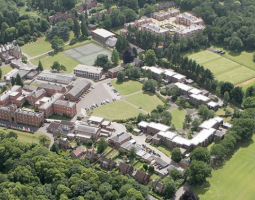
The total campus area reaches 160 acres - a well-maintained land with lots of green spaces, parks and lawns. Here reigns a calm, quiet, peaceful atmosphere of the British suburbs, where schoolgirls are not distracted from the learning process, where the noise of a big city does not interfere. If necessary, girls can always visit the nearest town of High Wycombe: go to a store, cinema, entertainment or shopping center, spend time in a cafe or coffee shop.
Despite the maintenance of the traditional way and the atmosphere of the past, Wycombe Abbey School is well equipped and fully complies with all modern education standards. Recently, a new functional sports complex was opened with a spacious heated swimming pool (25 meters), a sports hall, a climbing wall, a dance studio, a fitness center and squash courts. The territory has its own Center for Fine Arts, which includes a student theater and a concert venue for languages, as well as a special large Center for Modern Foreign Languages.
Admission dates and extra charges
The academic year is divided into traditional trimesters, interspersed with vacations for students' leisure:
- Autumn: from September to December,
- Spring: From January to March,
- Summer: April - July.
Each term has two three-day Short Leaves and one Long Leave of approximately 7–10 days. All students return to their parents or guardians during these breaks. A number of additional weekends at home are also allowed. Two weekends each term are Closed Weekends, when all students remain at school for shared activities and trips.
The main sports fixtures take place on Wednesday and Saturday afternoons. The whole school meets in the Chapel for a short service twice a week. Evensong takes place on Sundays, with Holy Communion during Closed Weekends. The DELF examination takes place in June, and LAMDA examinations take place in the Spring and Summer Terms. Private language lessons in the final year usually finish at the end of the Autumn Term to allow time for A-Level preparation.
School fees include:
- Tuition,
- Meals,
- Accommodation,
- Laundry,
- Personal accident insurance,
- Some educational materials and educational visits,
- The weekend activities program.
Almost all weekend activities are included in the school fees. Please note that there are some surcharges and fees not included in the basic cost of the program:
- Registration fee,
- Deposit for confirmation of place on the program,
- Supporting English language courses for foreign boarders (ESL) ,
- Registration in the guardian agency and guardian services,
- Initial knowledge level testing,
- Individual tuition,
- On-site summer athletics sessions with an external coach,
- Additional ballet, tap, modern, and jazz lessons when offered as paid extras,
- The separate golf lessons program.
Extras:
- Registration fee (for a programme/course) 250 GBP
- Deposit for a course/programme 13500 GBP
Perspectives
Examination results:
| Program and period | Results |
|---|---|
| GCSE, 2025/2026 | 95% of examinations were awarded grades 7–9. 60.82% received the highest grade, 9. |
| A-Level, 2026 | 46.6% of examination results were A*, and 82% were A* or A. All results were in the A*–C range. |
Each year, approximately one-fifth of the graduating year group secures places at Oxford or Cambridge. Some students continue their education in the United States and other countries.
Entry requirements, how to apply, what is required to enrol
As with other prestigious and popular British schools, applications for enrolling in Wycombe Abbey School are accepted in advance, about one and a half to two years before the expected start of classes.
The procedure is as follows:
- The registration form is filled in,
- Admitting girls are invited to the school, where they are interviewing in personal and group sessions together with other applicants for studying,
- In the school, a small test is conducted to determine the general level of knowledge.
If all the stages were passed successfully, the student receives a conditional place. In order to confirm this place, it is necessary to pass a common exam in English (Common Entrance Test), as well as testing in mathematics and natural sciences. Tests are conducted approximately six months before the official enrollment (in January or February), for them the educational organization ISEB (Independent Schools Examination Board) is responsible.
The main entry ages are 11, 13, and 16. Places occasionally become available in other year groups. The school seeks motivated girls who are ready for boarding and eager to participate in all aspects of school life. It uses its own materials to assess applicants’ academic potential and suitability for the school. Sixth Form accepts both the school’s own students and applicants from other schools.
Scholarships Wycombe Abbey School
Scholarships and bursaries are available for entry at ages 11, 13, and 16. Academic and arts scholarships and Exhibition Awards recognize excellence, achievement, and potential. Financial support through these awards is limited. Music scholarships are also available.
Academic scholars are expected to produce original research or a reflective piece over the summer holidays and present their work at the Scholars’ Presentation evenings in the Autumn Term.
Institution on the map
Residence permits, citizenship and other services
- Guardianship services during the studies
- Student supervision
Review about Wycombe Abbey School
Recommendations on when to apply
| Language courses, schools and children's language camps | Primary and secondary education - private schools | Preparation programmes for entering universities - higher education | Higher education (after completing accredited programs A-level, IB, High School) - Bachelor, Master, MBA |
| - we recommend to apply 6-9 months before the start of the course (some camps and schools offer discounts for early booking or for lengthy study programs) - there are some very popular and high demand children's camps, where the applications need to be submitted 1 year in advance (in particular Switzerland , Great Britain , USA , Canada , Austria) | - we recommend to apply one year before the start of the training program, - some schools have a specific time frame (September-November - please specify an individual school) - some schools require tests in several stages (UKISET, internal tests of the school: English, mathematics, logics, subjects, interview, some require a personal visit) | - we recommend to apply one year before the start of the program, - for Foundation and Pathway programs, IELTS and TOEFL certificates are usually required, respectively | - recommended submission one year before the start of the program, - the deadline normally closes in January, for TOP HEIs and, as a rule, in March in other universities - for a bachelor, a Foundation or Pathway preparatory program a completed A-level, IB, High School + IELTS / TOEFL are required - for Masters you need a graduated higher education, in some cases you need a pre-Masters program - MBA requires completed higher education, work experience preferably at least 2-3 years, etc. |