For partners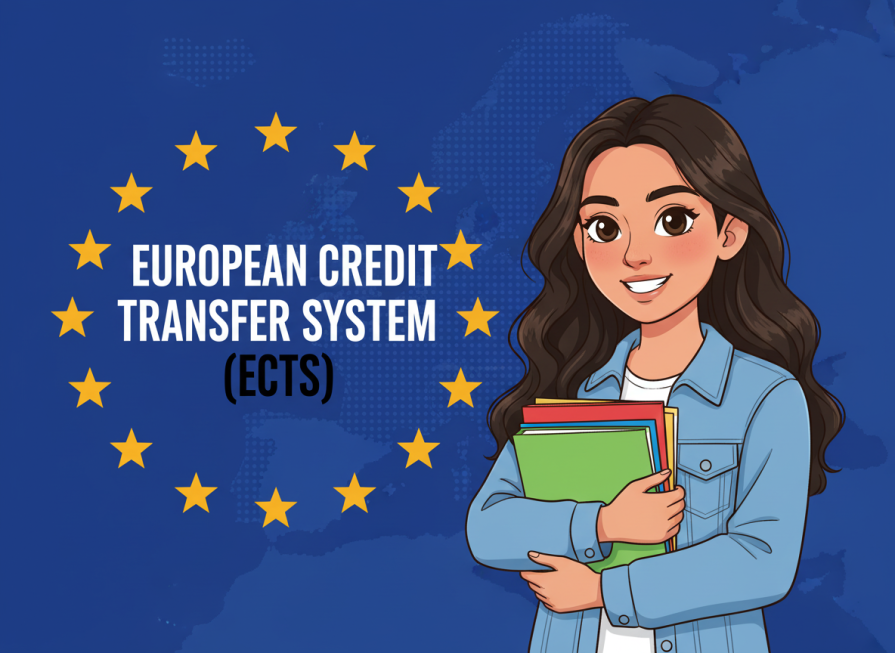
A modern student learns not only in the classroom: he takes online courses, internships, participates in projects, and sometimes changes universities or even countries. How to calculate all this and transfer it from one system to another so that no one loses hours and grades? To do this, Europe came up with its own "common language" of education – the ECTS, the European Credit Transfer and Accumulation System.
To put it simply, an ECTS credit is a unit of measurement of the time spent on study. It shows not so much the number of lectures as the total load: reading, self-study, practice, exams. 1 credit is equal to approximately 25-30 hours of student work; During the academic year, 60 credits are taken, which corresponds to about 1500-1800 hours of classes.
This system is needed not only for tracking hours. Thanks to it, universities in different countries build bridges through which students who have gained credits at one university can easily transfer to another, maintaining their results. In fact, credits have become the currency of European education, a universal measure of academic load

How ECTS appeared
The idea of credits was born not in the offices of bureaucrats, but within the walls of universities. In the 1980s, the Erasmus program was launched in Europe, allowing students to study abroad for a semester or a year. But it quickly became clear that each university had its own system of hours and exams, and it was almost impossible to compare the results. This is how experiments with a single scale of load intensity began.
The first pilot project of ECTS started in 1989 in 145 universities in Europe: at that time, the system was used only for exchange programs, but the success was so obvious that soon it was decided to spread the idea everywhere. In 1999, after the signing of the Bologna Declaration, ECTS officially became part of the pan-European educational space. Since then, the system has spread far beyond the EU: almost all European countries, including Switzerland, Turkey and Eastern European states, have adopted it.
How the system works in practice
Everything looks simple, although there is a subtle logic behind this simplicity. Each university in Europe determines the complexity of the courses in credits: for example, a basic course in macroeconomics can "cost" 6 credits, a lecture in the history of art - 4, and a laboratory course in physics - 8. The more time a student has to spend on a subject, the higher its "value".
At the end of the semester, the student receives a Transcript of Records, colloquially a transcript is an official document that indicates subjects, grades, and the number of credits. This document can be presented at another university, and there the courses will be counted without retaking. That is why the system is called Transfer and Accumulation: credits can be transferred from one educational institution to another and accumulated until the full volume of the degree is collected.
For a bachelor's degree, you usually need to collect 180 credits (three years of study), for a master's degree — 120 credits. In total, this is the equivalent of about five years of university education. If a student decides to take an academic break or change the university, their credits do not "burn out", but are recorded in the database and can be credited later.

In some ways, the system resembles a construction set. In some countries, a student can draw up an individual curriculum: some subjects in the main specialty, some elective, and all this is expressed in credits. As a result, studies become more flexible: someone delves into their field, and someone combines economics with psychology or biology with philosophy.
Grades in ECTS are also unified - instead of the usual fours and fives, a letter scale is used: from A (excellent) to F (unsatisfactory). This makes it easier to understand the results when applying to universities abroad.
How ECTS has changed European education
Before the advent of ECTS, education in Europe was, in fact, "feudal": each university lived by its own rules, and transferring from one to another meant actually starting all over again. Hours, exams, tests - everything was counted differently.
The Bologna Process and the introduction of ECTS have turned this chaos into an orderly system where learning outcomes have become comparable across countries. ECTS has made Europe a single educational space: now a person can start a bachelor's degree in France, spend a semester in Germany, defend a diploma in the Netherlands and enroll in a master's program in Italy — and at the same time not waste time on retakes. Universities recognize each other's results because credits and grades are recorded in the same format.
Such mobility has changed not only students, but also the universities themselves: universities began to compete for foreign students, develop joint programs and open English-language courses. Joint degrees have appeared, when students study in two countries and receive a degree recognized by both.
ECTS has also made the structure of studying transparent: employers now understand how many hours a student has spent on courses and can assess the real level of preparation. For universities, this has become an incentive to build clear educational trajectories and explain why certain subjects are needed.
Along with the credit system came a new philosophy: education was no longer a "package of disciplines" set from above. Now the student is not an object, but a participant in the process: he can plan his own path, combine courses, transfer credits and build a program for his own goals.

ECTS Outside Europe: Global Distribution and Adaptation
When the European credit system showed its effectiveness, universities outside the EU began to look at it: first as a tool for student exchange, and then as a model that helps to build flexible educational programs. Today, ECTS equivalents exist in almost all regions of the world:
- In Asia, the system is used in an adapted form by Japanese, South Korean and Singaporean universities: there credits are recalculated according to their own standards, but the general principle - taking into account load intensity, and not just classroom hours - remains unchanged.
- In Australia and Canada, national credit systems are similar: there credits are used not only to count hours, but also to assess competencies gained through practice and research.
- Even in the United States, which traditionally has its own credit hours system, universities participating in international exchanges are increasingly converting their courses to the ECTS format in order to make programs comparable to European ones.
- In recent years, the principles of ECTS have also begun to be used in online education. Large platforms such as Coursera or EdX partner with universities and offer courses that count towards credits. This is gradually blurring the boundaries between "formal" and "informal" learning: now even an online course can become part of the university program.