University of St Andrews










Programs and prices, tuition fees in University of St Andrews


Information on the program can be found on the official website of the school.
Information on the program can be found on the official website of the school.
Description of University of St Andrews
- Name: University of St Andrews, St. Andrews University, St-Andrews,
- Location: St Andrews, UK,
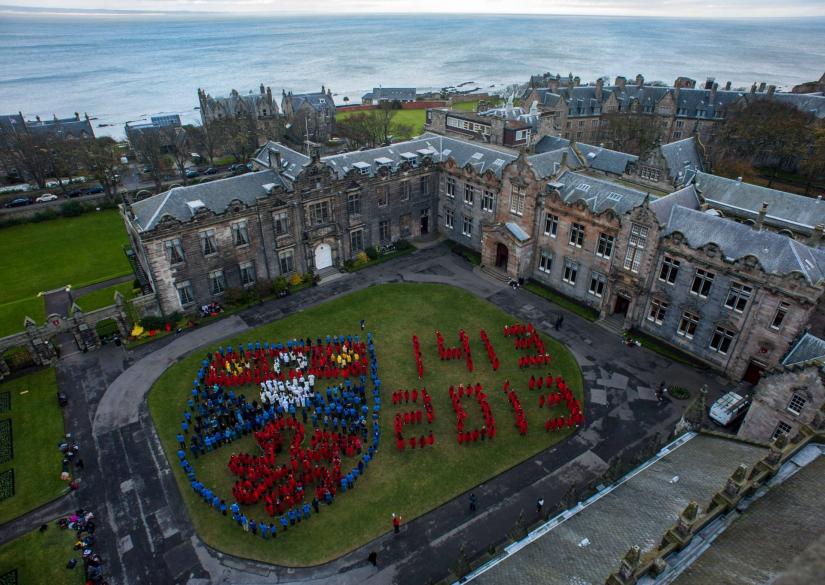
- Year of foundation: 1413,
- Number of students: 10,356 in the 2024-2025 academic year,
- Institution type: nonprofit public university,
- Historical status: one of the oldest educational institutions; Scotland's oldest university; third oldest in the English-speaking world,
- National rankings: among the country's top 30 universities,
- Programs: taught master's programs, online postgraduate programs.
- Year of foundation: 1413, formally established by a papal bull,
The University of St Andrews is Scotland's oldest university and the third oldest in the English-speaking world.
The University of St. Andrews consists of a number of academic schools and departments, which are organized in four directions. Each division is headed by a leader and is supported by a number of academic staff.
At the University of St Andrews, you can get education in the following areas:
- Chemistry,
- Classical literature,
- Computer science,
- Earth and environment sciences,
- Economics and finance,
- Geography,
- History,
- International relations,
- Mathematics and statistics,
- Medicine,
- Music,
- Philosophy,
- Physics and astronomy,
- Psychology and neurology,
- The history of art,
- Biology.
In the 1980s, St. Andrews embarked on a broad investment program to strengthen its research capacity and strategy. This program helped establish the university's reputation as an international center with extensive experience in the field of research.
The university offers taught master's programs. Flexible online postgraduate programs are also available, allowing students to pursue their education from any location at a pace that suits them.
In the 2024-2025 academic year, there were 8,381 undergraduates, 931 students in taught postgraduate programs, 906 in research programs and 138 in online postgraduate programs. Students represented more than 120 countries. Staff from outside the UK make up 25% of the university's workforce.
Educational process
Students can take part in exchanges or spend time studying abroad in Europe, Australia, New Zealand, Hong Kong, Singapore, Canada and the USA.
In computer science, some lectures take place in a room equipped with workstations, alternating lecture material with practical exercises. Other lectures are conducted in large, traditional lecture theaters in neighboring buildings. Modern rooms for small groups may be used for specialized modules in the later years of an undergraduate degree.
Of the students who entered in the 2021-2022 academic year, 99.27% continued their education at St Andrews. Less than 1% transitioned to other universities, and less than 1% left higher education altogether.
Faculties and colleges
- IELLI offers four pre-sessional courses in academic English for students who have an offer to enter the university and use English as an additional language,
- IELLI offers Academic English Qualification courses for applicants without an offer,
- Music modules are available at all undergraduate levels,
- A master's program in sacred music is available at the postgraduate level.
Scientific achievements
St Andrews ranked first in the UK and was named Scottish University of the Year in The Sunday Times Good University Guide 2027. In both The Times and Sunday Times Good University Guide 2026 and The Guardian University Guide 2026, the university ranked first in Scotland and second in the UK. It was named Scottish University of the Year in The Daily Mail University Guide 2026.
Eight disciplines at the university ranked first in the UK in The Times Guide 2026:
- Art History,
- Chemistry,
- English, joint first with Oxford,
- French,
- History,
- International Relations,
- Physics,
- Social Anthropology.
In The Guardian Guide 2026, the university led the UK in Maths, History, Art History, and International Relations. Another 17 disciplines ranked in the national top 10.
In the National Student Survey 2024, St Andrews students rated their education more positively than students at any other mainstream university in the UK. The university's students had the highest satisfaction in the country in the Complete University Guide 2026. In the 2021 Research Excellence Framework (REF), more than 88% of the university's research was recognized as world-leading or internationally excellent.
Things to know about
- Teaching in St Andrews began in 1410,
- Bishop Henry Wardlaw issued the original founding charter in 1411 or 1412,
- The university's motto is "Ever to Excel." It comes from a speech in Homer's Iliad,
- The crescent moon on the university's coat of arms represents Peter de Luna, Pope Benedict XIII,
- The lion comes from the royal arms of Scotland and symbolizes the authority of King James I, who was associated with the university's foundation,
- The gold diamonds come from the personal arms of Henry Wardlaw, Bishop of St Andrews from 1404 to 1440,
- The open book with red page edges symbolizes learning, and the blue and silver cross represents the saltire of Scotland,
- Music Society was founded in 1876. It is the university's oldest and largest music society.
Accommodation, meals, prices
The university has more than 4,000 bed spaces. Undergraduate, Foundation and postgraduate students can live in university-managed halls of residence, houses and apartments, or rent privately. University accommodation ranges from modern buildings designed for student residential use to converted 15th-century buildings.
Accommodation is guaranteed for incoming undergraduates, students who have been in care and students who are estranged from their families. A limited number of guaranteed rooms are available for postgraduate students. Flexible contracts are offered to those spending a semester abroad. Standard accommodation contracts run for 34, 38 or 50 weeks. Temporary and commuter accommodation is unavailable.
Catered and self-catered accommodation is available. Students can choose a room with a private bathroom or use a shared bathroom. Heating, hot water, internet access and insurance are included in the cost of university accommodation.
Staff in halls and Halls Life wardens support residents and organize events. Student committees elected annually by residents run events and report residents' views to the university. A free night bus service is available. Student Accommodation Services advises on university and private accommodation and on accommodation applications.
Activities University of St Andrews
The university hosts academic lectures, research conferences, concerts, exhibitions and cultural festivals. The Students' Association runs societies and helps students create new interest groups. Societies cater to interests in food and drink, media, charity, fan and geek culture, politics and academic activities.
About one in seven students participates in musical activities. Every week, hundreds of students, staff and local residents sing, play, compose, practice and listen to music at the university's music center. Paid lessons and equipment rental are available.
Music scholarship recipients can sing and play in auditioned groups. Groups that do not require an audition are also available. Music Society has six auditioned and non-auditioned groups, ranging from a symphony orchestra to a big band. The university has six a cappella groups.
Students participate in Jazzworks, Folk and Trad, Musical Theatre, Chamber Opera and Gilbert and Sullivan Societies.
Advantages
International scientists come to St. Andrews to get a new experience. Teachers strive to teach here, and students to learn. Many great minds were associated with this institution:
- William Dunbar, the poet (1479)
- John Napier, the inventor of logarithms (student, 1563)
- James Gregory, the inventor of the Gregorian telescope (professor of mathematics, 1668)
- Benjamin Franklin (Honorary Doctor of Law, 1759)
- Edward Jenner, first invented the vaccine against smallpox (MD, 1792)
- John Stuart Mill, philosopher and economist (Rector, 1865)
- M. Barry, writer (rector, 1919)
- Rudyard Kipling, writer (rector, 1922)
- Sir James Black, Nobel Laureate in Medicine (1946).
Facilities and equipment at University of St Andrews
St. Andrews is a small town located on a rocky promontory overlooking the North Sea. In addition to three beaches and historic buildings, the town has dozens of cafes and boutiques. The university has no separate campus: its buildings are located throughout St Andrews. The university has a library, student hostels, canteens, cafes, interest clubs, recreation areas. The university has more than 180 student societies, ranging from art and music to religion and culture. Sport is a very important aspect of university life. More than 50 sports clubs and 100 competitive sports teams will allow everyone to develop their sports talents.
The university has more than 8,000 students, many of whom are foreign citizens. It is a medium-sized educational institution. The teaching staff consists of 1100 specialists, including staff from other countries. The University of St. Andrews received a gold award in the 2017 TEF for high-quality teaching. Student life is actively covered on social media: Facebook, Linkedin, Twitter.
The Laidlaw Music Centre has practice rooms and a recording suite. Visiting musicians, including the Scottish Chamber Orchestra and the Fitzwilliam String Quartet, perform in the Macpherson Recital Room.
The Jack Cole building provides offices for all computer science academic staff, teaching rooms and student computing labs. The neighboring John Honey building has additional computing labs and teaching rooms. Students have 24-hour access to both buildings. The labs provide spaces for collaborative and individual work, as well as areas for group work and socializing with large LCD screens. There are desks where students can use a personal laptop with a monitor. Most workstations have two monitors, and some have hardware for GPU-accelerated machine learning computation. Every desk has a power socket for charging personal devices.
Multi-function printers are available in both computer science buildings and other university buildings. The Jack Cole building has a coffee and lunch area. The School of Computer Science provides vending machines for drinks and snacks, as well as tea and coffee-making facilities.
Admission dates and extra charges
Travel costs need to be taken into account when planning a budget.
Enrolment process
Qualifications are assessed in context, taking into account where applicants studied, any exam retakes and extenuating circumstances. Work or other experience relevant to the chosen discipline is considered where appropriate.
Most applicants do not need an interview. Interview performance is considered for Medicine, Gateway and Pathway programs.
Enrolment statistics
The university receives thousands of undergraduate applications each year.
Perspectives
In the Graduate Outcomes survey for 2022-2023, more than 95% of bachelor's degree graduates were in full-time employment or continuing their education.
Entry requirements, how to apply, what is required to enrol
Before applying for admission to the university, an applicant can book a visit day. The visit offers an opportunity to meet teachers, talk with students, see the town and university buildings, and ask questions. It helps applicants get to know the university and decide whether it is a good fit.
All applications are initially evaluated according to agreed academic eligibility criteria for the relevant program. Selection criteria for individual programs and faculties, as well as all requirements for admission are available on the site of the school. Meeting all program selection criteria and the faculty's minimum entry requirements does not guarantee a place, as competition can be very high.
Applications are assessed on academic performance to date and future potential, in comparison with other applications for the same program. The university gives preference to applicants with high academic potential who can thrive in a competitive academic environment. Achieved and predicted grades are considered first.
The selection process includes consideration of the following information within the applicant's application:
- Documentation of previous education and academic results. In addition to a certificate of general secondary education, applicants must provide confirmation of at least one year of full-time education at a university,
- Personal statement,
- Certificate of English proficiency. Where required, students entering the university must provide confirmation that they can use English confidently enough for their education. The University accepts a wide range of language tests and qualifications as confirmation of English proficiency.
An academic reference is required. An application without one is incomplete. For school and college students, it is usually written by their Head of Year, University Counsellor or another teacher. After a gap year, a reference from the school or college is also recommended. Applicants who are no longer at school or college and cannot obtain a reference from a former teacher need one from a responsible person familiar with their academic abilities. References from relatives and close friends are usually not accepted. For the Common Application, references must be on headed paper and signed. The university may request supporting documentation at any stage of admission.
Applicants who have taken a gap year must explain their reasons and describe the experience and skills they gained that relate to their chosen disciplines. For deferred entry, the personal statement must explain the reasons for deferral, plans for that period, and how those activities will strengthen the application.
Tuition fees at the university
In addition to the official payment for tuition, it is necessary to take into account that accommodation, meals, sports expenses and hobbies will cost extra. Given the high prices for education, the institution provides its students with a range of financial programs and scholarships.
Scholarships University of St Andrews
Scholarships and support packages are available at all levels of education for both applicants and current students. The university provides advice where needed. Support may depend on household financial circumstances, academic performance, leadership, sporting or musical achievements. Scholarship support does not need to be repaid.
International scholarships provide full or partial tuition support. Bursaries are available to reduce accommodation costs. Available scholarships depend on the program, place of residence and tuition status. Applicants with refugee status, humanitarian protection, discretionary leave or asylum seeker status can apply for support.
A total of 3292 scholarship awards are available across all levels of education. Recipients represent 111 countries. The university funds 94% of undergraduate and taught postgraduate scholarships.
Music scholarships provide talented singers and instrumentalists with free weekly vocal or instrumental lessons from specialist teachers. They are awarded at the beginning of the academic year.
Institution on the map
Residence permits, citizenship and other services
- Guardianship services during the studies
- Student supervision
Review about University of St Andrews
Recommendations on when to apply
| Language courses, schools and children's language camps | Primary and secondary education - private schools | Preparation programmes for entering universities - higher education | Higher education (after completing accredited programs A-level, IB, High School) - Bachelor, Master, MBA |
| - we recommend to apply 6-9 months before the start of the course (some camps and schools offer discounts for early booking or for lengthy study programs) - there are some very popular and high demand children's camps, where the applications need to be submitted 1 year in advance (in particular Switzerland , Great Britain , USA , Canada , Austria) | - we recommend to apply one year before the start of the training program, - some schools have a specific time frame (September-November - please specify an individual school) - some schools require tests in several stages (UKISET, internal tests of the school: English, mathematics, logics, subjects, interview, some require a personal visit) | - we recommend to apply one year before the start of the program, - for Foundation and Pathway programs, IELTS and TOEFL certificates are usually required, respectively | - recommended submission one year before the start of the program, - the deadline normally closes in January, for TOP HEIs and, as a rule, in March in other universities - for a bachelor, a Foundation or Pathway preparatory program a completed A-level, IB, High School + IELTS / TOEFL are required - for Masters you need a graduated higher education, in some cases you need a pre-Masters program - MBA requires completed higher education, work experience preferably at least 2-3 years, etc. |