University of Notre Dame





Programs and prices, tuition fees in University of Notre Dame


<p> Undergraduate program at the University is represented by the following main areas:
</ p>
<ul>
<li> Art and writing letters </ li>
<li> Natural Sciences </ li>
<li> Engineering </ li>
<li> Business </ li>
<li> Architecture </ li>
<li> Right </ li>
</ ul>
<p> Master's program at the University is represented by the following main areas:
</ p>
<ul>
<li> Art and writing letters </ li>
<li> Natural Sciences </ li>
<li> Engineering </ li>
<li> Business </ li>
<li> Architecture </ li>
<li> Right </ li>
</ ul>
Description of University of Notre Dame
The University of Notre Dame (ND) in the city of South Bend enjoys immense popularity in the USA among entrants. It is a private higher education institution founded by a priest in 1842. ND is considered one of the most beautiful buildings in architecture throughout the country.
The University of Notre Dame (ND) in the city of South Bend enjoys immense popularity in the USA among entrants. It is a private higher education institution founded by a priest in 1842. ND is considered one of the most beautiful buildings in architecture throughout the country.
Prestigiousness of the university
University of Notre Dame is one of the many high ranking in the ranking of the best universities in the US, namely: one of the top twenty. Students of the University of Notre Dame take an active part in sports competitions, have repeatedly won cups, providing a high position in TOP of the best institutions of the country in this field. Due to the qualified graduates are in demand in various fields of activity.
Admission and studies at the university
To become a student at Notre Dame University, you must submit grades from a previous place of study and take exams. Competitiveness among applicants is high - 5 people per place. Apply for admission to the University of Notre Dame can be both local residents and foreigners. The academic year consists of two semesters. Since the tuition fee is quite high, there are various scholarship programs. You can get knowledge both internally, on a daily basis, and remotely.
Structure of the University of Notre Dame
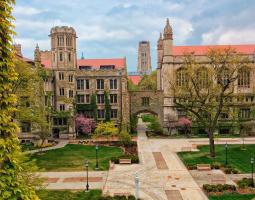
The campus is in the suburbs. A hostel is provided by a nonresident. The campus is made in the classical Gothic style, which attracts hundreds of people with live flowers. The university contains the richest library in the world, which allows to carry out a large number of research works. On the territory of the institution there are two modern sports stadiums. The symbol of the institution is the statue of the Virgin Mary on top of the cathedral
Educational process
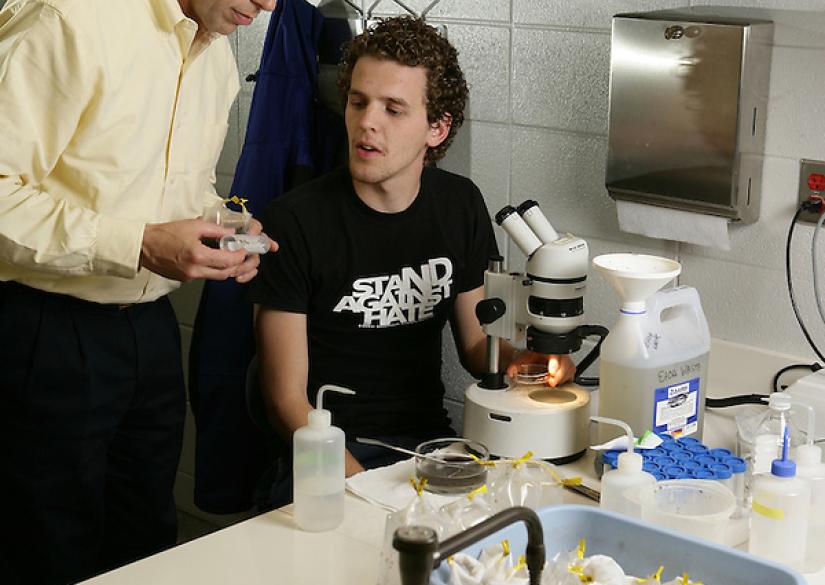
91% of classes at the university are held in groups of fewer than 50 students, and 33% of undergraduate students participate in research activities.
International students and scholars are supported by the International Student and Scholar Affairs (ISSA) office: it processes documents for the U.S. Department of Homeland Security, tracks visa and immigration deadlines, and conducts comprehensive orientation for new students.
Faculties and colleges
The university offers more than 70 undergraduate programs, master's programs, and professional programs; they are organized into eight colleges and schools:
- School of Architecture,
- College of Arts and Letters — the oldest and largest of the colleges,
- Mendoza College of Business,
- College of Engineering,
- Keough School of Global Affairs,
- The Graduate School,
- The Law School,
- College of Science.
The College of Arts and Letters includes the following departments and programs:
- Africana Studies,
- American Studies (includes Journalism),
- Classics,
- East Asian Languages and Culture,
- English, German, Slavic and Eurasian Studies,
- History,
- Philosophy,
- Program of Liberal Studies,
- Romance Languages and Literature,
- Theology.
The Graduate School administers master's and doctoral programs for the College of Arts and Letters, College of Engineering, College of Science, and Keough School of Global Affairs, as well as a number of joint doctoral programs with the Mendoza College of Business. The Mendoza College of Business's own programs (other than the joint doctoral programs), the School of Architecture, and The Law School are administered separately.
Scientific achievements
Over the past 14 years, the university has received more National Endowment for the Humanities fellowships than any other institution in the country — 49 fellowships — and has ranked 1st in the United States for the number of faculty members awarded these fellowships since 1999. University researchers have attracted more than $220 million in funding for research on cancer treatment, facial recognition technology, peacebuilding, ecology, data science, and the study of world religions.
21 university graduates and students have become Rhodes Scholars, and 27 faculty members have been elected to the American Academy of Arts and Sciences. The university ranks 3rd in the country for the share of undergraduate students participating in study abroad programs (87.5%), and in 2025 received the Simon Award for Campus Internationalization — an award for advancing the international campus environment.
Things to know about
- 82% of students are Catholic, 20% are first-generation college students in their families or Pell Grant recipients, 8% are international students representing more than 80 countries,
- international students and scholars make up more than 1,400 members of the university community — 10% of the total community — and their numbers have grown by approximately 34% over the past decade.
Accommodation, meals, prices
| Dormitory | there is |
| Cost of living | $ 859-1,425 USD / month |
Subjects, specialties
Advantages
- The student-to-faculty ratio is 8:1,
- 91% of full-time faculty hold a doctoral degree or its equivalent.
Facilities and equipment at University of Notre Dame
The campus is located near Lake Michigan and the city of Chicago, which is convenient for master's program students.
The campus is home to numerous research institutes and centers:
- Kellogg Institute for International Studies,
- Kroc Institute for International Peace Studies,
- Keough-Naughton Institute for Irish Studies,
- Nanovic Institute for European Studies,
- Eck Institute for Global Health,
- Lucy Family Institute for Data and Society,
- Harper Cancer Research Institute,
- Center for Research Computing,
- a number of other university, departmental, and competitively established centers.
The Hesburgh Libraries network encompasses several buildings on campus. The main building was constructed in 1963; the libraries collaborate with the Saint Joseph County Public Library. The university implements campus sustainability programs — investments in renewable energy and green roofs, and a dedicated sustainability tour of campus facilities is offered to visitors.
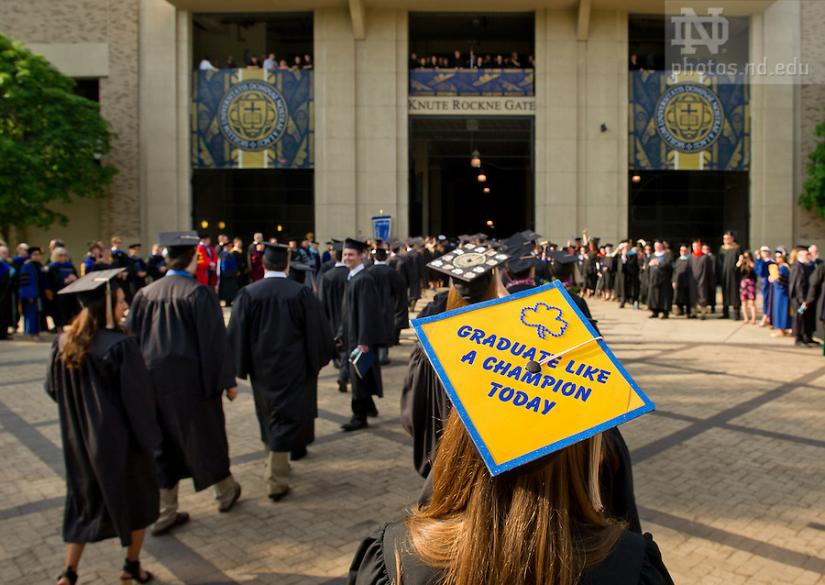
The Eck Visitors Center welcomes campus visitors and serves as the starting point for a public tour of the grounds: the Grotto, the Basilica of the Sacred Heart, the main building with its golden dome, and the Hesburgh Library with its famous mosaic depicting Christ, known by the nickname Touchdown Jesus. A separate tour of Notre Dame Stadium, known as "The House That Rockne Built," is also available, with the opportunity to take photographs on the field and at the sign bearing the motto "Play Like a Champion Today."
The campus features the Morris Inn, an AAA Four Diamond hotel with 150 rooms, Rohr's restaurant, a terrace with a fireplace, and event spaces.
The Notre Dame Global program offers more than 50 semester and year-long study abroad programs and more than 30 summer programs in over 30 countries. More than 70% of undergraduate students study abroad, including in Tokyo, Athens, the Loire Valley, Santiago, Singapore, Senegal, South Korea, and Spain.
Admission dates and extra charges
The academic year includes fall and spring semesters and a separate summer session. The fall semester begins in late summer, the spring semester — in mid-winter. Breaks between semesters include Thanksgiving, a mid-semester break, and Easter; graduation week takes place in May.
The summer session — a standard one, approximately six weeks long — typically runs from early June to mid-July. The summer graduation ceremony takes place in early August.
Enrolment process
The application campaign traditionally opens at the beginning of August. The deadline for submitting an application under the Restrictive Early Action program is the beginning of November, and under the Regular Decision program — the beginning of January.
Smapse specialists will guide you through all stages of the admissions process.
Perspectives
82% of students preparing for medical specialties are admitted to medical schools — twice the national average. 99% of students return for their second year, and 95% graduate on time — both figures rank among the highest in the country.
92% of graduates find employment or enroll in graduate school within 6 months of graduation; 89% of students complete internships or participate in research before graduating.
Entry requirements, how to apply, what is required to enrol
Based on grades and exams
Scholarships University of Notre Dame
| Scholarship programs | there is |
Institution on the map
Residence permits, citizenship and other services
- Guardianship services during the studies
- Student supervision
Review about University of Notre Dame
Recommendations on when to apply
| Language courses, schools and children's language camps | Primary and secondary education - private schools | Preparation programmes for entering universities - higher education | Higher education (after completing accredited programs A-level, IB, High School) - Bachelor, Master, MBA |
| - we recommend to apply 6-9 months before the start of the course (some camps and schools offer discounts for early booking or for lengthy study programs) - there are some very popular and high demand children's camps, where the applications need to be submitted 1 year in advance (in particular Switzerland , Great Britain , USA , Canada , Austria) | - we recommend to apply one year before the start of the training program, - some schools have a specific time frame (September-November - please specify an individual school) - some schools require tests in several stages (UKISET, internal tests of the school: English, mathematics, logics, subjects, interview, some require a personal visit) | - we recommend to apply one year before the start of the program, - for Foundation and Pathway programs, IELTS and TOEFL certificates are usually required, respectively | - recommended submission one year before the start of the program, - the deadline normally closes in January, for TOP HEIs and, as a rule, in March in other universities - for a bachelor, a Foundation or Pathway preparatory program a completed A-level, IB, High School + IELTS / TOEFL are required - for Masters you need a graduated higher education, in some cases you need a pre-Masters program - MBA requires completed higher education, work experience preferably at least 2-3 years, etc. |