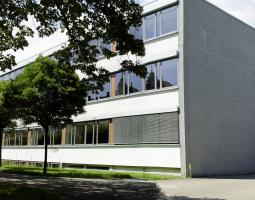
Technische Hochschule Würzburg-Schweinfurt


Programs and prices, tuition fees in Technische Hochschule Würzburg-Schweinfurt


BACHELORATE (German)
The first stage of higher education is according to the Bologna system adopted throughout Europe. The duration of study is 3.5 academic years (7 semesters). Programs are offered on a wide range of topics:
1) German language:
- Processing technology for plastics and elastomers
- Building engineering
- Engineering geodesy and geoinformatics
- Logistics
- Industrial mathematics
- Media management
- Architecture
- Electronic and computer technology
- Management in a health and geriatric environment
- E-commerce
- Computer engineering
- Communication design
- Economic informatics
- Specialized translations
- Business and engineering
- Social work
- Mechatronics
- Computer science
- Enterprise economy
- Mechanical engineering.
BACHELORATE (ENGLISH LANGUAGE)
Bachelor's programs lasting 3.5 academic years (7 semesters) are offered in the university and in English:
- International Management
- Business and engineering
- Logistics
- Mechatronics.
Students have the opportunity to pass TWIN-courses ("twins") of German-language programs in English (the content remains the same). In addition, foreign students can attend free German courses: bilingualism will become a significant career advantage in further employment. The studying starts in English, but the students attend additional free German courses, in 2-3 courses the students attend a part of the lectures in German, studying a profile lecture in both languages. Received at the release of the TWIN-certificate confirms that the graduate has mastered two foreign languages and is ready to work in the international community.
MASTER (GERMAN LANGUAGE)
Master's programs are the next step in obtaining higher education: this is a more in-depth, highly specialized study of the characteristics of the chosen profession. Duration of studying is 1.5 academic years. Available specialties taught in German are the following:
- Music therapy for people with disabilities and dementia
- Business and engineering
- Social work
- Specialized journalism and corporate communications
- Specialized translations and multilingual communication
- Information Systems
- Electrical and computer engineering
- Management in Health Care (MBA)
- Integrated planning and construction
- Innovations in SMEs
- Information design
- Brand and media management.
MASTER (ENGLISH LANGUAGE)
Master's degree in the university can be obtained by studying n English. Duration of studying is 1.5 academic years, available specialties:
- International business with Western Europe or Asia, or with Central and Eastern Europe (MBA)
- International social work with refugees and migrants
- Business with Europe (MBA).
Students have the opportunity to pass TWIN-courses ("twins") of German-language programs in English (the content remains the same). In addition, foreign students can attend free German courses: bilingualism will become a significant career advantage in further employment. The studying starts in English, but the students attend additional free German courses, in 2-3 courses the students attend a part of the lectures in German, studying a profile lecture in both languages. Received at the release of the TWIN-certificate confirms that the graduate has mastered two foreign languages and is ready to work in the international community.
PREPARATORY COURSES OF GERMAN LANGUAGE
A special preparatory program is designed for foreign students whose language level is not high enough to study at the university's German-language programs.
Classes begin in September (September 4-29). The total duration is 120 academic hours (4 weeks), on weekdays from 9:00 to 14:00. The minimum level of initial knowledge for enrollment is B1, classes take place on the Schweinfurt campus.
After the completion of the preparatory program, the student receives a prestigious UNIcert I or II certificate and can enter the selected German language course at FHWS.
Description of Technische Hochschule Würzburg-Schweinfurt
- Location: Würzburg and Schweinfurt, Germany,
- Founded: in 1971,
- Total number of students: 9267 in the winter semester 2025/26,
- Language of instruction: German and English,
- Type of institution: State University,
- Programs: Bachelor's and master's programs, TWIN programs.
The largest university in the north of Bavaria is the University of Applied Sciences of Würzburg-Schweinfurt, located immediately in two neighboring cities. The institution was founded in 1807 - it is true that the current name and campuses he acquired only in 1971 - but today the university is considered to be one of the best in Europe. The multinationality of the university is also striking - representatives of more than 60 world countries, representatives of various religions, nationalities are studied here.
In total, there are 10 faculties in the structure of the German university, where the students are offered more than 40 specialties - studying is maximally practical, which helps graduates to quickly find work in their specialty:
- Faculty of Applied Social Sciences
- Faculty of Plastics and Engineering Geodesy
- Faculty of Economics
- Faculty of Informatics and Economic Informatics
- Faculty of Natural and Human Sciences
- Faculty of Architecture and Civil Engineering
- Faculty of Business and Engineering
- Faculty of Electrical Engineering
- Faculty of Design
- Faculty of Mechanical Engineering.
The university staff includes more 230 professors: they provide students with exhaustive practical and theoretical knowledge, focusing on the practical component of studying in Germany - laboratory studies and experiments are constantly conducted, and thematic clubs and sections are operating. Much attention is paid to the seminar works and group projects, students are honing the skill of effective work both independently and in a team.
German is the main language of instruction, but many programs are taught in English - the bilingualism of the university also increases its popularity among foreign students.
The studying is conducted in small groups - each student can count on the proper amount of personal attention from the teacher, an individual approach.
Students are given the opportunity to pass production practice in the best regional and national companies (6 months) - this is an excellent opportunity to prepare for writing a thesis project, to gain valuable knowledge and practical skills, to prove yourself as a specialist and make useful business contacts and connections.
The University of Applied Sciences Würzburg-Schweinfurt closely cooperates with more than 230 universities around the world, including Russian institutions:
- Plekhanov (Moscow)
- University of Management and Economics (St. Petersburg)
- University of Economics and Finance (St. Petersburg)
- Omsk University.
International students have the opportunity to work up to 120 full or 240 part-time working days, if this does not interfere with the studying. These days are not spent if the student works at the university as an assistant (this post is usually called Wissenschaftliche Hilfskraft). The earned money (minimum - 450 euros a month) is not taxed. Most often pupils find themselves working in cafes, shops and restaurants, work as tutors (Russian students are usually strong in mathematics), work at companies during vacations, and closer to the middle of studies, students already have their first opportunity to work in their specialty.
Germany is the only European country that provides students with a full year and a half after graduation to search for a job in their specialty. If your salary is from 56,800 euros gross per year or you have worked for 2 years, then you can apply for a permanent residence permit, and then for German citizenship!
In 2014, the University of Applied Sciences Würzburg-Schweinfurt was awarded the prestigious Best-Strategy Award MINternetional - an award from the German Scientific Association for an innovative and unique project for Germany - the i-Campus, in which FHWS offers specialties in both languages: in German and in English. Thus, students have the opportunity to start their studies at FHWS without German language proficiency, but they can study in English, at the same time acquire knowledge of German and, during their studies, go to study in German in the same specialty. For graduates, bilingualism (knowledge of professional terminology in English and German) is a significant advantage in the global labor market.
Educational process
The general academic advising service helps students and prospective applicants with questions about their education. The libraries offer online courses on finding information and citing sources. In exceptional cases, a faculty may grant full or partial credit for vocational education and work experience in place of a practical semester in a bachelor's program.
Students may receive credit toward their degree for education and internships abroad. Students have accident insurance during their education, but they need their own coverage for internships abroad.
The student representative body advocates for students' academic, economic, and social interests, promotes equal opportunities, and strengthens connections between German and foreign members of the university community. Studierendenwerk provides legal, social, and psychotherapeutic counseling. Additional support is available for students with children, disabilities, or chronic illnesses, and for foreign students. Athletes in A, B, and C squads receive help coordinating exams and seminar attendance. When needed, they may take a semester of leave to compete in championships.
To obtain a TWIN certificate, students must graduate from the relevant program and meet the following language and academic requirements:
- C1 proficiency in both German and English,
- At least 10 ECTS credits in intercultural competence modules,
- At least 60 ECTS credits in modules from both language versions of the program, for students who began their studies in October 2016 or later.
For certain programs, the university recommends improving German proficiency to C1 through Campus Sprache courses while completing the degree.
Come Together EveryBuddy brings foreign and local students together in mutual support groups at the start of their studies. Participants become familiar with student life, develop social and intercultural skills, and practice languages. The p2p team introduces participants and provides advice. EveryBuddy is part of KomPass-International, and participation is recognized with a university certificate.
Ready for Uni? Your Guide to THWS and the Region introduces foreign students to support services, university education, and everyday life in Germany. Students in the Soziale Arbeit bachelor's program organize the event as part of the p2p project. Since 2020, JOBMESSE study&stay in Würzburg has been a joint event with Universität Würzburg. The career day in Schweinfurt is primarily intended for students in mechanical engineering, electrical engineering, industrial engineering, and mathematics.
The goPhD program helps participants decide whether to pursue a doctorate and prepare for research at THWS. It is open to female master's students in all disciplines who have at least two semesters remaining, and to female employees with a master's degree. The program receives equal opportunity funding.
Professors lead mentoring sessions in groups of approximately three to four participants. Over two semesters, the program provides about five 90-minute mentoring sessions, three 90-minute meetings for the full group, two half-day workshops, and opening and closing events. Topics include choosing a research topic and supervisor, entering a doctoral program, funding, career planning, and everyday research work. Additional activities include informal conversations with doctoral students and online meetings about balancing responsibilities and impostor syndrome.
Selection for goPhD considers motivation, strong academic performance, and availability throughout the two semesters. A limited number of student assistant positions in research or knowledge transfer projects may be available to participating master's students. Regular attendance at mentoring sessions and other program components over both semesters is recognized with a confirmation of participation.
Faculties and colleges
Academic units are distributed across several campuses:
- Campus Münzstraße — Fakultät Angewandte Sozialwissenschaften, Fakultät Angewandte Natur- und Geisteswissenschaften, and THWS Business School,
- Campus Röntgenring — Fakultät Architektur und Bauingenieurwesen and Fakultät Kunststofftechnik und Vermessung,
- Campus Sanderheinrichsleitenweg — primarily Fakultät Gestaltung and Fakultät Informatik und Wirtschaftsinformatik,
- The continuing education unit — at Campus Hella Waltenberger.
In the winter semester 2025/26, the bachelor's offerings included nine English-language programs, one transnational program, two online programs, and two programs being phased out. The master's offerings included six English-language programs and two being phased out.
TWIN programs include:
- Angewandte Mathematik — Applied Mathematics,
- Betriebswirtschaft — Business Administration,
- Electrical Engineering and Information Technology,
- Elektro- und Informationstechnik — Electrical Engineering and Information Technology,
- Mechanical Engineering.
Other programs include Computational and Experimental Physics.
Scientific achievements
A doctoral student at the university took second place at the Würzburger Science Slam with StethoSCOPE, a method for preparing medical students. A dissertation was successfully defended at the interuniversity doctoral center Nachhaltige und Intelligente Systeme.
Research projects address energy, artificial intelligence, and assistive technologies:
- ReDiFlex-B — using industrial battery storage to reduce the load on the power grid,
- Project enefit — electricity and heating solutions, tools, and services introduced to companies and organizations in Mainfranken,
- CAIRO — research into the reliability of artificial intelligence testing,
- Carebells — a voice-controlled assistive platform for older adults presented at the U.S. conference VapiCon.
Professor Christoph Bördlein contributed behavioral science expertise to international work on the ISO 45001 standard in Seoul.
StudyFAB ran from January 2023 to February 2025 with support from the Bundesministerium für Wohnen, Stadtentwicklung und Bauwesen and the city of Schweinfurt. The city was a project partner.
Things to know about
- In the winter semester 1971/72, the university began teaching 1566 students in seven programs: architecture, civil engineering, business, and communication design in Würzburg, and electrical engineering, mechanical engineering, and industrial engineering in Schweinfurt,
- In 1978, the university took over the former physics institute building of Universität Würzburg on Röntgenring and converted it for plastics technology and surveying,
- In 1980, a lecture building was constructed on Münzstraße in Würzburg for the faculties of economics and applied social sciences,
- In 1983, a high-voltage laboratory was built in Schweinfurt,
- In the winter semester 1984/85, student enrollment exceeded 5000 for the first time,
- In 1985, a laboratory and workshop wing was built in Schweinfurt for the Faculty of Mechanical Engineering,
- In 1989, a student dining hall opened in Schweinfurt,
- In 1991, the university took over additional buildings of the physics institute of Universität Würzburg on Röntgenring for the Faculty of Architecture and Civil Engineering,
- In 1994, an additional building was constructed in Schweinfurt for the library, information technology center, and student administration,
- In the winter semester 1995/96, the Aschaffenburg branch began offering Betriebswirtschaft. In the winter semester 2000/01, it became the independent Fachhochschule Aschaffenburg,
- In 2004, a circular lecture building was constructed in Schweinfurt,
- In 2011, Campus Konrad Geiger opened in Schweinfurt, and a new building opened on Sanderheinrichsleitenweg in Würzburg,
- In 2011, Kompetenzzentrum Mainfranken was established in the renovated teaching and workshop building in Schweinfurt, focusing on energy and medical technology,
- The first English-language TWIN programs under FHWS i-Campus began in the winter semester 2014/15,
- In 2020, a new building opened on the site of former U.S. military barracks in Schweinfurt,
- In the winter semester 2020/21, the university had 9329 students: 6144 in Würzburg and 3185 in Schweinfurt.
Accommodation, meals, prices
Würzburg-Schweinfurt University of Applied Sciences helps students to organize safe and comfortable living during the entire period of study.
Many students prefer citywide student residences, which are managed by the Student Self-Help Society. Residences are within walking distance from the academic buildings: they are cozy, comfortable apartments with private facilities.
It is possible to rent an apartment, studio or room. Often pupils rent a common apartment for several people: it is a separate bedroom and a dedicated educational space for each person, as well as a kitchen, a bathroom and a living room in a common free access.
The additional monthly expenses of each student are presented as the following:
- Accommodation
- Food
- Compulsory medical insurance
- Public transport and travel
- Clothing and household items Trivia
- Leisure and fun
- Additional costs and charges.
Accommodation options depend on the chosen type (room, studio, apartment, apartment), comfort level and living conditions, location in the city (proximity to the center and to the university campus).
Subjects, specialties
Activities Technische Hochschule Würzburg-Schweinfurt
Student organizations are involved in university radio, motorsports, and sustainability. Each year, Mainfranken Racing builds its own race car and competes in international Formula Student events.
Students officially enrolled at THWS can participate in sports activities at Julius-Maximilians-Universität Würzburg. The winter sports schedule in Schweinfurt includes:
- Basketball — Mondays from 20:00 to 21:30 in the upper gym at Olympia-Morata-Gymnasium,
- Soccer — Tuesdays from 20:00 to 21:30 in the gym at Auenschule,
- Kickboxing — Wednesdays from 20:00 to 21:30 in the upper gym at Olympia-Morata-Gymnasium,
- Volleyball — Thursdays from 20:00 to 21:30 in the middle gym at Walther-Rathenau-Gymnasium.
The student health service offers sports groups and courses.
Cultural activities, events, and excursions are offered to foreign students throughout the semester. During the fall break, the university organizes TecGirls’Day in cooperation with Schaeffler, municipalities in Mainfranken, and Agentur für Arbeit.
THWS organized the Science Equality Award 2026 with ICS and the city of Würzburg on June 12, 2026, as part of science4all and science4fem. The event focused on Gleichstellung & Male Allyship.
Advantages
- The University of Applied Sciences of Würzburg-Schweinfurt was awarded the prestigious Best-Strategy Award MINternetional, a special award from the German Scientific Association awarded for the excellent education and studying of young professionals, conducted in two languages. For graduates bilingual (knowledge of English and German) is a significant advantage in the world labour market;
- Established partnerships with more than 230 universities around the world;
- Inexpensive German language courses for any foreign student throughout the course of study (usually at lunchtime or evening hours);
- Special adaptation program for foreign students: acquaintance with the city and campus infrastructure, introductory lectures, familiarity with the rules of conduct and university charter, features of the national mentality, assistance in all administrative issues (opening a bank account, changing a visa to a residence permit, obtaining medical insurance, etc.)
- The initial salary of an engineer in Schweinfurt is approximately 56 thousands of euros per year - this is the highest figure for young professionals throughout Germany!
- The University Career Center conducts free regular useful trainings aimed at improving the personal qualities of a young specialist: writing a resume, self-presentation skills, interviews and interviews, business fundamentals (starting a business), international business etiquette, etc. Also for students, production excursions to various German companies, career exhibitions with potential employers, etc.
- Germany is the only country in Europe where university graduates (even citizens of another country) are given a full year and a half to look for work after graduation!
- The largest university of applied sciences in Bavaria and one of the largest profile Universities of Europe;
- Strong orientation to practical application of the acquired knowledge - graduates of the university are already qualified and experienced enough;
- Strong teaching staff: more than 230 professors work on the basis of the university with rich practical experience in their field;
- Small academic groups - each is guaranteed an individual approach, the international composition of students;
- 10 faculties and more than 40 modern, demanded specialties;
- Constant cooperation with world universities and the best, largest companies in Germany, Europe and the world;
- Possibility of training in German or English (TWIN programs) with the right to switch from one language of instruction to another during the course of your studies.
- Free study at all bachelor's programs and in most master's programs, regardless of nationality and language of instruction.
- Personal supervision and assistance to foreign students.
Facilities and equipment at Technische Hochschule Würzburg-Schweinfurt
Campuses in two neighboring cities are located not far from each other - only 40 kilometers: you can get there by car from one to another in about half an hour. In the transport accessibility are the major airports in Munich, Stuttgart, Frankfurt and Nuremberg: this greatly facilitates the students transfer, travel and student exchanges.
Northern Bavaria (Franconia) is a very picturesque, cozy land with vast agricultural land (especially winemaking and brewing) and well-established infrastructure of big cities, developed tourism. There are a lot of historical and cultural monuments here, and the cultural life is bubbling all year round and boiling - large celebrations, festivals, international projects and sports days are held regularly.
- Würzburg has around 129,000 residents and around 36,000 students at its three higher education institutions.,
- Schweinfurt has 55,000 residents and is one of Germany's fastest-growing cities. Companies based in the city include Schaeffler, Bosch Rexroth, SKF, and ZF. For students, this is an excellent opportunity to get a job in the specialty immediately after graduation (sometimes even before obtaining a degree).
The spacious, bright, modern lecture halls, auditoriums and scientific and practical laboratories have been prepared for teaching students: innovative newest equipment is installed, free access to fast Wi-Fi is provided throughout the territory. Equipped with a large IT-center, an extensive library with printed and electronic sources, computer rooms with the latest PCs, a separate Career and Employment Center. The Student Union is constantly working, helping students in all aspects of learning and leisure. There are large dining rooms and cafeterias, an infrastructure for sports and outdoor activities, outdoor games.
The campuses offer specialized teaching and research spaces:
- Campus Ignaz Schön — lecture rooms, laboratories, offices, a library, a dining hall, the Mainfranken Racing workshop, and the startup lab Werk:Raum,
- Campus Konrad Geiger — a focus on robotics and the CERI research center. Campus Ignaz Schön and Campus Ledward are a few minutes away on foot,
- Campus Ledward — modern laboratories, its own cafeteria, and a hydrogen technology center,
- Campus Münzstraße — university leadership, the library, student representation, the IT-Service-Center, general academic advising, and other services.
A scanning electron microscope was put into operation in a Faculty of Mechanical Engineering laboratory in cooperation with SFK GmbH. Students can use the THWS libraries in both cities and the libraries of the university in Würzburg.
In the winter semester 2025/26, the university had 39 instructors with special duties: 29 in Würzburg and ten in Schweinfurt. It also had 364 adjunct lecturers and 173 research staff, including 91 in Würzburg and 82 in Schweinfurt. There were 438 nonacademic staff: 264 in Würzburg and 174 in Schweinfurt. The university also had 142 student assistants, 23 tutors, and four other assistants.
StudyFAB is an urban meeting space for students, entrepreneurs, companies, and residents interested in innovation. It offers project rooms, creative spaces, a meeting area, and an event space.
Admission dates and extra charges
Another significant plus of the University of Applied Sciences of Würzburg-Schweinfurt - studying on major programs is free here! Bachelor's programs are subsidized by the government of Germany (specifically Bavaria), therefore, even for foreign students, tuition fees are not provided.
There are paid MBA programs and some master's programs. In addition, intensive preparatory German courses are paid (offered to foreigners before admission), as well as semester language courses = an average of 150 euros per course. Additional fees include:
- Insurance
- Accommodation
- Meals
- Round trip air tickets
- Roundtrip transfers
- Personal pocket expenses
- Visa fees and services, translation and certification of documents.
Enrolment process
Applicants may enter the university in an advanced semester. The examination committee of the relevant faculty determines the semester of entry.
Enrolment statistics
In the winter semester 2025/26, the university had 2600 first-semester students: 1729 in Würzburg and 871 in Schweinfurt. For comparison, there were 2452 first-semester students in the winter semester 2020/21.
Admission restrictions are set separately for each semester. The minimum grade average for admission cannot be determined in advance, as it depends on the number of applications and available places.
Entry requirements, how to apply, what is required to enrol
The requirements for future students at the University of Applied Sciences in Würzburg-Schweinfurt vary according to the chosen language of instruction and the program.The applicant should provide:
- At least 1-2 years of education in the home country university
- Copy of the passport
- Personal resume (if possible)
- Certificate of knowledge of the English language: TOEFL iBT (from 83) or IELTS (from 6.0) or Cambridge (CAE level) .
Applicants to the Faculty of Business and Engineering (logistics, engineering and business programs) must additionally provide:
- A certificate of proficiency in German at a level not lower than A2 (available before the end of the second semester, can be obtained through courses at the university);
- At least 6 weeks of industrial practice (it is possible to pass in the native country before the beginning of study or in Germany during the first two semesters of studying).
- If the education is incomplete, then it is possible to enter only having at least 1 course in related specialties (management, economics and others).
Those entering the Faculty of Business and Economics (specialty "International Management") must additionally provide:
- A certificate of knowledge of the German language at the level of A2
- Have an incomplete higher education in their home country in related specialties (management, economics and others).
2) German-language programs:
- The basic requirement is a certificate of knowledge of the German language at the B2 level (DSH1, TestDaF3). The remaining requirements - both in English programs.
Since 2015, the university works according to the common base of analyzing the applications:
- First you apply online application and a package of documents - this can be done all year round. Documents are reviewed within 3-6 weeks.
- You submit the confirmation application online and send the package of documents to the University by mail - this must be done from the beginning of April to July 15 (if your preliminary application was approved).
All documents must be translated into English or German and notarized.
Scholarships Technische Hochschule Würzburg-Schweinfurt
The university participates in Deutschlandstipendium. Selection considers outstanding academic performance, community involvement, and special social circumstances. The scholarship is awarded regardless of income.
The federal Aufstiegsstipendium supports professionals with vocational qualifications and several years of work experience as they pursue their first university degree. Selection is based on professional achievements rather than secondary school qualifications. Applicants over 30 are eligible.
Studierendenwerk provides advice on student loans, other funding options, and insurance.
Scholarships from various organizations are available for education and internships abroad.
Literature and references

Institution on the map
Residence permits, citizenship and other services
- Guardianship services during the studies
- Student supervision
Review about Technische Hochschule Würzburg-Schweinfurt
Recommendations on when to apply
| Language courses, schools and children's language camps | Primary and secondary education - private schools | Preparation programmes for entering universities - higher education | Higher education (after completing accredited programs A-level, IB, High School) - Bachelor, Master, MBA |
| - we recommend to apply 6-9 months before the start of the course (some camps and schools offer discounts for early booking or for lengthy study programs) - there are some very popular and high demand children's camps, where the applications need to be submitted 1 year in advance (in particular Switzerland , Great Britain , USA , Canada , Austria) | - we recommend to apply one year before the start of the training program, - some schools have a specific time frame (September-November - please specify an individual school) - some schools require tests in several stages (UKISET, internal tests of the school: English, mathematics, logics, subjects, interview, some require a personal visit) | - we recommend to apply one year before the start of the program, - for Foundation and Pathway programs, IELTS and TOEFL certificates are usually required, respectively | - recommended submission one year before the start of the program, - the deadline normally closes in January, for TOP HEIs and, as a rule, in March in other universities - for a bachelor, a Foundation or Pathway preparatory program a completed A-level, IB, High School + IELTS / TOEFL are required - for Masters you need a graduated higher education, in some cases you need a pre-Masters program - MBA requires completed higher education, work experience preferably at least 2-3 years, etc. |