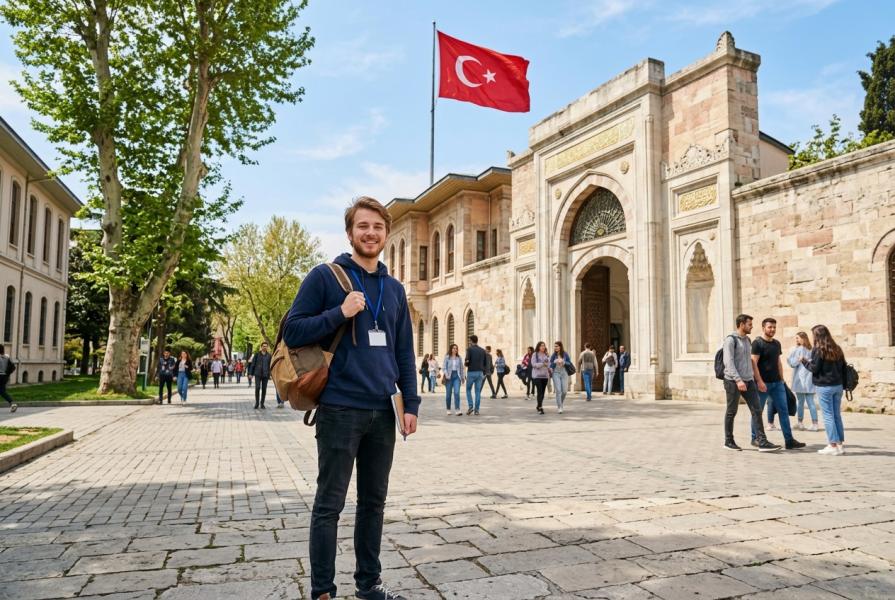
Turkey is gaining popularity among students and is confidently strengthening its position in the international education market, attracting more and more applicants from Asia, Africa, the Middle East, and other regions. According to the Council of Higher Education of Turkey (YÖK), while in 2014 approximately 48,000 foreign students were studying in the country, by the 2025/26 academic year their number exceeded 350,000. The government plans to bring this figure to 500,000 by 2028.
What advantages of Turkish universities attract foreign students today? We highlighted 4 main reasons.


What is the secret behind the popularity of Turkish education?
The main reason for the growing interest is a favorable combination of cost and quality. In recent years, studying in the United States, the United Kingdom, Canada, and Australia has become noticeably more expensive (also it was never known for being affordable). In addition to high tuition, living costs have risen, visa procedures have become more complex, and post-graduation work permit rules have become less predictable.
Compared to Western countries and American states, Turkey offers foreign students far more transparent conditions. Tuition at Turkish universities typically range from $3,000 to $30,000 per year, depending on the program and institution. Medical specializations cost more — approximately $18,000 to $50,000 — but even these figures remain significantly lower than at most universities in Europe, North America, or Australia. At Turkish public universities, the cost of studying can be even lower — at some programs it start at just $200–1,000 per year.
More programs in English are becoming available

Turkey today offers a wide range of English-language programs. In 2026, Turkish universities offer 15,000+ academic courses taught fully or partially in English, allowing foreign students to pursue their education without a mandatory knowledge of Turkish. Private universities in particular offer a large number of such programs, and most of them also provide their own scholarships as a bonus.
Turkish university degrees are recognized in Europe
Turkish higher education is becoming more visible and valued on the world stage. Today the country has 200+ universities, 11 of which are listed in the QS World University Rankings top 1000, and 6 in the top 500. Turkish degrees are recognized across European countries, making them attractive for students who plan an international career or wish to continue their studies abroad.
Convenient location also plays a role

Geography has become one of Turkey's unexpected advantages. The country is located at the crossroads of Europe, Asia, and the Middle East, so the journey to university takes significantly less time and costs less than flying to North America or Australia. This is especially important for families who carefully track education expenses. It is no surprise that the largest source countries sending foreign applicants are Syria, Azerbaijan, Turkmenistan, Iran, Iraq, Kazakhstan, Egypt, Afghanistan, Somalia, and Pakistan.
Types of Turkish universities
Foreign students in Turkey can choose between public and private universities.
- Public universities are traditionally better represented in international rankings, offering very affordable tuition, but admission is more competitive and most programs are taught in Turkish. Worth noting separately is the state program Türkiye Scholarships, through which approximately 5,000 foreign students receive funding to study in Turkey each year.
- Private universities, by contrast, more often offer instruction in English, flexible admission requirements, and their own scholarship programs, though tuition is higher.
Additional opportunities for foreign students during and after studies
International students have the opportunity to work during their studies for up to 24 hours per week. However, for undergraduate students this becomes possible only from the second year onward, while master's and doctoral students may start working immediately after beginning their studies.
After graduation from university, foreign students can obtain a one-year residence permit to look for work in the country. If they receive a job offer during that time, they can apply for a work permit.
For highly skilled professionals, the Turquoise Card program is available, combining long-term residency and employment opportunities; applications are assessed on the basis of education, professional experience, salary level, work in priority sectors, and knowledge of Turkish.
Challenges in the Turkish education system

Despite the rapid development of the higher education system, certain challenges and nuances remain.
- The main one is employment after graduation. Although many programs are taught in English, knowledge of Turkish remains a significant advantage for a successful career in Turkey — particularly for professions involving client-facing roles, the public sector, and regulated specializations.
- The country's labor market today is not always able to provide employment for all graduates. Therefore, those who plan to build a career specifically in Turkey should factor in employer requirements, their priorities, and employment opportunities in advance.
Prospects for Turkish education
Today, an increasing number of foreign students choose a university not only by its reputation, but also by how justified the investment in education is. Turkey offers precisely this balance: comparatively affordable tuition, recognized degrees, a large number of English-language programs, scholarships, a convenient location, and comfortable living costs. This is why the country is gradually transforming from an alternative destination into one of the fastest-growing players in the global higher education market.
The next important step for the Turkish education system will be not only attracting foreign applicants, but also creating conditions that help graduates successfully build their careers after receiving their degrees.