
Not long ago, robots seemed like characters from science fiction films, but today they assemble cars, help doctors perform complex surgeries, deliver orders, and even explore other planets. Behind all these technologies stands robotics — one of the most promising fields of our time.


About Robotics in Simple Terms
Robotics combines several fields of knowledge at once: programming, engineering, electronics, physics, and mathematics. Its main goal is to create devices that can independently perform certain actions by analyzing information from the surrounding world.
We encounter robots far more often than it might seem: a robot vacuum cleaner maps a route around an apartment, warehouse vehicles transport goods without human involvement, and industrial manipulators work in factories with a precision that humans cannot achieve.
At the same time, robotics is not some separate, complex science for the chosen few, but a field that can be mastered gradually, step by step.
Where Robots Are Used

Today, robotics has penetrated virtually every area of life.
- In industry, robots handle assembly, welding, painting, and quality control, working quickly, accurately, and with virtually no errors.
- In medicine, technologies help perform surgeries, create modern prosthetics and exoskeletons, and assist in the rehabilitation of patients after injuries and illnesses.
- In logistics, robots sort goods in warehouses and deliver orders.
- Automated cleaning machines have long been in operation at major airports and shopping centers.
- A separate field is space robotics: robots explore Mars and other objects in places where human presence is not yet possible or is too risky.
Why Robotics Is Becoming Increasingly Popular
Interest in this field is growing not only because of impressive technology. Robotics helps develop skills that are in demand in any modern profession. In the process of learning about the field, schoolchildren and students study to:
- Think logically,
- Find solutions to complex problems,
- Program,
- Work with engineering systems,
- Create projects as part of a team,
- Present their ideas.
In essence, robotics teaches not just how to mechanically assemble robots, but how to think like an engineer.
Who Is a Robotics Engineer?

Many people think that a robotics engineer is one specific profession. In reality, it is an entire group of specializations. Some specialists design the mechanical part of devices, others work on electronics, others write software, and there are even experts in machine vision who teach robots to recognize objects and analyze images. So most often, the creation of a single robot is the result of a whole team of engineers and programmers from various disciplines working together.
What Knowledge Will Be Needed?
You don't have to be a genius in mathematics or programming to get started, but there are several subjects that will be especially useful:
- Mathematics,
- Physics,
- Computer science,
- English.
Further education is built on exactly this foundation. The good news is that many people begin their introduction to robotics while still in school, using simple construction kits and educational platforms.
Where to Start?

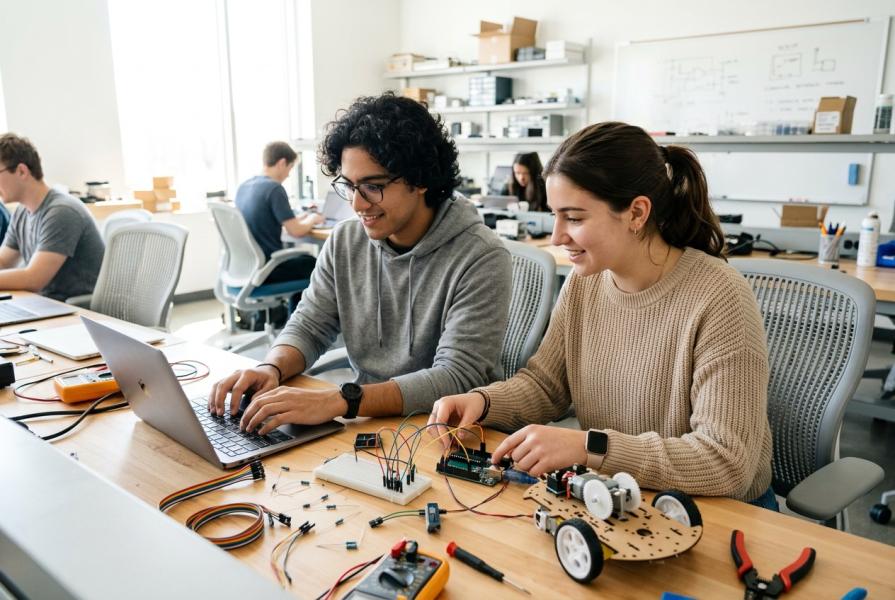
The simplest path is to try yourself in small projects: for example, assembling a robot based on Arduino, building a car with an obstacle sensor, or setting up a smart lighting system. Such projects help you quickly grasp the basic operating principles of devices. All of them can be found in short-term formats — for example, in a two-week summer camp abroad.
Engineering clubs, specialized camps, hackathons, and competitions become valuable experience: participants there do not just study theory, but solve real problems, work in teams, and build their own portfolios.
Where Can You Study?
Robotics can be learned in various ways:
- Through online courses,
- In engineering clubs and sections,
- At colleges,
- At universities in programs such as «Mechatronics and Robotics» or «Control in Technical Systems».
The earlier practical experience is gained, the easier it will be to build a career in this field in the future.
Robotics and the Career of the Future
Automation is developing at a record pace, and demand for specialists continues to grow. Companies are looking for engineers, control system developers, and specialists in artificial intelligence and machine vision.
But the main advantage of robotics lies not only in employment prospects. It is an opportunity to participate in creating technologies that change the world around us: from medical developments to space exploration. That is why robotics today is not just a profession of the future, but a field that already opens up enormous opportunities for learning, development, and building a successful career.