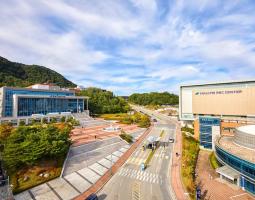
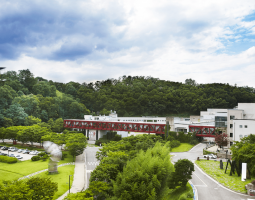
Jeju National University


Programs and prices, tuition fees in Jeju National University


Specify information on the training program on the official site of an educational institution.
Specify information on the training program on the official site of an educational institution.
Description of Jeju National University
- Name: Jeju National University (제주대학교),
- Location: Jeju City (a small city), Republic of Korea,
- Opened: 1952,
- Number of students: about 14,000,
- Type: Public university engaged in scientific and academic work.
- Location: Jeju City, Republic of Korea,
- Year of foundation: 1952,
- Academic structure: 15 colleges and 9 graduate schools.
The university also has 102 affiliated facilities, three affiliated schools, and three legal entities.
Considered to be a medium-sized university, Jeju National University each year accommodates about 14,000 people. Both local residents and visitors from different countries of the entire globe can enter here. The university offers teachers and students to take an active part in international academic exchange programs between universities.
The College of Medicine opened in 1998, became a graduate medical school in 2008, and returned to its medical college format in 2019. The College of Education traces its history to temporary courses for elementary school teachers established in Jeju in 1946 and has been part of the university since March 2008. The College of Arts and Design was established in the 2012 academic year. The College of Pharmacy opened in March 2020 and is the only pharmacy college in Jeju Province.
Educational process
The final exam is held at the end of the semester. Instructors may also conduct additional exams during the semester as needed.
The College of Medicine uses problem-based, team-based, and case-based learning, along with role-play exercises. The physical education program combines theory and practice through specialized curricula, field-based education, and career-focused preparation.
Faculties and colleges
- The College of Humanities teaches and conducts research in linguistics, literature, philosophy, history, and sociology,
- Since 2010, the College of Humanities and Jeju Special Self-Governing Province have operated a workforce preparation program in cultural content, planning, and public relations,
- The College of Natural Sciences focuses on health, beauty, biological sciences, information technology, and biotechnology,
- The College of Arts and Design offers programs in music, fine arts, and industrial design,
- The Department of Chemistry and Cosmetics studies the properties and chemical changes of matter and prepares professionals for the cosmetics industry,
- The university also has a continuing education center.
Scientific achievements
- The College of Life Sciences and Resources secured a gene bank for subtropical and tropical organisms, a priority RRC institute, and a citrus export research team,
- The College of Marine Sciences participated in the government-sponsored BK21, NURI, POST-BK21, and LINC projects and a workforce development program for Jeju's water industry,
- The Institute for Humanities publishes Research in the Humanities, a KCI-indexed journal,
- The Subtropical Horticulture Industry Research Institute conducts research in crop molecular breeding,
- The Tamna Culture Research Institute publishes the journal Tamna Culture,
- The Institute of Tourism, Business and Economics conducts theoretical and practical research related to regional economic development.
Accommodation, meals, prices
Medical students from outside Jeju can use the university's residence facilities. Sodeokheon, located near the hospital, accommodates third- and fourth-year medical students completing clinical practice.
Advantages
- Jeju National University regularly ranks high in the national ranking of South Korea,
- Jeju National University is one of the most famous and prestigious universities on the planet, one of the top 5% in the world,
- In 2006, the College of Life Sciences and Resources received an excellent rating in agricultural sciences from the Korean Council for University Education,
- In 2015, the College of Medicine received the highest accreditation rating from the Korean Institute of Medical Education and Evaluation for a six-year term,
- The architecture program meets the professional accreditation standards of the Korea Architectural Accrediting Board and is recognized by Canberra Accord participants and the UNESCO-UIA validation system.
Facilities and equipment at Jeju National University
The university has at its disposal a large scientific library. Among other things, the institution provides all visitors with housing in a hostel. There are on the campus and conveniently equipped sports fields, places for active recreation and playgrounds for walks.
The campus has a museum, health promotion center, sports promotion center, disability support center, and student counseling center.
- The College of Engineering operates an engineering education innovation center, an advanced technology research institute, and an affiliated factory,
- The College of Medicine's second building has classrooms for each year, a clinical skills center, a team-based learning room, a computer room, and lounges,
- The College of Veterinary Medicine has a veterinary hospital, a wildlife rescue center, Yonggang Training Farm, and an institute of veterinary science,
- The Jeju National University Human Rights Center is located on the second floor of the student center.
A direct bus from Jeju International Airport to Ara Campus takes about one hour. The trip from Jeju City Hall takes around 25 minutes.
Admission dates and extra charges
The medical college and law school maintain separate academic calendars.
- Daytime class periods last 50 or 75 minutes,
- Daytime classes with 50-minute periods run from 09:00 to 17:50,
- Evening classes with 45-minute periods run from 18:30 to 22:35.
Entry requirements, how to apply, what is required to enrol
A special admissions university commission holds a special set of freshmen. At the same time, the general academic results on the performance of each individual applicant are taken into account. Also, experts make their decision based on the results of the entrance exams. Each academic year can be divided into traditional semesters in the amount of two parts.
Tuition at Jeju National University
Education university leads for a fee. In this case, each student can expect to receive scholarships. For each semester, students pay about 2500 US dollars. Even with a small tuition fee, the university offers students financial support. Applicants can initially choose for themselves, among other things, the system of education - distance or full-time. Jeju National University offers to find out more detailed information about study programs, admission conditions, tuition fees through the official website (portal address https://www.jejunu.ac.kr ), as well as through the institution's pages in the most popular social networks.
Scholarships Jeju National University
- University-funded scholarships include merit awards, financial aid for low-income students, work-study scholarships, and special scholarships,
- Development Fund scholarships are awarded through student applications or recommendations according to the purpose of each donation and the program criteria,
- External scholarships follow the criteria established by the organizations that provide them,
- Donations from Lee Geun-sik were allocated to the Cheongbong Scholarship Fund.
Institution on the map
Residence permits, citizenship and other services
- Guardianship services during the studies
- Student supervision
Review about Jeju National University
Recommendations on when to apply
| Language courses, schools and children's language camps | Primary and secondary education - private schools | Preparation programmes for entering universities - higher education | Higher education (after completing accredited programs A-level, IB, High School) - Bachelor, Master, MBA |
| - we recommend to apply 6-9 months before the start of the course (some camps and schools offer discounts for early booking or for lengthy study programs) - there are some very popular and high demand children's camps, where the applications need to be submitted 1 year in advance (in particular Switzerland , Great Britain , USA , Canada , Austria) | - we recommend to apply one year before the start of the training program, - some schools have a specific time frame (September-November - please specify an individual school) - some schools require tests in several stages (UKISET, internal tests of the school: English, mathematics, logics, subjects, interview, some require a personal visit) | - we recommend to apply one year before the start of the program, - for Foundation and Pathway programs, IELTS and TOEFL certificates are usually required, respectively | - recommended submission one year before the start of the program, - the deadline normally closes in January, for TOP HEIs and, as a rule, in March in other universities - for a bachelor, a Foundation or Pathway preparatory program a completed A-level, IB, High School + IELTS / TOEFL are required - for Masters you need a graduated higher education, in some cases you need a pre-Masters program - MBA requires completed higher education, work experience preferably at least 2-3 years, etc. |