In a remarkable reversal that has captured global attention, Denmark—long celebrated as a pioneer in digital education—is now championing a return to analog learning. This shift reflects a growing awareness that unfettered screen time in schools may do more harm than good.
For years, Denmark stood as a global model for digital integration in education. The country began its journey in the 1990s, driven by a vision to transition from an agricultural to a knowledge-based economy. By the early 2000s, a spirit of "digital optimism" pervaded classrooms, and by 2011, tablets were introduced in schools. Today, Danish 15-year-olds spend an average of 3.8 hours daily on digital tools during school hours—the highest among OECD countries—and the nation's computer and information literacy ranks among the world's best.


The Reckoning
Despite these achievements, concerns have mounted. The 2022 PISA study revealed significant declines in Danish students' reading and numeracy skills, dropping below turn-of-the-century levels. Meanwhile, Danish teens aged 13-18 spend an average of 5.5 hours daily on their smartphones, contributing to declining mental well-being.
Government happiness surveys paint a troubling picture: only 23% of students reported the highest level of "learning well-being" in 2024, down 10 percentage points over a decade. The percentage of children reporting boredom and lack of motivation doubled from 5% to 10% between 2015 and 2023.
Teachers describe what one calls "digital chaos." Students appeared productive but were often playing games or scrolling social media. "With a single swipe, a lesson becomes a video game, making deep concentration nearly impossible in a fully digital environment," observers note.
The Response
Denmark's political establishment has responded decisively. In early 2024, the Ministry of Education issued twelve non-binding recommendations, including banning mobile phones during lessons and limiting tablets to pedagogically justified use. Minister for Children and Education Mattias Tesfaye apologized to Danish youth, stating they had been made "guinea pigs in a digital experiment".
In December 2025, a broad parliamentary majority agreed to legally mandate mobile-free primary and lower secondary schools starting from the 2026/2027 school year. Content filtering tools blocking social media, gaming, and shopping sites will also be required, with plans to ban social media for under-15s.
Rediscovering Balance

At Roskilde's Krostamark School, first-graders now read "Little Red Riding Hood" from printed materials. Teacher Ellen Skøtt Jensen explains: "Digital devices can malfunction, children press the wrong buttons, pages don't turn properly. For this age, paper achieves the learning goal more easily".
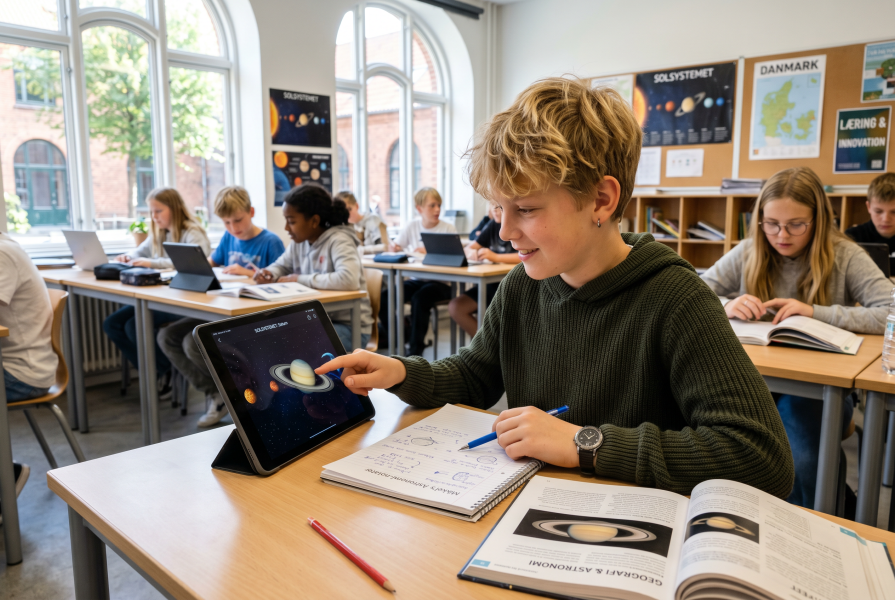
Yet educators emphasize this is not a wholesale rejection of technology. Jensen's students use Excel for graphing when the focus is on analysis rather than drawing skills. A student studying the solar system combined a physical model with an iPad for 3D visualizations. As one teacher observes, "The children we teach today don't see analog and digital learning forms as opposites, but as parts of a whole".
Lene Madsen from the National Centre for Teaching Resources notes rising demand for "practical materials" where children collaborate hands-on—building sets for stop-motion animation or creating prototypes in science classes.
A Lesson for the World
Denmark's experience offers a valuable lesson: what works in theory doesn't always work in practice. As one headteacher notes, "learning styles vary by child"—some learn best from paper, others from audio, still others from video. The goal is not choosing between analog and digital, but thoughtfully integrating both.
Ralph Müller-Eiselt of Germany's Forum Bildung Digitalisierung cautions against simplistic conclusions: "When you replace analog teaching tools with digital technology without adapting the didactics, there are no improvements". He argues for developing "future skills" like resilience, communication, and adaptability—competencies that no algorithm can provide.
A researcher notes that Nordic countries act as "experimental nations"—willing to try, assess, and if necessary, reverse course. "What didn't work isn't failure," he observes, inviting other nations to learn from Denmark's example.
Denmark's journey demonstrates that true educational innovation lies not in fully embracing or rejecting technology, but in the thoughtful integration of both—keeping what serves learning, discarding what distracts, and always placing children's well-being at the center.