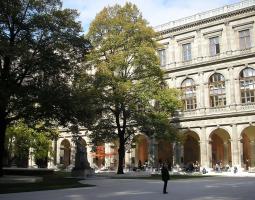
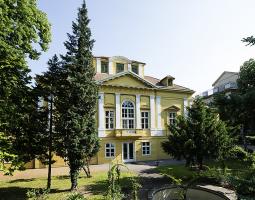
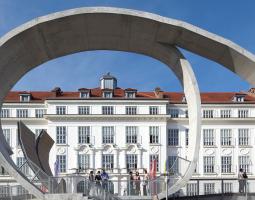
Vienna University of Economics





Programs and prices, tuition fees in Vienna University of Economics


Quick overview: The program is conducted entirely in German - for foreign students special intensive courses are provided, so you can reach the required level already during studying, after enrollment.
Specialties are as follows:
- Economy and Law;
- Economics and Social Sciences.
Brief information: International students have the opportunity to obtain a master's degree, studying in English. Applicants must demonstrate a sufficiently high level of language (international certificates), provide a diploma of first higher education (bachelor's degree).
List of master's degree in the following areas:
- Logistics, supply chain management;
- Innovation and control of management.
About the educational program: since all teaching is conducted in German, students will need to demonstrate a sufficiently high language level (no lower than B2), and also present a diploma of basic higher education (bachelor / specialist).
List of specialties:
- Finance and accounting;
- Socioeconomics;
- Information Systems;
- Taxation and accounting;
- Management;
- Taxes, auditing and accounting.
Description of Vienna University of Economics
- Location: Vienna, Austria,
- Foundation year: 1898,
- Educational programs: University preparation, Bachelor's, Master's program, doctoral programs, PhD, MBA,
- Number of students: 23,019 in the winter semester of 2025,
- Foreign students: 8292 in the winter semester of 2025,
- Language of instruction: German and English,
- The rector: Professor, Dr. Christoph Badelt.
The largest specialized university in Europe, intended for international students in economic fields, is the Vienna University of Economics (Wirtschaftsuniversität Wien), founded in 1898. Over the years of existence and successful work, the name of the institution has changed many times, but the goal of the studying has remained the same: the education of qualified and talented managers, directors of enterprises capable of establishing and developing a profitable business.
In 2007, the Vienna University of Economics received the prestigious quality mark EQUIS (European Quality Improvement System): it is the first Austrian university in Vienna accredited in this way (a total of 110 economic universities in 32 countries). Today, the Vienna University of Economics is ranked 16th in the world by the ranking of MBA programs and is included in the TOP-50 of the best business schools.
There are two main and popular faculties:
- Socio-economic faculty.
Specialties: economic informatics, international economics, national economics, enterprise economics, socioeconomics with the option to select an additional qualification module. There are programs of magistracy and doctoral studies.
- Economic / Entrepreneurial Law.
Master and PhD programs operate here.
The most popular specialties are:
- Law;
- Economics;
- Business.
Graduates demonstrate an excellent level of academic skills and build a successful career in any country in Europe and the world, are part of the business and political elite.
Many of the graduates of the Vienna University of Economics became known to the whole world by specialists, political and scientific figures, Nobel laureates:
- Franz Vranitzky (Federal Chancellor of Austria in 1986-1997);
- Thomas Klestil (President of the Republic from 1992 to 2004, he received his doctorate at the age of 25).
In the educational process, all students participate in a large number of international and national conferences, symposiums, round tables - this is a chance to talk with the best specialists of their industry, to observe the application of the knowledge gained in practice, and to exchange experience with foreign colleagues.
The Vienna University of Economics actively participates in student exchange programs around the world (in total 215 economic schools participate in it) - in order to learn by exchange, it is necessary to prepare a certificate from your institution with the obligatory indication of the faculty.
Today more than 400 teachers work here, 82 of them having a professorship. Annually, the rector, Dr. Christopher Badelt, receives more than 800 applications from well-known global corporations who want to employ young graduate students. Former students maintain close ties with each other for many years - this is facilitated by the Career Center and the Alumni Club.
Educational process
The first year of WiSo consists of the 16-ECTS introductory and orientation phase, STEOP, and the 47-ECTS Common Body of Knowledge, CBK. The introductory course explores business, social sciences, law, economics, the digital economy, and sustainable economic practices. From the third semester, students develop more advanced knowledge in their chosen specialization. To choose a specialization, they must complete STEOP and at least 20 ECTS of CBK courses. Students write their bachelor's thesis in their chosen specialization. In FiRe, specializations help students tailor their program.
Doctoral education consists of classes, exams, and a dissertation. In exceptional cases, a dissertation supervisor may permit students to complete the program in English. WU offers support programs for students and staff with disabilities. The WU Business Language Center offers the Oxford Test of English.
More than 1300 students participate in exchanges each year. The International Office advises students on exchanges, education abroad, and short programs. Partners include HEC Paris, Copenhagen Business School, ESADE, London Business School, and TUM School of Management. Master's exchanges, the CEEPUS network, and Central Europe Connect are available.
Bachelor's exchange destinations:
Europe:
- Albania,
- Belgium,
- Bosnia and Herzegovina,
- Bulgaria,
- Croatia,
- Czechia,
- Denmark,
- Estonia,
- Finland,
- Hungary,
- Ireland,
- Montenegro,
- Netherlands,
- Norway,
- Poland,
- Romania,
- Serbia,
- Slovakia,
- Slovenia,
- Sweden,
- Ukraine,
- United Kingdom,
- France,
- Germany,
- Greece,
- Italy,
- Portugal,
- Spain,
- Switzerland.
Asia and Turkey:
- China, including Hong Kong,
- Israel,
- Japan,
- Indonesia,
- Malaysia,
- Singapore,
- South Korea,
- Taiwan,
- Thailand,
- Vietnam,
- Turkey.
North and South America:
- Canada,
- USA,
- Argentina,
- Brazil,
- Chile,
- Mexico,
- Peru.
Other destinations: Egypt, Kenya, Morocco, Australia, and New Zealand.
The quality management system for education brings together four levels: strategic documents and policies, processes and tools, organizational structures, and a culture of quality.
Scientific achievements
WU ranks second in QS Masters in Supply Chain Management. Its master's programs in management, marketing, and finance rank in the top 10% of their respective QS rankings.
Research spans business administration, economics, formal sciences, law, social sciences, and language sciences. The Hans-Kelsen-Preis recognizes the top graduates of the bachelor's program in Wirtschaftsrecht.
Things to know about
- In 1919, the institution became the state-run Hochschule für Welthandel, with a six-semester program,
- After the Anschluss, the institution adopted the laws and regulations of the German Reich. It returned to the Austrian academic regulations in the winter semester of 1946/47,
- The university adopted the name Wirtschaftsuniversität Wien in 1975 as part of a reorganization of universities,
- WU has more than 2400 employees. Almost 1600 are researchers, teaching staff, and academic staff.
Accommodation, meals, prices
WU works with independent student accommodation providers. The university has no influence over them.
- OeAD,
- Vetheim,
- Porzellaneum,
- ÖJAB,
- Campus Studios - Akademikerhilfe,
- CoLivi,
- THE FIZZ,
- HANS-Y All in Living,
- MILESTONE,
- Smartments,
- The Social Hub Vienna,
- STUWO,
- Viennabase.
Subjects and sports
Activities Vienna University of Economics
Themed student clubs are open to all WU students:
- A Study Group — focused group studying and development of learning methods,
- Debattierklub Wien — practice sessions and international debating tournaments,
- ELSA WU Wien — legal workshops, social events, international law schools, and moot courts,
- WeU Debate — debates on legal and sociopolitical issues,
- Business & Finance Club Vienna — events with partner companies, social gatherings, and international trips,
- Green Finance Society — workshops, lectures, and opportunities to meet experts and companies working toward a sustainable economy,
- Student Investment Club — a stock market simulation that provides practice in investing, trading, and portfolio management, plus workshops and networking events,
- AI Society Vienna — practical artificial intelligence workshops, guest speakers, and collaborative projects,
- The consulting organization icons — about 70 members from different academic disciplines and more than 500 projects for startups, small and medium-sized enterprises, and international corporations,
- Solutions for AI Integration — AI workshops from beginner to professional level, with a certificate for each level. Twice per semester, entrepreneurs and practitioners demonstrate how companies use AI,
- START Vienna — entrepreneurship events, visits to startups and venture capital companies, and mentoring,
- WU Social Entrepreneurship Club — events, projects, and opportunities to meet the entrepreneurial community,
- AIESEC — international internships, volunteering, and leadership development,
- FORE Wien — workshops and talks with companies and organizations in the real estate sector,
- Guidance Mentoring — a year of individual mentoring for selected participants, workshops, and a practical project with a nonprofit organization,
- Ladies that Lead — a women's community and networking events with experts and companies,
- Talente Österreich — individual mentoring, workshops with partners, and interdisciplinary networking,
- Mind the Gap — group runs from the library through the Prater,
- Vienna Fashion Club — fashion, its economic aspects, and workshops,
- Vienna Student Sports — running, road cycling, padel, Hyrox, and Pilates for participants of all levels,
- Vienna Wine Collective — tastings and events with professionals and local winemakers on grape varieties, terroir, and tasting techniques,
- WU Tigers — men's and women's basketball, mixed American football, and mixed cheerdance in the ACSL. Games take place before more than 7500 fans and are televised,
- WU Wolves — participation in European sporting events for universities of economics, plus parties, sports, and networking events in Vienna,
- BBE Club — the official student representation of the BBE program, run by students,
- Econ Master Club — social and academic events for Economics master's students,
- The E&I Club at the institute for entrepreneurship and innovation — events, workshops, and lectures for students, graduates, and anyone interested in starting a business,
- WUMA — the official club for the Marketing master's program, offering networking events, mentoring, and practical workshops.
Officially recognized clubs can book seminar rooms and use the Club Space in the Student Center. Additional accreditation provides an opportunity to receive financial support.
Advantages
- Ability to gain practical experience or complete an internship in the best international organizations and companies. This is an invaluable experience of practical work and cooperation with the best specialists, thanks to which graduates immediately after the end of the programs are ready to begin to perform direct duties. Practices and internships will be a valuable mention in a personal resume and will impress employers,
- Full self-realization, development of valuable business and personal qualities. Students become more independent, disciplined, attentive and persistent, they competently and objectively form their goals and ways to achieve them,
- Wide travel opportunities: a special student card, which every student in Austria receives, gives you the chance to go to any country in the Schengen agreement. Austria borders on 8 developed and original states - this is an excellent opportunity to get acquainted with the new culture, customs, traditions, way of life and behavior,
- WU holds triple accreditation from AACSB, EQUIS, and AMBA. It is the only university in Austria with this combination of accreditations,
- WU is one of 147 universities of economics and business schools worldwide with triple accreditation, one of eight such institutions in German-speaking countries, and one of five in Central and Eastern Europe,
- In 2023, WU's EQUIS accreditation was extended for five years, through 2028,
- WU has held AACSB accreditation since 2015. In 2025, it was extended for another six years,
- WU Executive Academy has held AMBA accreditation since 2010 and became the first and only MBA provider in Austria with this accreditation. In 2024, its accreditation was extended for five years.
Facilities and equipment at Vienna University of Economics
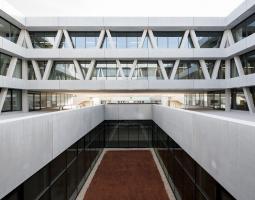
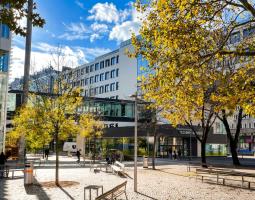
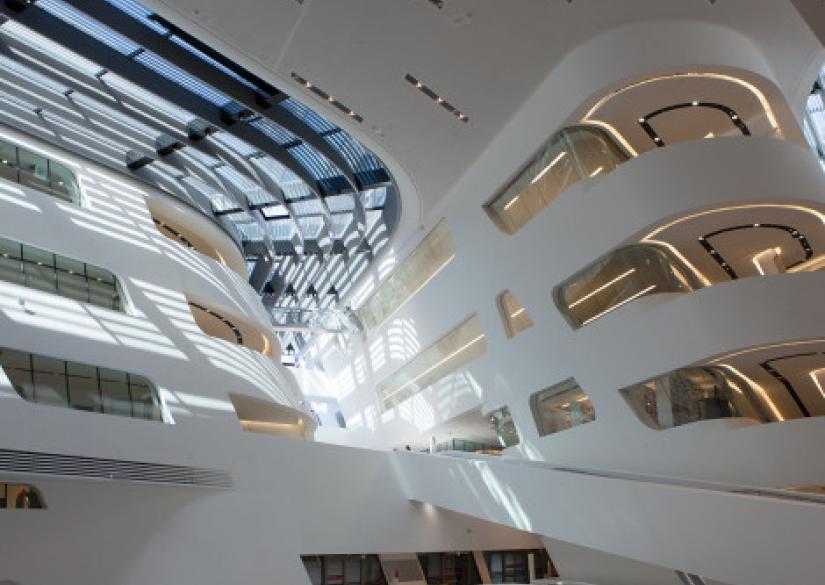
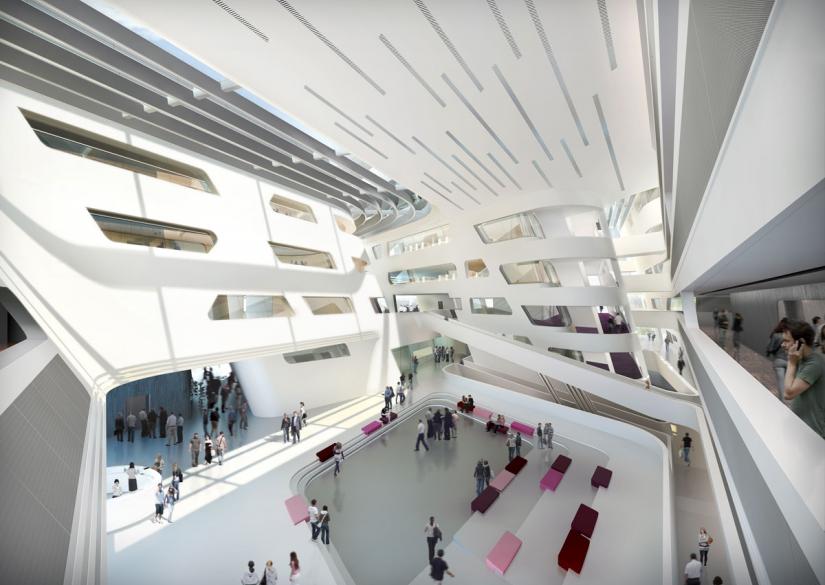
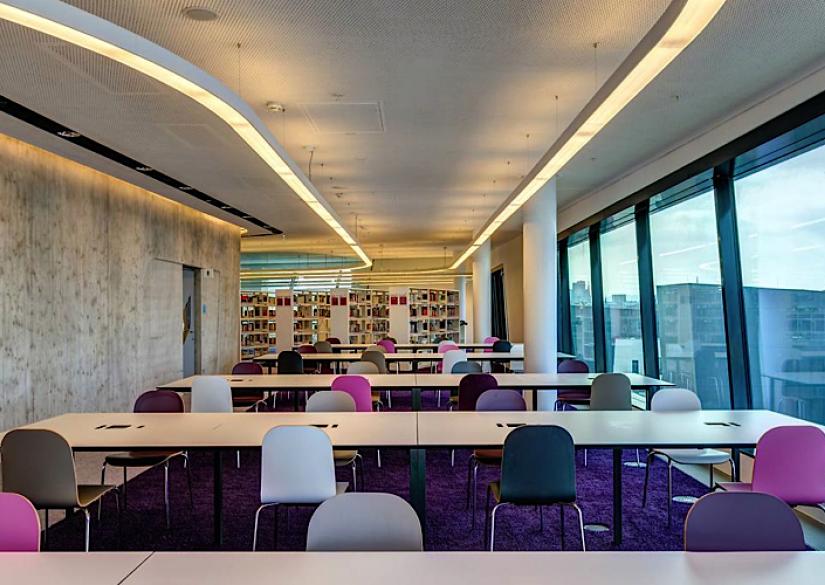
Campus WU consists of seven building complexes, with approximately 90,000 m² of usable floor space and a built-up area of 45,000 m². In 2019, it became Austria's first climate-neutral university campus. It has the country's largest economics library, workspaces for independent studying, and spacious computer rooms.
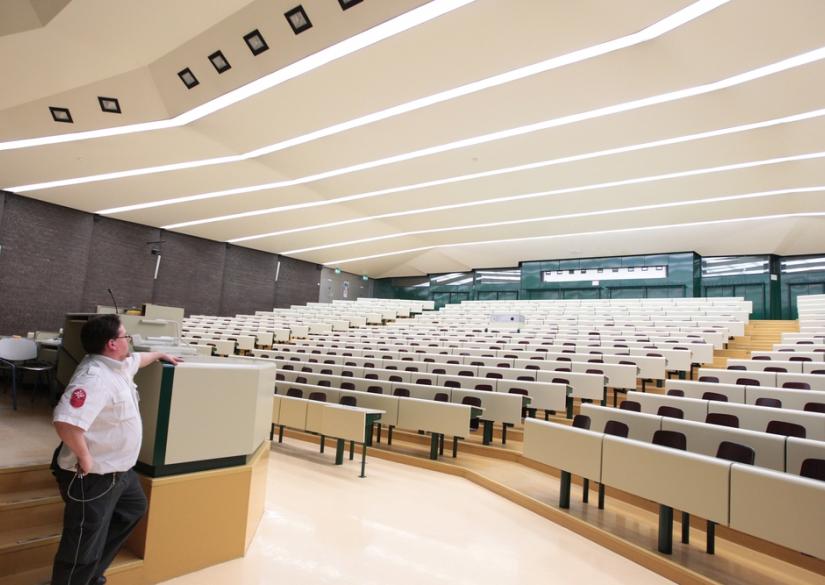
All lecture halls are designed to be accessible, and wheelchair users have access to every area of campus. A tactile navigation system guides people with visual impairments.
The campus is located between the Messe-Prater and Krieau stations on the U2 subway line. Each is about a 5–10-minute walk from the Library & Learning Center. Nearby public transportation options are bus 82A, with stops at Trabrennstraße, Südportalstraße, and Welthandelsplatz, and tram 1 to Prater Hauptallee.
An underground parking garage beneath the main pedestrian walkway has 411 spaces. Approximately 180 are available for short-term parking, and the rest are reserved for regular users. Four exits lead from the garage to the campus. Approximately 1000 bicycle parking spaces are located along the bike path that surrounds the campus. About 250 are in enclosed bicycle garages with card access. Cycling on the campus itself is prohibited.
Admission dates and extra charges
German-language master's programs begin in the winter semester. The Wirtschaftsrecht master's program can also be started in the summer semester. The BBE bachelor's program starts only in the winter semester, in September or October.
A separate registration fee is charged for each selected program. It is nonrefundable except in cases of late or duplicate payment.
Enrolment process
The self-assessment used when choosing a bachelor's program is not graded and helps applicants decide whether the program is a good fit. The BBE selection procedure applies to all applicants from the EU and from countries outside the EU and EEA. The university does not offer preparatory courses for the BBE entrance exam. WiSo applicants can take part in online meetings with students and preparatory days that introduce them to the campus. The BeAble team can arrange accommodations for the BBE, WiSo, and Wirtschaftsrecht written exams for applicants with long-term physical or mental impairments. WiSo also takes chronic conditions and neurodivergence into account.
Selection for English-language master's programs varies by program and may involve an expert panel's review of application documents and an interview. The PhD programs in Finance and International Business Taxation have separate selection procedures. Prospective doctoral students must find their own dissertation supervisor. The university does not conduct this search for them. Applicants interested in several programs must complete a separate admissions process for each.
Enrolment statistics
WU admitted 5481, 5948, and 5922 students in the winter semesters of 2023, 2024, and 2025, respectively. Of these, 4271, 4784, and 4683 were entering WU for the first time.
2703 places are available in WiSo and 870 in Wirtschaftsrecht. BBE plans to accept 240 students in the winter semester.
All three bachelor's programs, the German-language master's program in Management, and the English-language master's programs have limited places and competitive selection. The other German-language master's programs and the Doctoral Programs category have no limit on places. Applicants must meet the admission requirements.
Entry requirements, how to apply, what is required to enrol
The requirements change every year, so it's worth asking questions in advance and clarifying the actual information.
Please note that you can register for economic specialties only once a year (applications are accepted until May 30). On most specialties the entrance exams are accepted, compulsory also is the completion and submission of the registration application in the prescribed form.
Scholarships Vienna University of Economics
The Leistungsstipendium rewards academic achievement. Eligibility depends on the permitted program duration, minimum academic achievement requirements, and the grade average. The Förderungsstipendium is available to master's students.
Students who completed a WU bachelor's program in the preceding winter semester and enter a WU master's program in the summer semester can combine ECTS from both programs, provided they remain within the permitted duration for each. Recognized credits are assigned to the academic year in which the work was completed. Preparatory courses, additional courses, and voluntary academic work outside the curriculum are excluded from the calculation. Bachelor's and master's theses count, but dissertations without assigned ECTS do not. The grade average is weighted by ECTS and calculated using the best results until the minimum credit requirement is met. Failing grades and results without a numerical grade are excluded from the average.
WU provides financial support for all exchanges organized by the International Office. Under certain conditions, funding is available for internships abroad and participation in international scientific events, including conferences, moot courts, and case competitions.
- Erasmus+ — support for exchanges in EU member states and selected other countries, and for internships abroad,
- Swiss European Mobility Programme (SEMP) — support for mobility to Switzerland,
- WU mobility grant — support for a semester or year on exchange and international short programs in Great Britain, overseas, and selected other countries,
- WU mobility grant special support — additional assistance for students whose financial circumstances would otherwise prevent them from pursuing education abroad,
- CEEPUS — grants for selected partner universities in Central and Eastern Europe,
- Prof. Ewald Nowotny Grant — support for participation in international scientific events, moot courts, and case competitions,
- An additional scholarship for bachelor's students on exchange at Kansas University can be combined with the WU mobility grant. Six grants are available per academic year. Students on a year-long exchange receive two payments.
The International Office's Erasmus+ and grants team helps students and staff with financial support for mobility. Erasmus+ Faculty & Staff Mobility in Europe and Erasmus+ International Credit Mobility are available to faculty and staff.
Institution on the map
Residence permits, citizenship and other services
- Guardianship services during the studies
- Student supervision
Review about Vienna University of Economics
Recommendations on when to apply
| Language courses, schools and children's language camps | Primary and secondary education - private schools | Preparation programmes for entering universities - higher education | Higher education (after completing accredited programs A-level, IB, High School) - Bachelor, Master, MBA |
| - we recommend to apply 6-9 months before the start of the course (some camps and schools offer discounts for early booking or for lengthy study programs) - there are some very popular and high demand children's camps, where the applications need to be submitted 1 year in advance (in particular Switzerland , Great Britain , USA , Canada , Austria) | - we recommend to apply one year before the start of the training program, - some schools have a specific time frame (September-November - please specify an individual school) - some schools require tests in several stages (UKISET, internal tests of the school: English, mathematics, logics, subjects, interview, some require a personal visit) | - we recommend to apply one year before the start of the program, - for Foundation and Pathway programs, IELTS and TOEFL certificates are usually required, respectively | - recommended submission one year before the start of the program, - the deadline normally closes in January, for TOP HEIs and, as a rule, in March in other universities - for a bachelor, a Foundation or Pathway preparatory program a completed A-level, IB, High School + IELTS / TOEFL are required - for Masters you need a graduated higher education, in some cases you need a pre-Masters program - MBA requires completed higher education, work experience preferably at least 2-3 years, etc. |