 Spain
Spain
 For partners
 University of British Columbia Summer Camp, Summer Camp at the University of British Columbia


Programs and prices, tuition fees in University of British Columbia Summer Camp, Summer Camp at the University of British Columbia


English & Culture Camp
- Age of students: 11-17 years old.
- Duration of study: from 1 to 6 weeks.
English & Culture Camp is a classic language program in an immersive format. Here, English is not separated from the rest of camp life: it is used both in classes and during joint projects, and on excursions. The idea is simple — to overcome the language barrier and teach a teenager to speak freely in real situations, and not just complete exercises from a textbook.
The academic workload — at least 15 hours of English per week. On the first day, testing is conducted, after which participants are assigned to levels. Classes are held in small groups so that everyone regularly participates in discussions and oral assignments. The program is built on a communicative methodology: emphasis on speaking practice, everyday communication vocabulary, presentation skills and teamwork.
Additionally, conversation clubs and project assignments are integrated into the course — for example, preparing mini-presentations or team performances. At the end of the shift, participants receive a certificate indicating the duration of training.
Future of Work Academy
- Age of students: 15-17 years old.
- Duration of study — 2 weeks.
The Future of Work Academy is designed for teenagers who are thinking about choosing a profession and want to understand how the labor market will change in the coming years. The course focuses on economic transformation, technology development, digital skills and new employment formats. Participants will discuss what competencies become key — from analytical thinking and creativity to teamwork and presenting ideas.
The course is based on the format of practical exercises: teenagers analyze real examples from business and technology, work with cases, learn to formulate a problem and find a solution. A significant part of the time is devoted to teamwork: groups develop their own project — from idea to presentation. Workshops on leadership, basics of entrepreneurship, building a personal development path and public speaking skills are planned.
The focus is on practical skills: the ability to argue, defend your position, distribute roles in a team and bring the project to completion. The program ends with the defense of group work before the audience.
Studying takes place in an English-speaking environment and is combined with the general cultural program of the camp — this format allows you to simultaneously develop language skills and gain first experience in serious project work, close to university level.
Description of University of British Columbia Summer Camp, Summer Camp at the University of British Columbia
- Year of foundation: 1993,
- Location: Vancouver, British Columbia, Canada,
- Number of students: ~500,
- Type of study: mixed,
- Type of institution: children's language summer camp,
- Language of instruction: English.
Summer camp on the University of British Columbia campus is a summer program for teenagers aged 11-17, organized on the territory of one of Canada's leading universities. Participants are accommodated in UBC residences and spend their session in the atmosphere of a real university campus, meet and communicate with peers from different countries, using English every day in studies and life.
Sessions take place in summer, and you can choose the duration of classes — courses from one to six weeks are available. English is constantly heard here: in lessons, in conversations between participants, and in everyday situations. Teenagers come to the camp from different countries, so the environment is truly international. Studies and extracurricular activities run in parallel, creating a busy but balanced pace. This format is suitable for both the first independent trip abroad and for those who already have experience studying and relaxing abroad.
Things to know about
The University of British Columbia campus, where the camp is held, is regularly used as a filming location for Hollywood movies and TV series — many buildings and locations are familiar to you from the screen! Dozens of films have been shot here, including "Fifty Shades of Grey", "X-Men Origins: Wolverine", "She's the Man" and "The Butterfly Effect".
The university itself consistently ranks among the world's leading universities and is considered one of Canada's strongest research centers.
Accommodation, meals, prices
Teenagers are accommodated in UBC residences, usually in double rooms (single rooms are limited and booked well in advance). Bathrooms — shared on the floor, there are common areas. Wi-Fi is available in the buildings, access and rooms are opened with keys.
Meals are provided in the university cafeteria buffet-style: three times a day plus an evening snack. Dietary restrictions are taken into account (upon prior request). Lunch boxes or meal cards are issued during excursions.
Free laundry is available for stays of two weeks or more.
Activities University of British Columbia Summer Camp, Summer Camp at the University of British Columbia
After classes, the program doesn't slow down! Every week — trips around Vancouver and its surroundings are organized: Stanley Park, Vancouver Aquarium (one of Canada's largest aquariums: more than 65,000 marine animals and fish, including sharks, rays and sea lions, some exhibits are dedicated to the ecosystem of the Pacific coast of British Columbia), the Science World science center, Granville Island, city beaches and observation decks. Longer trips are also planned — for example, to Whistler or Victoria.
In the evenings, the kids will enjoy team games, themed parties, discos, quests and creative projects. On Sundays, there is a Sunday Options format: teenagers choose from a list — stay on campus or go on an active trip, including walks in parks and kayaking.
Advantages
- Real UBC campus: a teenager doesn't live in an ordinary school or summer camp, but in a full-fledged university environment.
- 15+ hours of English per week and constant conversational practice with students from different countries.
- Sunday Options format — the child chooses how to spend the weekend: from quiet activities on campus to trips to Whistler or Victoria.
Facilities and equipment at University of British Columbia Summer Camp, Summer Camp at the University of British Columbia
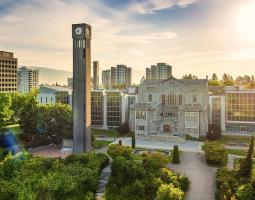
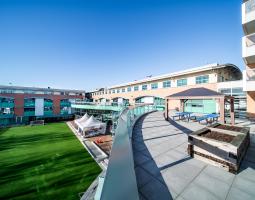
The camp is organized on the territory of University of British Columbia — a large university campus with academic buildings, sports facilities and its own infrastructure. Classes are conducted in equipped classrooms for small groups, halls, lounge areas and sports grounds of the campus are used for the evening program and general events.
The campus is located on a peninsula in the western part of Vancouver, near Pacific Spirit Park, the ocean and beaches. It takes about 30 minutes to get to the city center by transport.
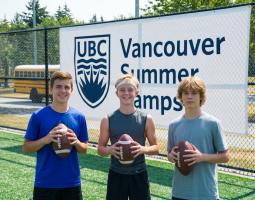
There are open fields for football and other games, indoor sports halls and grounds on the campus where tournaments and camp events take place. Everything is located nearby: from the classroom to the dining room or gym — a few minutes walk, no travel across the city and unnecessary logistics. The children go in groups along clear routes, always accompanied by camp staff. The territory is large, but well-organized, it is difficult to get lost here.
Admission dates and extra charges
The program is conducted in the summer, usually from late June to early August. Arrival and departure are on Sundays, and the duration can be chosen from one to six weeks. The studies are organized in weekly modules, there are no final exams, but upon completion of the shift, participants receive a certificate.
Flights, transfers at non-standard arrival times, separate paid Sunday outings (Sunday Options), and personal expenses are paid separately. Pocket money is usually budgeted for approximately 80-150 $CAD per week — for souvenirs, snacks outside the dining hall, and small purchases.
Enrolment process
First, you choose the participation format — with accommodation on campus or without it, then the duration (from 1 to 6 weeks) and arrival dates. After that, an application is submitted for the selected shift.
Next, the family receives confirmation and instructions for payment and preparation for the trip. The place is booked after the payment is made. Closer to the start of the program, you need to provide flight details to organize a meeting at the airport (if transfer is required).
On the day of arrival, participants are met, accommodated on campus, given an introductory briefing and English test, after which study groups are formed and a schedule for the first week is issued.
Entry requirements, how to apply, what is required to enrol
The program is designed for teenagers aged 11-17, participants are divided into two age groups: 11-14 and 15-17. There is no separate entrance exam in English — at the beginning of the shift a test is conducted, based on the results of which study groups are formed.
To participate, you need a registration form, parental consent forms must be signed and medical information provided. The child must be ready to live according to the camp schedule and comply with established rules of residence on campus.
Institution on the map
Residence permits, citizenship and other services
- Guardianship services during the studies
- Student supervision
Review about University of British Columbia Summer Camp, Summer Camp at the University of British Columbia
Recommendations on when to apply
| Language courses, schools and children's language camps | Primary and secondary education - private schools | Preparation programmes for entering universities - higher education | Higher education (after completing accredited programs A-level, IB, High School) - Bachelor, Master, MBA |
| - we recommend to apply 6-9 months before the start of the course (some camps and schools offer discounts for early booking or for lengthy study programs) - there are some very popular and high demand children's camps, where the applications need to be submitted 1 year in advance (in particular Switzerland , Great Britain , USA , Canada , Austria) | - we recommend to apply one year before the start of the training program, - some schools have a specific time frame (September-November - please specify an individual school) - some schools require tests in several stages (UKISET, internal tests of the school: English, mathematics, logics, subjects, interview, some require a personal visit) | - we recommend to apply one year before the start of the program, - for Foundation and Pathway programs, IELTS and TOEFL certificates are usually required, respectively | - recommended submission one year before the start of the program, - the deadline normally closes in January, for TOP HEIs and, as a rule, in March in other universities - for a bachelor, a Foundation or Pathway preparatory program a completed A-level, IB, High School + IELTS / TOEFL are required - for Masters you need a graduated higher education, in some cases you need a pre-Masters program - MBA requires completed higher education, work experience preferably at least 2-3 years, etc. |