 Spain
Spain
 For partners
 Simon Fraser University Summer Camp, Summer Camp at Simon Fraser University


Programs and prices, tuition fees in Simon Fraser University Summer Camp, Summer Camp at Simon Fraser University


English & Culture Programs
- Age of students: 7-10; 11-14; 15-17 years.
- Duration: from 2 to 5 weeks.
English & Culture is not just a "textbook language", but an immersion in the environment. The program creators focus on practical English that the child uses every day — in class, on excursions, communicating with peers from different countries. The task is to remove the language barrier and teach you to speak confidently, without fear of making mistakes.
There are 20 lessons per week, each lasting 45 minutes. Groups are formed according to level after testing. There is a lot of pair work and mini-group work in class, discussions, role-playing situations, projects, practicing everyday communication topics, listening comprehension, active vocabulary. Modern teaching materials and additional interactive assignments are used, and some assignments are related to city trips, that is, the language immediately (most importantly — regularly) "goes" beyond the classroom.
For each age group, the accents are slightly different:
- Younger students work through games and visual assignments;
- In the middle group, mini-projects appear, teamwork, preparation of short presentations, assignments for listening comprehension and vocabulary development on topics of travel, school and technology,
- For older students the emphasis shifts to independence: more discussions, argumentation, text analysis and news, preparing speeches.
This transition from a game form to discussion and public speaking allows you to take age into account and gradually complicate tasks.
Upon completing, participants receive a certificate indicating the level and duration of study.
AI Academy (Artificial Intelligence Academy)
- Age of students: 11-17 years old.
- Duration of study: 2 weeks.
AI Academy is a specialized intensive within the camp, designed for teenagers who are interested in technology and digital professions. The task of the course is to explain how artificial intelligence systems work, using understandable examples and without unnecessary theory. The creators focus on practice: teenagers don't just listen to lectures, but almost immediately try to create their own projects.
Classes are held in the format of laboratory work and team tasks. Participants get acquainted with the principles of machine learning, the concept of data, image and speech recognition algorithms, discuss issues of digital ethics. Educational platforms and tools adapted for school age are used, the work is structured step by step: from simple models to more complex tasks.
The course ends with the preparation of your own project and its presentation. Participants receive a certificate of completion of the academy.
Description of Simon Fraser University Summer Camp, Summer Camp at Simon Fraser University
- Year of foundation: 1995,
- Location: Vancouver, British Columbia, Canada,
- Number of students: ~400,
- Type of study: mixed,
- Type of institution: children's language summer camp,
- Language of instruction: English.
A summer camp on the Simon Fraser University campus in Vancouver is an international summer program for children and teenagers lasting from one to several weeks, held at a prestigious Canadian university. It is aimed at schoolchildren from different countries and combines English language learning with the rich cultural environment of Vancouver. Participants live and study on a real university campus, allowing them to experience the atmosphere of student life and independence.
The program is designed for schoolchildren aged 7—17 and is ideal for those who want to combine English language learning with a trip to Canada.
Educational process
Classes are held on weekdays, from Monday to Friday: 20 English lessons per week — each lasting 45 minutes. There is a lot of speaking practice in the classes: dialogues, pair work, discussions, mini-projects, students practice everyday communication situations, expand their vocabulary, and practice listening comprehension. Teachers make sure that everyone is involved in the work, not just present in class.
Homework is given in a reasonable amount. There are no grades in the usual school form, but teachers note progress, and at the end of the shift participants receive a certificate indicating their level and duration of study.
Things to know about
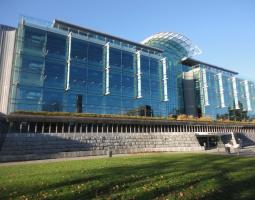
The Simon Fraser University campus on Burnaby Mountain was designed by renowned Canadian architect Arthur Erickson. Its recognizable concrete architecture has repeatedly served as a filming location for movies and TV series — the campus is used as a "universal" futuristic backdrop: episodes of the series "The X-Files", "Battlestar Galactica", "The Flash", "Supernatural", and scenes for Netflix projects were filmed here.
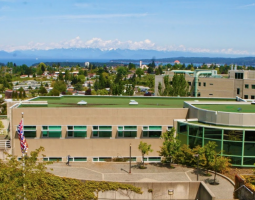
The campus is located at an altitude of approximately 365 meters above sea level. On a clear day, it offers a panorama of Vancouver, Burrard Inlet, and the North Shore mountains. Visibility in good weather reaches about 40-60 km, with clear views of mountain peaks and the ocean coastline.
Accommodation, meals, prices
Students are placed in the Simon Fraser University residence on campus grounds. The format is single rooms: a child has their own bed, desk, storage space and mini-fridge. Showers and toilets are located on the floor. The campus is compact: everything - classrooms, dining hall, sports areas - is within walking distance.
Children are supervised around the clock by camp staff, adults are on duty on the floors, and the university security service operates. At night, buildings are closed, and exits are controlled.
Meals are organized in the university dining hall: three times a day - breakfast, lunch and dinner buffet-style, with an additional evening snack provided. Allergies and dietary restrictions can be reported upon registration - they will be taken into account when forming the menu. On excursion days, participants receive lunch boxes or meals are organized in the city (for daytime camp participants, meals during full-day excursions are provided by the camp and included in the cost).
Activities Simon Fraser University Summer Camp, Summer Camp at Simon Fraser University
Life in the camp is not limited to lessons — participants with accommodation are waiting for two full excursions every week, daily activities after lunch and in the evening. The program includes — the city center, Stanley Park, Capilano Suspension Bridge, English Bay embankments and beaches, observation decks overlooking the bay. Groups visit Vancouver Aquarium, Science World, Richmond Night Market, and trips to Victoria on Vancouver Island or to the Whistler mountain resort are possible on separate weeks. Among the museums are — Museum of Anthropology UBC (here is one of the most famous collections of art of the indigenous peoples of the Pacific coast in Canada, including monumental totem poles; the exhibition gives a vivid representation of the culture and history of the region) and Science World (a large interactive science center under a glass dome, where most areas are designed for practical experiments and visitor participation).
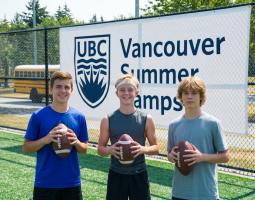
Sports games, tournaments, quests, themed evenings, talent shows, discos, movie screenings are held on campus every day. There are STEAM format classes and team projects where students prepare and present their ideas.
On Sundays you can choose to spend the day on campus in peace and quiet or go on an additional excursion. The schedule is busy, but with breaks for rest and communication.
Advantages
- Accommodation on the Simon Fraser University campus: students can expect single rooms and 24/7 supervision by staff and security services.
- Two full-day excursions per week plus a rich evening program — the schedule is indeed busy, but balanced.
- Groups usually consist of up to 16 people, children are assigned based on their level upon arrival at the camp.
- You can choose accommodation in a residence or a day camp format on the same university campus.
- Specialized intensives (including artificial intelligence) with a final defense of your own project.
Facilities and equipment at Simon Fraser University Summer Camp, Summer Camp at Simon Fraser University
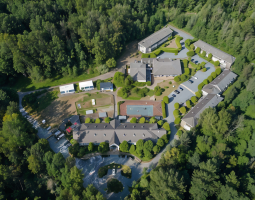
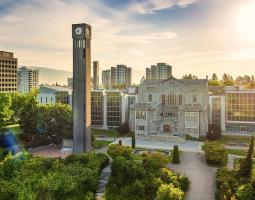
The camp is held on the main campus of Simon Fraser University in Burnaby. It's a hilltop university town overlooking Vancouver and the ocean. The area is secure and convenient: academic buildings, dormitories, a dining hall, and sports facilities are located nearby, and it takes only a few minutes to get around. Participants have access to sports grounds, team game halls, spaces for creative workshops, and areas for camp-wide events. There are cafeterias, recreation areas, laundry rooms, 24/7 security, and on-call medical support available on campus.
The center of Vancouver is accessible by public transport — the journey takes about an hour, so city tours and trips to major attractions don't turn into exhausting commutes.
Admission dates and extra charges
Arrivals are available weekly: a child can come for one week or stay for up to five weeks in a row.
Additional expenses include:
- Registration fee,
- Airport transfer,
- Escort of a minor and meeting/seeing off,
- Specialized intensives (e.g., AI), laptop rental or use,
- Notarial documents for the trip,
- Medical insurance,
- Visa expenses,
- Personal expenses.
Enrolment process
First you need to choose a format — with accommodation or without — and decide how many weeks the child will go for. Then, book a place for the desired dates and confirm participation by payment.
On the day of arrival, the child is met and registered on campus, placed in a room or marked on the lists of the day group, given a short briefing, familiarized with the territory and rules. In the first few days, children are assessed for their English level, then they study and participate in the program according to the established schedule.
Entry requirements, how to apply, what is required to enrol
The main requirement is compliance with the age of the chosen program: 7-10, 11-14 and 15-17 years old. There are no special exams or academic competitions: before starting education, students undergo placement based on their English level to get into a suitable group. For specialized intensives, such as the AI program, an intermediate English level is required.
To participate, you need to fill out a registration form, provide health information and possible allergies, and confirm parental consent to the camp rules. Foreign students require a valid foreign passport and documents for entry into Canada (visa or electronic travel authorization - depending on citizenship).
Institution on the map
Residence permits, citizenship and other services
- Guardianship services during the studies
- Student supervision
Review about Simon Fraser University Summer Camp, Summer Camp at Simon Fraser University
Recommendations on when to apply
| Language courses, schools and children's language camps | Primary and secondary education - private schools | Preparation programmes for entering universities - higher education | Higher education (after completing accredited programs A-level, IB, High School) - Bachelor, Master, MBA |
| - we recommend to apply 6-9 months before the start of the course (some camps and schools offer discounts for early booking or for lengthy study programs) - there are some very popular and high demand children's camps, where the applications need to be submitted 1 year in advance (in particular Switzerland , Great Britain , USA , Canada , Austria) | - we recommend to apply one year before the start of the training program, - some schools have a specific time frame (September-November - please specify an individual school) - some schools require tests in several stages (UKISET, internal tests of the school: English, mathematics, logics, subjects, interview, some require a personal visit) | - we recommend to apply one year before the start of the program, - for Foundation and Pathway programs, IELTS and TOEFL certificates are usually required, respectively | - recommended submission one year before the start of the program, - the deadline normally closes in January, for TOP HEIs and, as a rule, in March in other universities - for a bachelor, a Foundation or Pathway preparatory program a completed A-level, IB, High School + IELTS / TOEFL are required - for Masters you need a graduated higher education, in some cases you need a pre-Masters program - MBA requires completed higher education, work experience preferably at least 2-3 years, etc. |