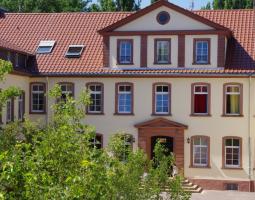
Private Kurpfalz-Internat


Programs and prices, tuition fees in Private Kurpfalz-Internat


Quick overview: This program of general secondary education provides an opportunity to obtain a prestigious Abitur certificate. It is considered to be the equivalent of the British standard A-level, confirms the academic (and not only) academic performance of the student and gives an opportunity to enroll in German universities or higher schools, to receive the chosen specialty and profession.
All studying is conducted in German. In addition, children can learn other languages:
- Russian;
- Spanish;
- English;
- French;
- Latin language.
Description of Private Kurpfalz-Internat
- Institution type: private school;
- Established in 1961;
- Language of instruction: German;
- Type of education: mixed;
- Location: Bammental, Baden-Württemberg, Germany;
- Educational programs: middle classes (7-10), grammar classes - Abitur (7-12);
- Total number of students: 190 people, all at the boarding house (approximately 70 girls and 120 boys);
- The age of the students: 10 to 19 years.
- Year of foundation: 1961,
- Number of students: 170,
- Type of studying: mixed,
- Programs: Gymnasium, Realschule, Summer School.
Founded in 1961, the private Kurpfalz-Internat has become a successful alternative to general state schools, with an approach based on each child’s individual interests, talents, characteristics and unique abilities. Education in Germany aims to provide exceptional academic knowledge while helping students fulfill their personal potential and develop into well-rounded individuals. Classes are deliberately small, with up to 10 students, so teachers can closely monitor academic progress and understanding of the material. Upper school sports courses are exempt from this class-size limit. The individual approach also makes education accessible to children with difficulties such as dyslexia (difficulty in reading). Small classes give every student the opportunity to contribute in class, take part in discussions and debates, express their views, and learn to work effectively both independently and in a team or group.
Kurpfalz-Internat has a total of 170 students across its Gymnasium and Realschule divisions. The Gymnasium prepares students for the Baden-Württemberg Abitur, while the Realschule prepares them for the Realschulabschluss qualification in the same state. The Lehmann family has run the school since 1961, and its fourth generation is now in charge. Since the 2012/13 school year, students in grades 7–10 of both divisions who live with their parents in Bammental or neighboring communities have been able to attend as day students.
Additional summer courses in Germany provide academic support. Special programs are available for foreign students, and individual lessons can be taken in particularly challenging disciplines. The two-week Summer School is open to students from grade 5 through the Abitur level.
Kurpfalz-Internat does not require a strict school uniform.
Kurpfalz-Internat is located not far from the major cities of Mannheim and Heidelberg. The school is located in Bammental, in the Rhein-Neckar-Kreis district of Baden-Württemberg, and offers education in Germany. The nearest international airport is in Frankfurt (90 kilometers). Zurich is 330 kilometers away, and the distance to Munich is slightly shorter, at 330 kilometers. The airports in Mannheim, Karlsruhe and Stuttgart are 35, 101 and 123 kilometers away, respectively.
Faculties and colleges
The school’s academic divisions offer the following options:
- Gymnasium: students who were in grade 7 in fall 2025 continue under the 12-year G8 system. Subsequent cohorts follow the 13-year G9 system,
- Foreign languages at the Gymnasium: English starts in grade 5, followed by Latin or French in grade 6. Students can choose Spanish as a third foreign language from grade 8. Russian and Italian are available on request,
- Science specialization at the Gymnasium: students who do not choose a third foreign language take science and technology from grades 8 through 10. In the upper school, biology, chemistry and physics are available as advanced disciplines with five hours of instruction,
- Bilingual option: history in grade 9 and geography in grade 10 are conducted in English. An English-language seminar is available in the upper school. The program offers Cambridge ESOL certificates: PET in grade 9, FCE in grade 10 and CAE in grade 11,
- G8 upper school: students in grades 11–12 choose at least two foreign languages or two natural sciences. Electives include literature and theater, psychology and geology. Students who advance from grade 10 of the Gymnasium receive the Mittlere Reife certificate without a separate examination,
- Realschule: English is the compulsory foreign language. From grade 7, students choose technology, French or everyday culture, nutrition and social affairs. Whether an option runs depends on the number of interested students. After passing the Realschulabschluss, students can move into the introductory K0 class of the Kurpfalz-Internat Gymnasium’s upper school,
- Summer School: each participant chooses one discipline: German, German as a foreign language, English, French, Latin, mathematics or Spanish. Courses run only during the summer vacation,
- Summer courses for children with dyslexia: an intensive course in a group of six students or a regular course in a chosen discipline with an additional individual spelling lesson.
Scientific achievements
The school has consistently received the MINT-freundliche Schule designation since 2019 for its work in mathematics, computer science, natural sciences and technology education.
In 2024, the Sharks won the interschool team tournament. At the opening of the 2025/26 school year, the Sharks won the school team games, finishing ahead of the Grizzlies, Falcons and Panthers.
Proceeds from the 2024 charity Christmas market went to Sterntaler Children’s Hospice and SOS Children’s Villages – Worldwide.
Accommodation, meals, prices
Residences for boys and girls are located directly on campus - there is no day school, all children live on a boarding house basis. Pupils are accommodated for 2-3 people in the room (each room has its own bathroom). There are always teachers on the floors. Curators and teachers monitor compliance with order, cleanliness and discipline, are always ready to help children solve any problems, are fully responsible for their 24-hour security.
Meals are organized according to the principle of full boarding (4 times a day, buffet); On a preliminary request, a dietary or vegetarian diet for an individual student can be organized.
Subjects and sports
Activities Private Kurpfalz-Internat
In their free time, many Kurpfalz-Internat students enjoy sports, arts and crafts, with facilities and support for these activities. Among the most popular options are the following:
- Judo,
- Athletics,
- Volleyball,
- Horse Riding,
- American football,
- Sailing,
- Rowing and canoeing,
- Golf,
- Tennis,
- Aerobics,
- Football,
- Volleyball,
- Swimming.
There are also entertainment and leisure activities, celebrations, parties and discos, and group visits to museums, galleries, city attractions, cafés, cinemas and shops.
The project program offers more than 65 projects. Activities take place after classes and in the evening under the guidance of teachers and boarding school educators. Fencing, basketball, fitness, padel, taekwondo and table tennis expand the sports program. Kickboxing, ice skating, swimming and climbing are organized with local partners. PGA professionals lead the golf program, and participants can improve their handicaps in tournaments. For riding, students visit a riding club in Wiesloch, where they take part in practical sessions, theory and groundwork with horses.
Project activities include:
- Design and making: developing items in wood and metal, creating models in Autodesk Fusion 360 and making objects with a 3D printer,
- Robotics and programming: building Lego Robotic robots in preparation for FIRST LEGO League and developing projects with the Microbit microcontroller,
- Graphic design: photo editing, vector images, printed materials, T-shirt printing and creating 3D objects in Blender. In the yearlong Procreate project, students draw comics and produce a shared digital book,
- Crafts: making bracelets, headbands, bags, jewelry and natural cosmetics. Students crochet, knit and scrapbook. In the sewing project, they develop designs, select fabrics and make clothing,
- Cooking: baking recipes from different countries, preparing Italian dishes and exploring Greek culture and mythology through food. Students make nonalcoholic drinks, jam, pesto, syrups and spice blends,
- Music: individual lessons in piano, flute, transverse flute, guitar and drums, weekly school band rehearsals and playing together in a wind ensemble. Students perform at school events,
- Film and the school press: film analysis, scriptwriting, filming, acting and editing. Students create the graduation newspaper with a teacher who helps with layout, design, text and photographs,
- Ballet: classes for beginners and experienced participants, with optional performances,
- Debating and games: developing arguments, chess for different ability levels, board games and creating an original board game or fantasy role-playing game,
- First aid: applying bandages and practicing the recovery position, leading to an official certificate. A separate lifesaving course offers swimming, rescue techniques and the opportunity to obtain an official lifesaving badge.
Students take part in school governance as class and residential group representatives, serve in the student parliament and learn conflict mediation. Blue Lion participants organize projects and help younger students with homework. In the school café project, students are responsible for product selection, purchasing, sales, bookkeeping, marketing and the café’s regular operation. They also run the school disco independently.
Every student belongs to one of four teams: Sharks, Falcons, Panthers or Grizzlies. A student captain leads each team with support from a member of the school leadership. At least once a month, teams compete in sports challenges, tasks involving skill and tactics, and knowledge games. Teams accumulate points toward the school cup. Since 2018, the winning team has competed against a team from Schloss Torgelow in a 15-game tournament, with the schools taking turns as hosts.
The school organizes theater and concert visits in Heidelberg and Mannheim, and older students visit Heidelberg for a stroll once a week. Saturday outings explore the Rhein-Neckar region. The program offers ski trips, obstacle races, adventure activities for grades 7–9 and September school trips for older classes. Graduation balls celebrate the award of school-leaving certificates, and the boarding school hosts the KPI-Awards gala. A shared barbecue at the start of the school year helps members of the school community get to know each other.
During a weeklong trip to Berlin, students visited the TV tower, the Reichstag and its glass dome, the Berlin Wall and the Topography of Terror exhibition. The program offered a conversation with an eyewitness to historical events, a street-art culture tour and a graffiti workshop in which participants painted a wall with their own designs.
Summer School offers a separate afternoon program:
- Arts: masks, sculpture and photography,
- Fencing: épée, foil and saber for participants of different ability levels,
- Funsports: water skiing, rafting, climbing and go-karting,
- Golf: a beginner course with professional coaches, play on a nine-hole course and the DGV-Platzreife examination, or a program for existing players with daily play and handicap-qualifying tournaments,
- Just for Girls: sports, self-defense, nutrition and personal care for girls aged 14 and over,
- Lego Mindstorms und Arduino Crafters: independent technical projects in the workshop,
- Fashion: design, pattern cutting, and making clothes and accessories for participants aged 13 and over. Fabrics, patterns and notions are provided,
- Outdoor activities: navigation, map skills, building a bivouac, rappelling, rope bridges and cooking over a campfire,
- Horse riding: an introductory course combining practice and theory, or English-style riding in an indoor arena and outdoor riding area, with trail rides when the weather permits,
- Natural sciences: chemistry or physics experiments, recording and assessing results. A visit to the BASF laboratory is planned,
- Tennis: basic strokes and serving for beginners, or technique, footwork and tactics for existing players.
Summer School participants spend evenings at parties, barbecues, cinemas and discos. A group trip to an amusement park is scheduled for Sunday.
Advantages
- Kurpfalz-Internat’s Gymnasium and Realschule are state-recognized,
- The school belongs to the MINT Zukunft schaffen! education network, which focuses on mathematics, computer science, natural sciences and technology.
Facilities and equipment at Private Kurpfalz-Internat
On the territory of Kurpfalz-Internat there is a cozy student café, where students like to gather after classes and have a snack, and small shops of various things and office supplies. There is also a large sports hall and studios for dancing classes and dramatic art and even a cinema.
Classrooms are equipped with interactive whiteboards. Science facilities provide dedicated classrooms and a large laboratory. The campus has project rooms, common rooms, a disco and a workshop for crafts and independent projects. Sports facilities offer two sports halls, a sports field and a modern fitness studio.
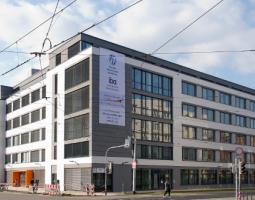
The Glashaus dining hall was built with 200 seats, a kitchen and ancillary rooms. The new school building has an atrium used for the Christmas market’s cultural program. The Oberstufenhaus residence is located 200 meters from the main campus.
Reilsheim railway station is a few meters from the school, with direct access to the grounds from the platform. Trains to Heidelberg and Mannheim stations run every half hour. The journey on the S6 from Heidelberg’s main station takes about 20 minutes. The bus service from that station stops directly in front of the school.
During the summer vacation, the school building and campus are reserved exclusively for Summer School participants.
Admission dates and extra charges
The academic year lasts for three terms:
- Starts from 6 September,
- Starts from 7 January,
- Starts from 12 April.
The school recommends preparing documents and obtaining a visa at least one month before the expected start of the course.
Some services are not included in tuition and must be paid for separately:
- Registration fee,
- Pocket money,
- Individual lessons,
- Excursions,
- Other personal expenses.
Tuition fee (full board) depends on the chosen program:
- From 7th to 9th grade,
- From 10th to 12th grade.
Tuition and boarding are charged annually. The base charge is for education, projects, accommodation and meals. Additional expenses are billed separately through a student account. These may include digital textbooks and licenses, school trips and paid projects.
Students may go home on Friday afternoons and return to the boarding school on Sunday evenings. Sunday afternoons allow time for sports or preparation for the next school week.
Arrival for Summer School is scheduled for July 25 by 6:00 p.m., with departure on August 7 from 11:00 a.m. Classes take place in the mornings from Monday through Saturday. The chosen afternoon module runs on Mondays, Tuesdays, Thursdays and Fridays. Wednesdays and Saturdays are reserved for group outings, sports and shared activities. Participants spend the program’s only weekend together at the boarding school.
The Summer School price is for classes, supervised sessions to reinforce the material, boarding accommodation and care, meals with a second breakfast, leisure activities and the weekend program. Some leisure activities carry an additional charge. Extra expenses may include individual lessons in an additional discipline, paid afternoon modules, pocket money and other personal expenses. Individual lessons are available only to a limited extent.
Extras:
- Registration fee (for a programme/course) 950 EUR
- Pocket money 180 EUR
Enrolment process
Families can get to know the school through an on-site consultation lasting about 90 minutes with a member of the leadership team and a campus tour.
Students coming from a G9 Gymnasium are placed in a grade that matches their academic level.
Perspectives
In 2026, 27 students received their Abitur certificates: 11 girls and 16 boys. Ten graduates achieved average grades between 1.0 and 1.9. The highest-achieving female graduate finished with an average grade of 1.0 and a total of 848 points.
Entry requirements, how to apply, what is required to enrol
For admission to Kurpfalz-Internat, you should take care in advance of obtaining a student visa and collecting the necessary documents (at least a month). It will be necessary to provide a report card with grades from the previous place of study (the average score is not lower than the average), and also to demonstrate a sufficiently high level of the German language (from B2).
If the level of the German language or academic knowledge is insufficient, the child is encouraged to take an effective preparatory course at the Humboldt Institutions (Lindenberg or Bad Schussenried). In just 6 months you can raise the language level practically from scratch to the required B2 thanks to qualified teachers, balanced curriculums and full immersion in the language and cultural environment of Germany.
In order to become a candidate for admission to Kurpfalz-Internat, the entrant will be required to provide the admission committee with the following information:
- Full name, date of birth;
- School report card with grades, translated into German or English;
- Personal hobbies, interests, success certificates in academic, creative activity;
- Recommendation letters from previous teachers translated into English or German;
- Personal written motivation letter (in English or German).
Also required:
- Indicate (approximately) the annual or monthly budget for training;
- Select the priority region for obtaining an education in Germany.
After receiving all the necessary information, the advisory council begins selecting a school for the student: assesses its opportunities and requests, contacts schools identified as priority , And reveals the number of seats available and the possibility of admission.
Usually, foreign students begin the process of studying in Germany with the Humboldt-Institute language courses (the German academic program for the year): in this case, the selected secondary schools receive full reports on the student's successes and achievements, his/her behavior, the degree of involvement in school extra-curricular activities. After the preparatory language course is completed and all formalities are settled, the student goes for basic education to the boarding school he/she and the advice board have chosen.
Scholarships Private Kurpfalz-Internat
A limited number of scholarships linked to academic performance are available to families who cannot fully afford tuition and boarding. Gymnasium and Realschule students who meet the admission requirements may apply. Candidates are expected to have good academic results, contribute to boarding school life and have interests in social, musical, creative or sporting activities.
The scholarship committee reviews school reports, a teacher’s recommendation, a biography describing the applicant’s interests, a photograph and a handwritten essay about expectations of the school and extracurricular activities. The family’s financial circumstances are assessed using income tax information and the amount the family may be able to contribute. Candidates must visit the school in person and receive an offer of admission.
The scholarship is usually awarded for full-day attendance. Support may continue through the Abitur as long as the eligibility conditions are met. Renewal is considered annually, based on the latest school report and current information about family income.
Institution on the map
Residence permits, citizenship and other services
- Guardianship services during the studies
- Student supervision
Review about Private Kurpfalz-Internat
Recommendations on when to apply
| Language courses, schools and children's language camps | Primary and secondary education - private schools | Preparation programmes for entering universities - higher education | Higher education (after completing accredited programs A-level, IB, High School) - Bachelor, Master, MBA |
| - we recommend to apply 6-9 months before the start of the course (some camps and schools offer discounts for early booking or for lengthy study programs) - there are some very popular and high demand children's camps, where the applications need to be submitted 1 year in advance (in particular Switzerland , Great Britain , USA , Canada , Austria) | - we recommend to apply one year before the start of the training program, - some schools have a specific time frame (September-November - please specify an individual school) - some schools require tests in several stages (UKISET, internal tests of the school: English, mathematics, logics, subjects, interview, some require a personal visit) | - we recommend to apply one year before the start of the program, - for Foundation and Pathway programs, IELTS and TOEFL certificates are usually required, respectively | - recommended submission one year before the start of the program, - the deadline normally closes in January, for TOP HEIs and, as a rule, in March in other universities - for a bachelor, a Foundation or Pathway preparatory program a completed A-level, IB, High School + IELTS / TOEFL are required - for Masters you need a graduated higher education, in some cases you need a pre-Masters program - MBA requires completed higher education, work experience preferably at least 2-3 years, etc. |