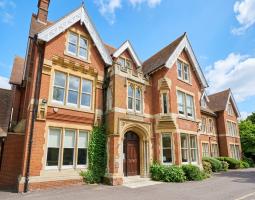
Ashford School


Programs and prices, tuition fees in Ashford School


Quick overview: an educational program of middle school (7-9 grades) is designed for international students.
About the educational program: the main goal is to lay a solid foundation of academic knowledge, develop the necessary skills and abilities, self-confidence and one's own strengths. Great attention is also paid to the sports development of schoolchildren, to the improvement of their physical form. It is also mandatory to participate in extracurricular activities of the second half of each day.
An educational schedule: 6 lessons per day (30 weekly).
Duration of the lesson - 50 minutes.
Classes in mathematics, English and the natural sciences are divided into groups according to the level of abilities of children.
List of sport activities, popular among girls:
- Tennis;
- Hockey;
- Athletics;
- Netball.
List of most preferable sport among boys:
- Athletics;
- Rugby;
- Cricket or hockey.
Brief information: an educational program of GCSE for international students is designed according to high standarts of UK education.
List of compulsory subjects, which are attended by all students without exception:
- English;
- Foreign language;
- Mathematics;
- Natural sciences (physics, chemistry or biology).
In addition, the curriculum includes three disciplines for the personal choice of each student:
- Acting art;
- Latin language;
- Physical education and sport;
- Spanish;
- Geography;
- Design and technology;
- French;
- Art and design;
- Classical civilization;
- Clothing design;
- German;
- Music art;
- Religious studies;
- History.
An active and rich program of extra-curricular and social events is also well developed.
About the educational program: the first year of study (AS) is devoted to a deep, thorough study of 4-5 disciplines (6 lessons per week). The second year (A2) consists of only 3-4 subjects of them.
List of subjects to study:
- Business theory;
- Geography;
- The Art of Photography;
- Biology;
- Classical civilization;
- Higher mathematics;
- Spanish;
- Theory of theatrical art;
- Design and technology;
- German;
- Mathematics;
- Theory of sports;
- Economics;
- Chemistry;
- Art;
- History;
- Textile design;
- English literature;
- Psychology;
- Latin language;
- Music;
- French;
- Physics.
International students also attend additional supportive English lessons in the EFL program.
Educational groups are formed from 1 to 18 people, depending on the popularity and relevance of the subject, on average one group consists of 10 students.
Various out-of-class and social activities are provided, many of which also carry a learning function. Well-known professionals of various fields of activity are often invited and provide thematic lectures (at least every two weeks) and individual lessons.
Description of Ashford School
- Location of Ashford School: Ashford, Kent, United Kingdom,
- Founded: in 1898,
- Educational programs at Ashford School: Preschool, KS1-3, GCSE, A- Level,
- Age of the pupils: from 0 to 18 years old,
- Accommodation type: full-time form or boarding house (residence, from 10 years),
- Total number of students: 850, including 155 boarders, 150 foreign students, approximately 350 in the preparatory school, 297 in the senior school, 180 in Sixth Form,
- Type of studying: mixed.
- Location: Ashford, Kent, United Kingdom,
- Founded: 1898,
- Number of students: 800,
- Type of studying: mixed,
- Age of students: 0–18,
- Accommodation: day school, full boarding and five-day boarding,
- Programs: Kindergarten, pre-primary classes, preparatory classes, GCSE and A-Level.
Ashford School is an independent private school for boys and girls ages 0–18. There is also a full-time form of education, and a full board (it is also possible to stay at the hostel 5 days a week). The total number of students reaches 800.
Ashford School was founded in 1898 as a women's school, the younger stage provided for coeducation, but up to 2006 the senior classes also included only girls. Since 2006, more than a hundred years after the foundation, the institution finally switched to mixed education.
The total campus area reaches 23 acres. The school is located in the county of Kent in a small cozy city of Ashford, the road to London will take about an hour. The St. Pancras Central Station is a 37-minute drive away, which facilitates transfers, trips and excursions to the children, and the local Ashford International station is a 5-minute walk away. Gatwick International Airport is about 100 kilometers away, and distance to Heathrow's largest airport is 125 kilometers.
Ashford School offers various educational programs of the average English school, which are divided according to the age of the student:
- Kindergarten (0 to 4 years),
- Pre-primary classes (4 to 7 years),
- Preparatory classes (7 to 11 years),
- 7-9 class,
- 10-11 class (GCSE),
- 12-13 class (A-level in the UK).
The director is Mike Bukanan: he is rightfully proud of the philosophy of the school, the observance of historical principles. Two are fundamental: the desire to achieve success in all directions and development of character in children. For a modern person it is very important to get not only a quality education, but also education, taking into account the realities of the modern world, to be able to adapt to rapidly changing conditions. Here, self-confident young people are raised, independent and responsible, capable of empathy, sympathy and compassion.
Here, a comfortable, friendly environment is created for students, and at the same time students are taught to compete in a healthy way, developing independence, ambitiousness, self-reliance and the ability to take responsibility. Ashford School is a valid and active member of the prestigious Association of Directors and Headmasters (The Headmasters 'and Headmistresses' Conference - HMC). The British school is regularly tested by the Independent Schools Inspectorate - the last one was conducted in 2014 and allowed the school to deserve the "Excellent" ranking for all the main points:
- Working with parents,
- Academic successes of children,
- The level of child care and students’ behavior,
- The quality and organization of the curriculum,
- The quality of school management,
- The quality of childcare,
- The organization of extracurricular education,
- Studying conditions, childcare and safety,
- Teaching quality,
- Living conditions.
Educational process
In Years 7–9, students usually have one teacher for each discipline. Year 7 students rotate through French, German and Spanish, spending half a term on each language. In Years 8–9, they take two modern foreign languages. GCSE options are discussed in Year 9, with students beginning to choose their disciplines in the Spring Term. Most Sixth Form students take a program equivalent to three A-Levels. Some choose four A-Levels or an individually tailored curriculum.
The Future Ready course for Years 7–9 develops skills in working independently, using artificial intelligence responsibly, conducting research and referencing sources. Students explore careers and develop communication, public speaking and project management skills. Each student completes an individual project, either an essay or an artifact, and presents it to peers, staff and parents at the end of the year. Their work and progress are recorded in a project portfolio. Practical work also takes place in other disciplines. For example, Year 12 chemistry students carried out fractional distillation and cracking experiments.
Art lessons explore drawing, Old Master painting techniques and new media, including Adobe Creative Suite, film and animation. Techniques include:
- Observational drawing,
- Digital imaging for green screens,
- Ceramics,
- Intaglio printing,
- Reduction block printing,
- Screen printing,
- Textile techniques,
- Film and digital photography.
In Design and Technology, students work through the full design cycle, from research and concept development to prototyping, testing and manufacture. They explore product design, engineering principles, computer-aided design, computer-aided manufacture, resistant materials and graphic communication.
Two specialist teachers conduct Drama lessons for all year groups. The Head of Drama has 25 years of professional acting experience in theater, television and film. A full-time lighting and sound technician manages the theater spaces and helps GCSE and A-Level students with the technical side of productions. The GCSE and A-Level Drama programs provide performance evenings at which students’ work is assessed. Individual instrumental and vocal lessons are conducted by 16 peripatetic music teachers. The school is a center for ABRSM and Trinity music exams.
Career guidance introduces students to universities and professions. More than 25 universities and organizations took part in the school’s University Fair. Sixth Form students visited Drapers’ Hall and the City of London Courts, met lawyers and took part in speed networking sessions to explore legal careers. Boarders attend lessons with the other students. After dinner, they have time set aside for homework, with staff available to help with assignments and offer guidance.
Faculties and colleges
The Senior School has the following faculties:
- Faculty of Mathematics,
- Faculty of English,
- Faculty of Science and Technology: Biology, Chemistry, Physics, Computer Science, Design and Technology, Food Preparation and Nutrition,
- Faculty of Sports & PE,
- Faculty of Arts: Drama, Art, Photography and Music,
- Faculty of Languages: Spanish, French, German and English as an additional language,
- Faculty of Humanities:
- History,
- Geography,
- Business Studies,
- Economics,
- Psychology,
- Religious Studies,
- Government & Politics,
- Global Perspectives.
The curriculum for Years 7–9 consists of:
- English,
- Mathematics,
- Biology,
- Chemistry,
- Physics,
- History,
- Geography,
- Religious Studies,
- Art,
- Drama,
- Design and Technology,
- Computer Science,
- Food Preparation and Nutrition,
- Music,
- Physical Education.
Students take Design and Technology from Year 7 through Sixth Form. The Sixth Form offers BTEC Sport in Single and Extended formats, Crest Awards, an individual EPQ project and short professional courses.
Scientific achievements
The school's U11A team became Regional Champions and qualified for the National Finals.
Things to know about
- Ashford School is one of 18 schools in the UK with All Steinway School status,
- The Senior School holds an annual Remembrance Service at St. Mary’s Church.
Accommodation, meals, prices
On the terms of the boarding school, there are about 150 students from 10 years and older. On the campus there are 2 comfortable residences (Brabourne House for girls and Alfred House for boys): resettlement is conducted according to the gender and age of the students. Students of the lower classes occupy comfortable rooms for 2-3 people, high school students live in single private bedrooms with private facilities.
The boarding houses are led by Houseparents and Assistant Houseparents, supported by a team of tutors.
Subjects and sports
Activities Ashford School
For the full and comprehensive development of the students Ashford School has prepared everything you need: there are a huge number of clubs, sections and circles of interest. Each student will be able to find employment in their interests, share the joy of discoveries with like-minded people, show talents and abilities. Examples of extracurricular activities are:
- Fine Art,
- Orchestra,
- Design,
- Drama,
- The Vocal,
- The Chorus,
- Dances,
- Photography.
Many students devote their free time to active rest and sports - from the most popular classes it can be noted:
- Athletics,
- Football,
- Cricket,
- Squash,
- Hockey,
- Dances,
- Tennis,
- Netball,
- Badminton,
- Swimming.
On Saturday the students are free from academic studies: you can relax and walk with friends, go on an excursion to Canterbury or London.
The school stages two major and two smaller theater productions each year. Students in all year groups can participate in musical theater and plays. The extracurricular program offers individual Speech & Drama lessons in preparation for LAMDA exams. Student concerts take place throughout the school year. The school hosts and supports Ashford Youth Jazz Orchestra and Ashford School Voices. Children’s author Peter Murray visited the Senior School for World Book Day. The school has a Combined Cadet Force. At a Remembrance Service, cadets laid a poppy wreath, gave readings and lit a candle of remembrance.
At the beginning of each term, Houseparents plan activities based on suggestions from boarders. School sports fixtures are available on Saturdays, with organized excursions on Sundays. Other leisure activities include trips to the seaside, go-karting, ice-skating and gliding. Fitness, badminton, swimming, music and art activities are available on campus in the evenings and on weekends.
All students are expected to participate actively in extracurricular life. Some elements are compulsory and others voluntary, with requirements varying by year group. Activities and societies run before lessons, during the school day and after lessons. The program has three areas:
- Care: Caring for well-being, other people and the environment,
- Craft: Developing practical skills and techniques for project work,
- Cognition: Studying and developing thinking skills.
Advantages
- According to the independent directory the Good Schools Guide, "this is a forward looking ever-evolving school that hosts international students. The success of the school is frankly impressive. "
- According to the Telegraph, the school became 142 on the basis of the A-level exams in 2014 and 126 in 2012.
- According to the Sunday Times, the institution ranked 94th among the best independent British schools in 2013 and 207 in 2012 (progress is evident).
- Despite the fact that the school officially adopted anglicanism as the main religion, children of any religion can study here.
- Ashford School was recently included in the list of TOP-20 schools in Great Britain.
- Individual, personal approach to each child, full disclosure of his talents and abilities
- Favourable, comfortable environment, motivating to academic and personal achievements
- Extensive opportunities for extracurricular activities, thematic excursions, realization of talents and abilities
- Professional teachers are real fans of their business, actively using modern resources, authoring techniques and approaches. The work of prefects, which are appointed from among students, is also useful in academic preparation.
- Specialization on exactly the subjects and disciplines that are required for students to successfully enter the chosen institution.
Facilities and equipment at Ashford School
Ashford School is constantly expanding, modernizing, equipped with modern equipment and technology to meet high world standards. To date, the campus includes a spacious indoor swimming pool, studios for music and drama (with several scenes), modern bright classrooms for study, a gym, basketball and other games (with a special coating that can be used in any weather), as well as well-equipped art studios. There is a field for hockey, football, netball, tennis courts. Functional scientific laboratories operate in which practical classes, technology and design studios are often held. There is also a spacious common dining room, a student theater and a cafeteria.
Drama has three dedicated teaching spaces and a 300-seat theater. Two of the spaces have lighting and sound equipment for studio and full-scale productions. The Music department has upright and grand pianos, practice rooms, a large rehearsal space and an IT suite for composition.
Admission dates and extra charges
High School (full board) fees are calculated per term.
The academic year consists of Autumn, Spring and Summer Terms.
The cost of Individual Learning Support depends on the level of support. Additional charges apply for special and residential trips and specialist coaching. Please note that there are surcharges not included in the basic cost of the programs:
- Registration fee,
- Visa fees and services,
- A deposit for a place in the school,
- Tuition fee (one term),
- Examination fees,
- Medical insurance,
- Contribution to school development,
- Custodianship,
- Round trip (the cost is calculated depending on the airport),
- Additional lessons,
- Additional leisure activities and excursions.
Extras:
- Registration fee (for a programme/course) 150 GBP
Enrolment process
For admission, the school assesses candidates’ academic and other abilities and how well they meet its standards. Personal qualities and the potential to contribute to school life are also considered.
Entry requirements, how to apply, what is required to enrol
Ashford School is loyal enough to foreign students, but the requirements for applicants depend on the age of the student and on the level of education that he wants to get.
Institution on the map
Residence permits, citizenship and other services
- Guardianship services during the studies
- Student supervision
Review about Ashford School
Recommendations on when to apply
| Language courses, schools and children's language camps | Primary and secondary education - private schools | Preparation programmes for entering universities - higher education | Higher education (after completing accredited programs A-level, IB, High School) - Bachelor, Master, MBA |
| - we recommend to apply 6-9 months before the start of the course (some camps and schools offer discounts for early booking or for lengthy study programs) - there are some very popular and high demand children's camps, where the applications need to be submitted 1 year in advance (in particular Switzerland , Great Britain , USA , Canada , Austria) | - we recommend to apply one year before the start of the training program, - some schools have a specific time frame (September-November - please specify an individual school) - some schools require tests in several stages (UKISET, internal tests of the school: English, mathematics, logics, subjects, interview, some require a personal visit) | - we recommend to apply one year before the start of the program, - for Foundation and Pathway programs, IELTS and TOEFL certificates are usually required, respectively | - recommended submission one year before the start of the program, - the deadline normally closes in January, for TOP HEIs and, as a rule, in March in other universities - for a bachelor, a Foundation or Pathway preparatory program a completed A-level, IB, High School + IELTS / TOEFL are required - for Masters you need a graduated higher education, in some cases you need a pre-Masters program - MBA requires completed higher education, work experience preferably at least 2-3 years, etc. |