For partners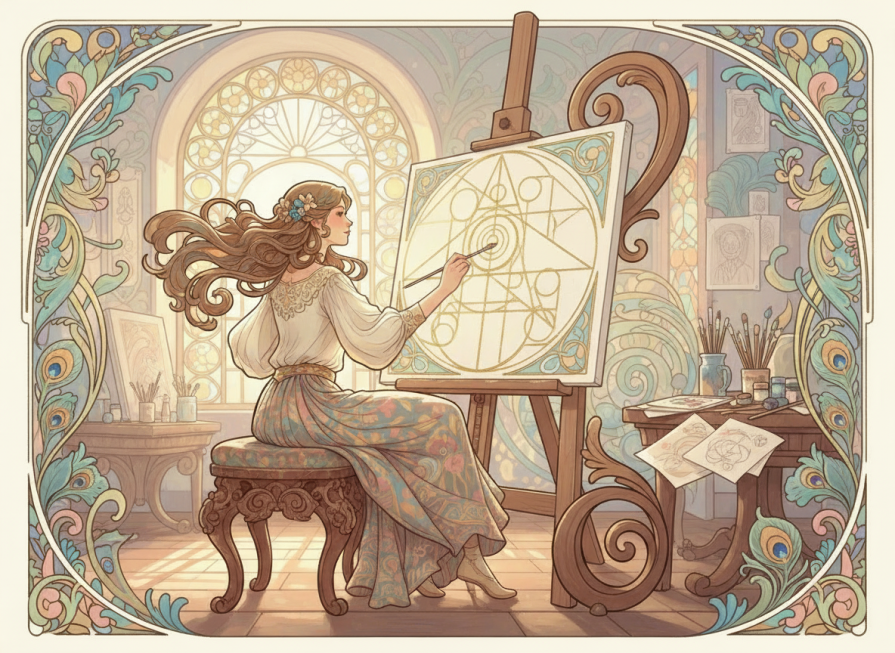
At first sight, mathematics and art could be regarded as two utterly different realms — one being the domain of reason and accuracy, while the other one the field of fantasy and feeling. Nonetheless, the two disciplines have been in close relations through the ages. Mathematics offers the artist the means of expression through structure and harmony; art endows the world of numbers with the attributes of beauty, creativity, and humanity. Comprehending the mutuality of these two domains not only makes one’s education richer but also provides one with new avenues for perceiving and pondering over the world.


Geometry as the Language of Beauty
For over a thousand years, from the ancient Greeks until the Renaissance artists, the use of mathematics to gain balance and proportion has been one of the characteristics of art. Geometry, specifically, has been the connecting link between math and art for ages. The Golden Ratio (φ) — approximately 1.618 — was used by architect and painter Leonardo da Vinci and Michelangelo to create visually pleasing works, among others.
Islamic art has geometrical patterns that show the beauty of the repetitive nature of mathematics and the harmony created by the symmetry. The same is true about the Gothic cathedrals in Europe where the building followed the rules of complex geometric designs that led to the cathedral’s being both strong and visually beautiful. In such examples, mathematics was not an obstacle but a beneficial partner in art design.
Mathematics Inspires Modern Art
A number of the artists in the modern period have consciously wrapped mathematical principles around their beads of creativity. One such personality was, besides others, the great artist M. C. Escher, who through the use of mathematical concepts of tessellation, reflection, and infinity produced fantastic artworks which not only opposed perception but also brought the issue of symmetry into focus. In a similar vein, the works of Piet Mondrian, in which simple lines and ratios are the basis, and which are at the same time, very abstract, reveal the strong connection between algebraic rigor and visual clarity.
Digital art and computer-generated imagery (CGI) are also to a great extent an illustration of how the use of mathematics in the modern world of flat and digital art. The algorithm, fractals, and 3D modeling make use of mathematical logic to produce forms that are at once intricate and eye-catching. In a way, mathematics has turned into a medium for creativity, not only a tool.

Art Brings Humanity to Mathematics
Mathematics imposes order on the art whereas art enlivens the math. Art is the means through which people get to the emotional and human aspects of the mathematical concepts — the beauty of patterns, rhythm, and proportion. Artists through color, shape, and movement have made the abstract mathematical concepts not only comprehensible but also interesting to a larger audience.
For the students, the blending of math and art could undoubtedly make the two subjects easier and more interesting to learn. The mathematical art projects like making fractals, drawing perspectives, or playing with symmetry, give the learners the opportunity to feel how creatively and logically the two sides of the coin are.
A New Approach to Education
In the present times, the concept of merging subjects holds a great deal of importance in education. The transition from STEM to STEAM is one of the indicators of the trend that the educational system is making and its catching up with the times; that is, it is recognizing and propagating the idea that creativity is not only the by-product of analytical thinking but its essence.
The concurrent teaching of art and mathematics develop in the students the ability to contemplate both critically and creatively at once. It fosters the development of skills such as spatial reasoning, design thinking, and problem solving — capabilities that are not only useful in academia but also in areas like architecture, engineering, programming, and innovation. The students in the situation where math and art coexist will learn to find the attraction in order and the order in attraction.
Why the Future Needs Both
The future will be claimed by those who are able to merge precision with imagination. Designers, architects, data scientists, and digital artists need mathematical concepts and principles to produce their work that is both useful and aesthetically pleasing. In all cases, whether it is a building, an animation, or a user interface, the professionals conduct their work with the cooperation of the logic and the aesthetic dimensions of thought.
The collaboration of mathematics and art together not only enriches culture and education but also makes us ready for the time when creativity and computation will be living together. While art softens the impact of technology, mathematics sharpens the impact of technology and gives it more substantiality — together they take the future of the innovation process.
Conclusion
Math and art could not be more different, yet still, they complement one another. Both of them are after patterns, balance, and an almost metaphysical comprehension of our surroundings. The synergy between art and science reveals the fact that creativity may be thoughtful, and thought may be aesthetic. A rapidly changing scenario where the intersection of imagination and precision occurs reveals that the true power of human thought is not to segregate the disciplines but to unify them.