The global healthcare systems are witnessing an increasing demand for competent medical practitioners. With an aging population, technological progressions, and staff shortages, educators and policymakers have resorted to exploring new means of training the next generation of healthcare workers. A viable strategy would be to expose students to the career options in the healthcare industry at an early stage using school-based pilot projects.
An exemplary case of middle schools that help students explore their career options in the medical field is that of Vernon Johns Middle School. The school is a model that illustrates how career exploration can contribute to building the future healthcare workforce.


Why Early Healthcare Education Matters
Most learners wait to consider careers as possibilities until they reach high school or college age. Yet, integrating medical themes at the middle school level can help the learner establish interest in the field early and build skills necessary in the future.
The pilot program geared towards medical professionals can help learners:
-
Discover different fields within the healthcare sector.
-
Gain knowledge in human biology and health.
-
Improve their critical thinking and problem-solving skills.
-
Boost their confidence through practical activities.
-
Make sound choices regarding future education.
Through early exposure, learners can understand that career opportunities in the medical sector go way beyond being a doctor and that one may pursue different professions such as nursing, medical technology, emergency medicine, pharmacy, physical therapy, public health, and many more.
Objectives of the Pilot Project
Vernon Johns Middle School's health careers preparation program was specifically developed to accomplish several educational objectives.

These include the following objectives:
-
Expose children to the health care field.
-
Encourage students to show more interest in STEM (Science Technology Engineering and Mathematics).
-
Enhance teamwork and communication skills.
-
Promote healthy lifestyles and community wellness.
-
Prepare them for healthcare education in the future.
The program does not focus on the direct development of medical professionals but acts as an introduction stage instead.
Integrating Healthcare into the Curriculum
The success of the pilot study relies on the incorporation of healthcare subjects in different disciplines.
Science courses familiarize the students with:
-
Human anatomy and physiology.
-
Body systems.
-
Prevention of diseases.
-
Healthy living and nutrition.
-
Basic genetics.
Meanwhile, mathematics courses place a lot of emphasis on data analysis and medical statistics, and language arts courses encourage research writing on healthcare subjects and medical cases.
Such an interdisciplinary approach allows the students to realize the importance of various disciplines in healthcare career development.

Hands-On Learning Experiences
Another extremely useful component of the project is experience. Students engage in practical activities that make medical concepts interesting and memorable.
Examples of such activities can be:
-
Obtaining basic knowledge in first aid.
-
Training in CPR awareness through use of special training materials.
-
Measuring pulse rate and blood pressure.
-
Understanding laboratory safety.
-
Performing simple biological experiments.
-
Simulation of patient treatment scenarios.
These experiences help students apply classroom knowledge in realistic settings while developing practical skills.
Partnerships with Healthcare Professionals
The project will be successful because of the cooperation of the school and local health care agencies.
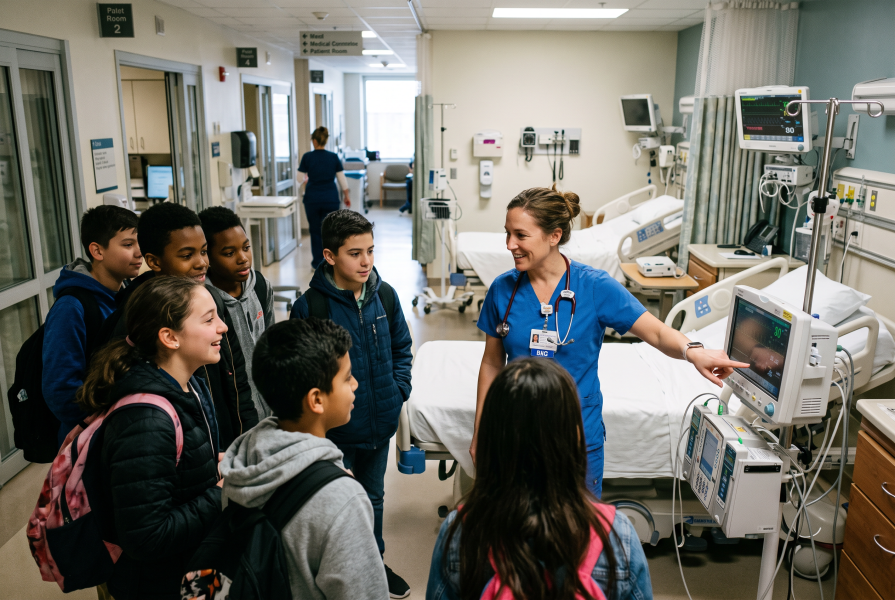
The doctors, nurses, EMTs, pharmacists, and lab experts come to the classes and share information about their work, describe their everyday duties, and answer all questions of the students.
There are other activities the students can engage in:
-
Hospital/clinic tours.
-
Career presentations.
-
Workshops.
-
Health fairs.
-
Online mentoring.

Working with the health care experts will allow the students to have a realistic idea about the medicine and get positive role models.
Developing Essential Soft Skills
Health professionals do not need only technical information. Skills like communication, empathy, teamwork, and ethics also play an important role.
The pilot program helps students acquire such skills by:
-
Group projects.
-
Role playing.
-
Patient communications.
-
Leadership programs.
-
Community services.
Such skills help students in preparing themselves for future studies and careers.
Encouraging Diversity in Healthcare
One of the main objectives of this program is to inspire students from diverse backgrounds to think about pursuing healthcare careers.
There is an absence of healthcare professionals who reflect the populations they serve. This can be achieved by making all students aware of the career options in medicine.
By making it possible for all students to explore career options, it will enable students from diverse social and economic backgrounds to see themselves successful in healthcare careers.

Technology in Medical Education
The current medical industry is highly dependent on technology, which makes digital literacy a necessary element of the course.
Experience in working with:
-
Digital health care resources.
-
Databases for medical research.
-
Anatomy simulation programs.
-
Science simulations.
-
Software for healthcare education.
Apart from enhancing learning, technology familiarizes students with innovations in the field of medicine.
Measuring Program Success
Several measures can be used to assess the success of the pilot project. These include:
-
Interest in STEM topics from students.
-
Involvement in activities relating to health care.
-
Better science performance.
-
Feedback from students and parents.
-
Participation in advanced science classes in high schools.
Career paths in the field of health care can be monitored over time.
Challenges and Opportunities

Similarly, the pilot program has its share of difficulties, ranging from lack of financial support to availability of health facilities, teacher training, and collaboration with the community.
However, all these issues present opportunities for cooperation between schools, hospitals, universities, and even local authorities, since community partnership can prove to be an excellent learning opportunity.
Looking Ahead
With the continuous evolution of healthcare systems, early career preparation programs may become increasingly relevant within education. For example, the pilot program at Vernon Johns Middle School shows how schools can foster curiosity, promote necessary academic skills, and motivate young people to embark on a career path in the field of healthcare.
Implementation of such programs at other middle schools can aid in building stronger future workforces in the healthcare field and providing youth with necessary knowledge about health and science.
Conclusion
The pilot project on medical personnel preparation at Vernon Johns Middle School illustrates the value of introducing healthcare education during the middle school years. Through interdisciplinary learning, practical experiences, partnerships with healthcare professionals, and a strong emphasis on STEM education, students gain a deeper understanding of medical careers and the skills required to succeed in them.
Although such programs represent only the first step toward a healthcare career, they play an important role in building motivation, expanding career awareness, and preparing the next generation of medical professionals who will serve their communities in the future.